
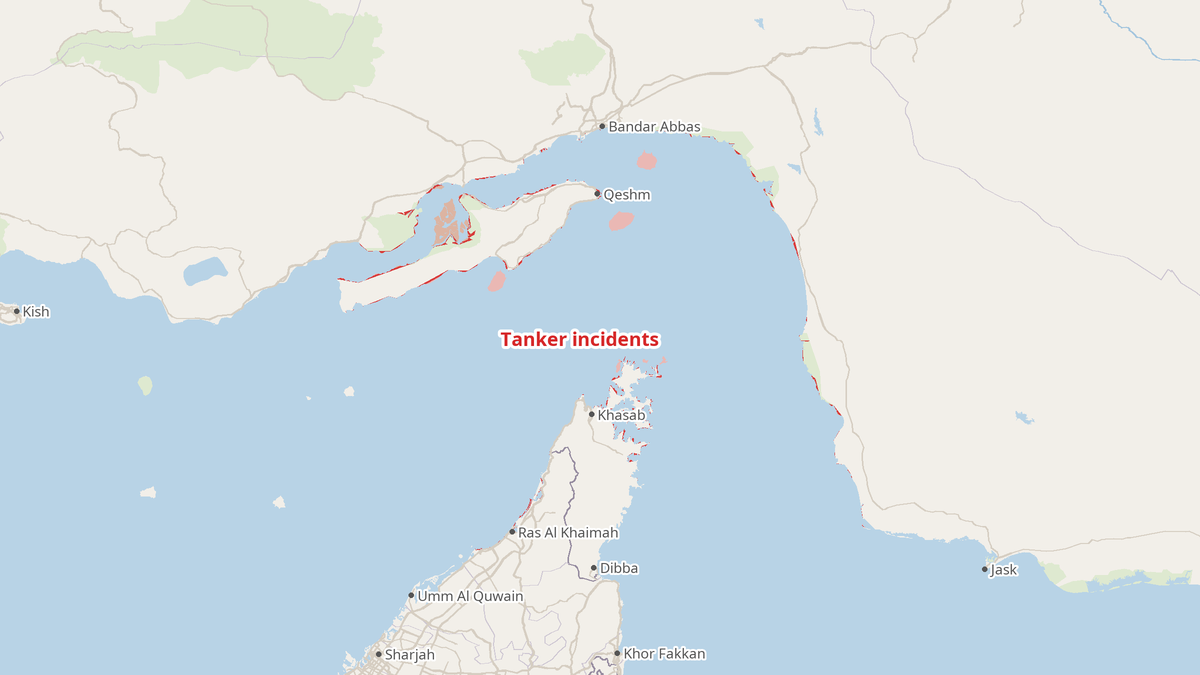
At least three oil tankers came under attack in or near the Strait of Hormuz on Saturday, Nov. 21, 2026, as the war involving Tehran, Washington and Tel Aviv put growing pressure on the vital shipping route. The United Kingdom Maritime Trade Operations (UKMTO) reported two projectile strikes near Oman, while Iran’s navy said a tanker caught fire after striking a naval mine. Independent verification of Iran’s account wasn’t possible, and it wasn’t clear whether that tanker was involved in either reported strike.
Strikes near Oman
UKMTO said a projectile hit one tanker at the stern, about 20km (13 miles) north of Khasab, a port town on Oman’s northern coast. Another strike hit an engine room about 31km (20 miles) east of Khasab. Both reports concerned vessels leaving the Persian Gulf through the strait. Nobody reported casualties.
The agency said it couldn’t determine whether the incidents involved separate vessels. Haaretz reported that an unidentified projectile struck a tanker sailing out of the strait about 11 nautical miles north of Khasab; it also reported no casualties. Reuters couldn’t verify Iran’s separate claim that a tanker caught fire or link it to UKMTO’s reports.
Iran’s navy said the tanker hit a naval mine in a restricted area east of the strait before noon, then caught fire. In a statement carried by Iranian state television, the navy accused the vessel of ignoring warnings and sailing with its identification and navigation equipment switched off. Al Jazeera reported that Iran hadn’t immediately commented on UKMTO’s reports.
Control of the waterway
The incidents took place during a war involving Tehran, Washington and Tel Aviv that, according to Al Jazeera, began when the United States and Israel attacked Iran in late February. About nine months into the conflict, the strait has become a flashpoint over who controls passage through the narrow route linking the Gulf to international shipping lanes.
Before the conflict, nearly a fifth of the world’s crude oil supplies passed through the Strait of Hormuz. Tehran has since moved to tighten its control of the waterway. The United States answered Iranian shipping restrictions by blockading Iranian ports and sending naval vessels to escort tankers.
Al Jazeera correspondent in Tehran Resul Serdar said tanker incidents had risen sharply over the previous week. Citing statements from Iran’s armed forces, he said they had reported about 25 incidents since the previous Saturday, an average of roughly three a day. He called the trend “quite dramatic.”
“This is becoming a pattern,” Serdar said. He said Iranians were asserting control over the strait and insisting that ships passing through coordinate fully with Iranian authorities and follow routes and lanes set by Iran. Iran said that if vessels didn’t comply, “they are either going to be attacked, or they are going to hit the sea mines that are laid by the [Islamic Revolutionary Guard Corps] IRGC or the Iranian forces,” Serdar added.
A struggle over exports
Serdar said Tehran was deliberately raising tensions to signal that if Iran couldn’t export its oil, other countries wouldn’t be able to export theirs either. He said Iran also wanted to show that it remained in control of the strait.
Commercial vessels now find themselves caught between Washington and Tehran in a fight over access to the route. The reported strikes and mine incident came as both governments asserted control through shipping restrictions, a port blockade and naval escorts. The attacks caused no reported casualties, but it remains unclear whether the reported incidents involved separate ships or whether the tanker Iran says caught fire was among them.
- strait of hormuz
- oil tankers
- tanker attacks
- oman
- iran
- ukmto
- naval mines
- oil shipping