
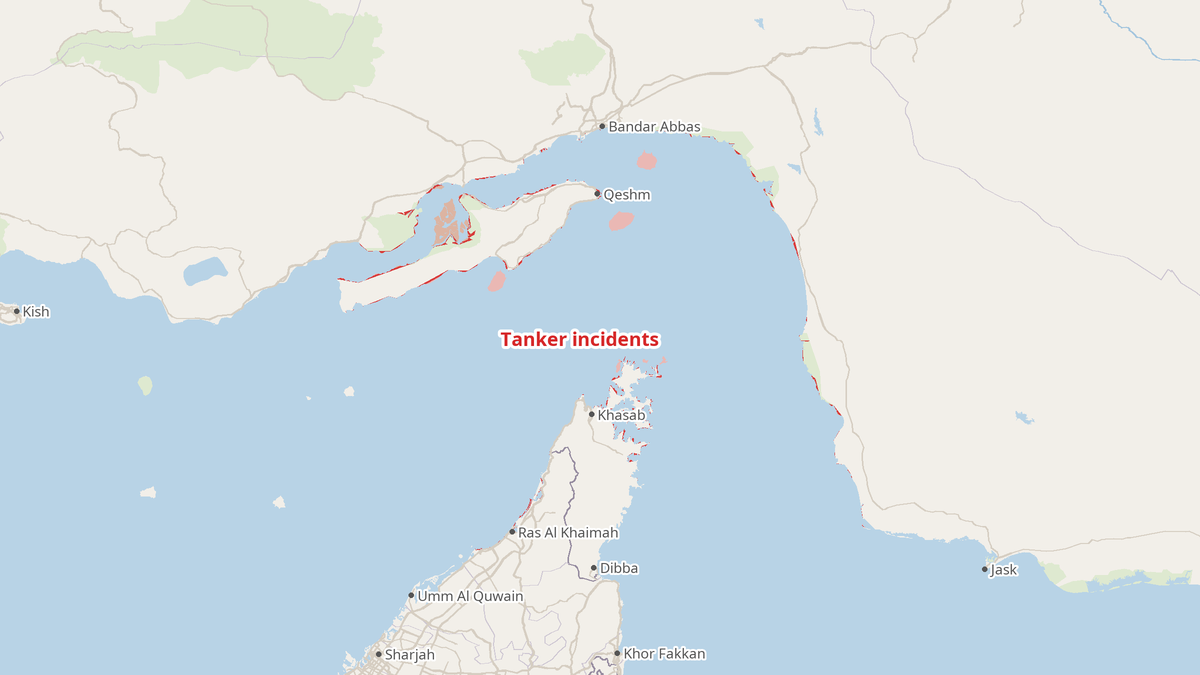
At least three oil tankers were attacked in or near the Strait of Hormuz on Saturday, Nov. 21, 2026, as Tehran asserted control over a waterway used by commercial ships carrying a major share of the world's crude oil. The United Kingdom Maritime Trade Operations reported two projectile strikes near Oman; Iran's navy separately said a tanker caught fire after hitting a naval mine. That Iranian account couldn't be independently verified, and it remains unclear whether the burning vessel was one of the tankers in the UKMTO reports.
Attacks Near Oman
UKMTO said one tanker was hit at the stern about 20km (13 miles) north of Khasab, a port town on Oman's northern coast. Another was struck in its engine room about 31km (20 miles) east of Khasab. Both incidents were reported as vessels exited the Persian Gulf through the strait. No casualties were reported, and UKMTO said it was unclear whether the reports involved separate vessels.
Haaretz reported that a tanker sailing out of the strait was hit by an unidentified projectile about 11 nautical miles north of Oman's Khasab. It also said no casualties were reported. Reuters couldn't verify Iran's separate claim of a tanker fire or connect it to the incidents reported by UKMTO.
Iran's navy said a tanker struck a naval mine in a restricted area east of the strait before noon and caught fire. In a statement carried by Iranian state television, the navy accused the vessel of ignoring warnings and traveling with its identification and navigation equipment switched off. Al Jazeera reported that Iran had made no immediate comment on UKMTO's reports.
Tehran's Control Claims
Al Jazeera correspondent in Tehran Resul Serdar said tanker incidents had increased sharply over the previous week. Citing statements from Iran's armed forces, he said about 25 incidents had been reported since the previous Saturday, averaging roughly three a day. Serdar called the increase “quite dramatic.”
“This is becoming a pattern,” Serdar said. He reported that Iranians were asserting the strait was under their control and that ships passing through had to coordinate fully with Iranian authorities and follow routes and lanes set by Iran. If vessels failed to comply, Iran said “they are either going to be attacked, or they are going to hit the sea mines that are laid by the [Islamic Revolutionary Guard Corps] IRGC or the Iranian forces,” Serdar added.
The statements describe a direct threat to commercial shipping: vessels that don't follow Iranian instructions could face attack or mines, according to Serdar's account of Iran's position. No casualties were reported in the incidents described by UKMTO and Haaretz, but the reported strikes and mine claim came as Tehran sought tighter control of a critical international shipping route.
Energy Route Under Pressure
The incidents occurred amid a war involving Tehran, Washington and Tel Aviv, which Al Jazeera said began when the United States and Israel attacked Iran in late February. Before the conflict, the Strait of Hormuz carried nearly a fifth of the world's crude oil supplies.
Tehran had since sought to tighten control of the waterway. The United States responded to Iranian shipping restrictions by blockading Iranian ports and deploying naval vessels to escort tankers. Commercial vessels are now caught in a confrontation over access to the strait, which connects the Gulf with international shipping routes.
Serdar said Tehran was deliberately escalating tensions to signal that if Iran couldn't export its oil, other countries wouldn't be able to do so either. He said Iran was also seeking to demonstrate that it remained in control of the passage. The reported attacks, the Iranian mine claim and Tehran's warnings to ships place commercial traffic at the center of that struggle, with security along a major global energy-supply route at stake.
- strait of hormuz
- oil tankers
- tanker attacks
- oman
- iran
- ukmto
- naval mines
- oil shipping