
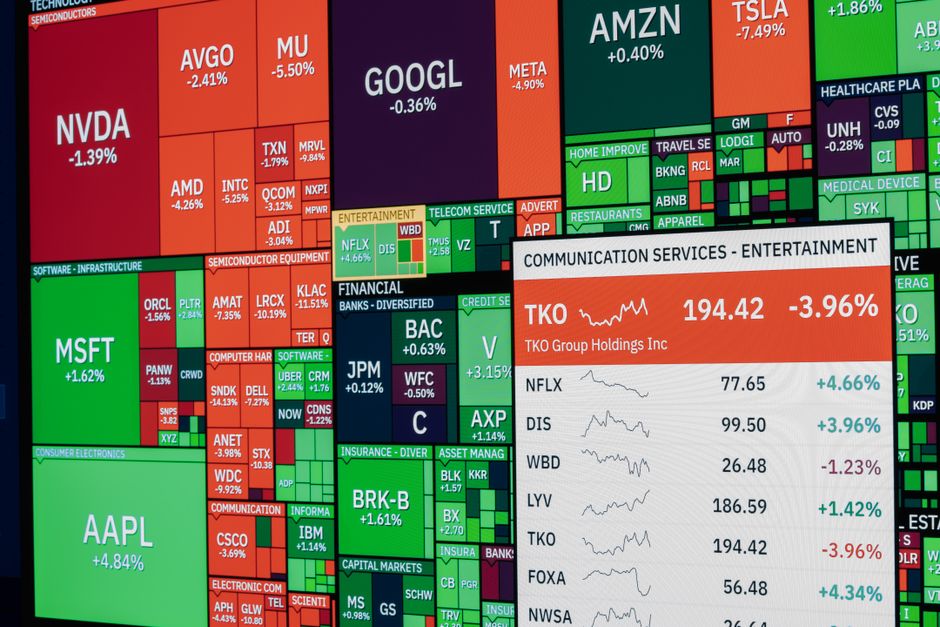
The Nasdaq Composite dropped 694 points, or 2.6%, to 26,008.86 on Thursday, its steepest decline since June. Investors began asking whether the artificial intelligence spending spree can keep paying off. The S&P 500 fell 93.74 points, or 1.21%, to 7,663.43. The Dow Jones Industrial Average managed a small gain, rising 11.89 points, or 0.02%, to 52,867.98. That split tells you something: money isn't fleeing the entire market. It's pulling back from companies that have ridden the AI wave hardest.
Earnings Fail to Calm Nerves
Tesla beat Wall Street estimates for the third quarter, yet its shares still fell, sliding 3% in one session snapshot and 2% in another as investors reacted to lower profitability. The company trimmed its capital-expenditure estimate for the year to $20 billion from $25 billion. Meta posted better-than-expected earnings and revenue and offered strong guidance for the coming quarter. Its shares dropped 7% in the closing snapshot anyway. Meta's annual capital-expenditure estimate was largely unchanged.
Economist David Rosenberg read the signals plainly. Investors saw indications of greater spending discipline, he said, a possible sign that the AI investment boom could slow, with consequences for supplies across the industry. Good results weren't enough. The market wanted proof that companies were spending the money wisely, and it isn't convinced yet.
Semiconductors took the hardest hit from that skepticism. The iShares Semiconductor ETF fell nearly 7% in the closing snapshot, after reports had it down 3% earlier in the session. The Nasdaq 100 closed down 2.90%, at 28,958.69.
Oil and Bonds Tell a Wary Story
Brent crude, the international benchmark, climbed more than 3% to above $112 a barrel in one snapshot and 4% to above $113 in another. West Texas Intermediate gained 2% but stayed just below $100. Markets reacted to a New York Times report citing U.S. officials that the United States and Israel were planning strikes on Iran after the midterm elections. The proposed operation was described as "short but intensive." Higher crude renewed worries about pressure on supplies, a cost families and businesses feel directly at the pump.
Treasuries told a different story. The 10-year U.S. Treasury yield fell 11 basis points, reaching its lowest level in about a month. Another closing snapshot put the drop at 18 basis points, to about 4.97%, below 5% for the first time in almost a month. JPMorgan's markets intelligence desk said the bullish tone had "reversed overnight" and investors appeared to be in a "flight-to-quality trade." The bank pointed to "the still fragile narrative around AI financing concerns and the lack of conviction / re-grossing from the recent tech reversal," and noted that hyperscalers' corporate bond spreads had widened to levels last seen in July.
Across the Atlantic, France's 10-year OAT yield rose 7 basis points amid political unrest. Earlier this week, during cost-of-living riots, that yield topped 5% for the first time in 24 years.
A Warning From the Chart Watchers
David Morrison, a senior market analyst at Trade Nation, said both companies had reported solid results, making the reaction hard to explain. "The market reaction to these key updates and the overall effect this has had on the chip sector and other AI-adjacent stocks this morning is concerning," he wrote in a client note. "Not only does it show that upside momentum has waned significantly, but that intermediate support levels are creaking dangerously."
Paul Hickey, co-founder at Bespoke Investment, offered a sharp observation. Investors may be mostly passive these days, he said, but their mood still follows individual stocks, plenty of which have struggled even as the indices trade much closer to all-time highs.
CoreWeave, a neocloud company facing investor scrutiny over its debt, fell 4% in one report and plunged 10% in another. Its shares were down 25% since October 13 in the earlier account and 39% from early-October levels in the closing snapshot. Nvidia CEO Jensen Huang defended CoreWeave and other neocloud companies, saying demand was "off the charts." Demand talk is one thing. Balance sheets are another, and investors are checking both.
The individual moves were broad. SK Hynix, Samsung Electronics, SanDisk, AMD and Intel were among the hardest hit, while Nvidia, Broadcom, Alphabet and Amazon slipped less. Several volatile weeks have left traders on edge as the midterm elections approach, an event stocks are often thought to struggle ahead of.
Why This Matters: The sell-off raises a basic question for anyone with money in the market, from pension funds to retirement accounts. Companies are pouring enormous sums into artificial intelligence, and Goldman Sachs projected that global AI investment would exceed $1 trillion this year. Investors are asking whether that money will earn a return, and they're punishing firms when the answer looks uncertain, even when quarterly numbers beat forecasts. That's how a market is supposed to discipline spending. It also means capital allocation decisions are facing a real-time test, not just being promised. On the fiscal side, Treasury yields are once again acting as a safe haven after a long stretch of selling tied to inflation and fiscal worries, suggesting investors still reward Washington's debt when private risk looks shaky. Add a possible military operation against Iran and an oil price above $112, and pressure on consumers and supply chains grows. Markets are doing what they're meant to do: pricing risk and forcing accountability. Whether that discipline holds through the midterms will show how much conviction remains in the AI trade.
- technology stocks
- artificial intelligence
- nasdaq composite
- tesla
- meta
- semiconductor stocks
- treasury yields
- oil prices