
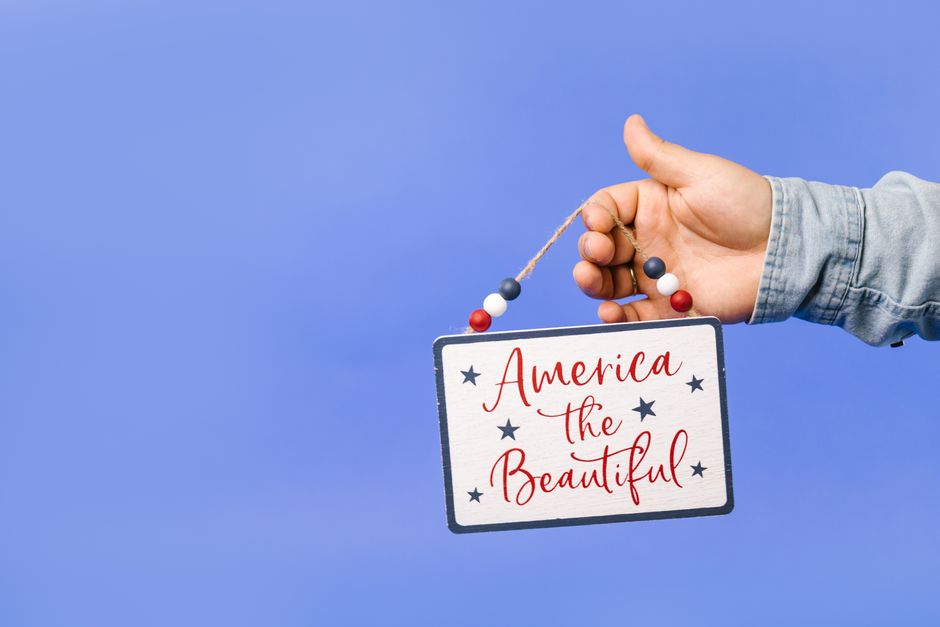
Owen Jansson of Ann Arbor, Mich., wants a new national anthem. In The Atlantic's October 13, 2026, letters section, he argued that "America the Beautiful" should replace the current one because it celebrates the country's grandeur and evokes the principles of its founding documents.
It's a modest proposal in tone, but a sweeping one in scope. And it landed in a mailbag that revealed how many different songs Americans carry in their hearts.
The Spark
Jansson responded to Jake Lundberg's July issue essay, "Never Call Retreat," about the history and endurance of "Battle Hymn of the Republic." Lundberg argued that the United States effectively has two national anthems: the official "The Star-Spangled Banner" and the unofficial but sacred "Battle Hymn of the Republic."
Readers had plenty to add. Laura Cardinal of Hereford, Ariz., said the July cover, featuring the music for the hymn, sat on her piano and got played "loudly and often." Sandy Shapiro of Washington, D.C., pointed to Elaine Showalter's biography of the hymn's author, Julia Ward Howe, titled "The Civil Wars of Julia Ward Howe." Shapiro quoted Showalter's inscription: "Julia's motto was 'Up to Date!' Good words for us as well." The magazine, Shapiro noted, had celebrated Howe again 164 years after first publishing her poem.
Competing Candidates
Not everyone agreed the field was settled. Donna Jane Krupkin of Nashville, Tenn., said she was surprised Lundberg left out "Lift Every Voice and Sing," often called the Black national anthem. James Weldon Johnson composed it as a poem in 1900, she wrote, and his brother, J. Rosamond Johnson, set it to music. Krupkin said the song makes no reference to war and embraces the sorrow and majesty of shared American life. Her church sings it as an opening hymn once a month.
Jerry Albritton of Brandenburg, Ky., offered another choice: "Amazing Grace." He called it a spiritual national anthem that prompts introspection about the country's struggle to abolish slavery. John Newton wrote the words in 1772, Albritton noted, 42 years before Francis Scott Key wrote "The Star-Spangled Banner." He described "Battle Hymn" as a battle cry for abolitionist action and "Amazing Grace" as a soulful anthem for people seeking freedom. He hoped renewed attention to both would lead the nation toward "real freedom for all Americans."
Memory and Craft
Some letters focused less on politics than on how a song lodges in a life. Nigel Clements of Mississauga, Canada, recalled first hearing "Battle Hymn" while watching Winston Churchill's funeral at St. Paul's Cathedral in London on January 30, 1965. A huge choir performed it at Churchill's request. Clements called the experience moving and unforgettable.
Jeanette Condie Pearson of Salt Lake City, Utah, supplied the most vivid backstory. Her father, Richard P. Condie, directed the Mormon Tabernacle Choir from 1957 to 1974. She recalled his collaboration with Eugene Ormandy and the Philadelphia Orchestra on a Columbia Records recording of the hymn. Condie called Ormandy at 2 a.m. to ask him to consider the score, Pearson said. Ormandy initially said he wasn't "excited" by the idea and doubted it would work. He later agreed at Condie's insistence.
The gamble paid off. The choir's recording became a hit in 1959, reached No. 13 on the Billboard Hot 100 and stayed there for 16 weeks. Condie won a Grammy for the performance the following year. Pearson said the recording brought the choir and orchestra prominence and began a lifelong friendship between her father and Ormandy.
She also pressed a point about the lyrics, which she said speak to eternal truths of the human soul. She urged the nation to heed Howe's words by overcoming hatred, evil and vengeance with forgiveness, love and charity. "Then, I think, we could say with confidence that 'His truth is marching on,'" she wrote.
The Author Responds
Lundberg answered the letters by returning to the hymn's origins. It addressed the country's gravest crisis, he wrote, in the dire biblical idiom familiar to many Northerners when Howe wrote it at the end of 1861. Abraham Lincoln gave that idiom its fullest expression in his second inaugural address four years later, Lundberg said.
He didn't dodge the hymn's harder edges. Its imagery is stark and violent, he acknowledged, and some interpretations have been dark. He called it a "capacious vessel for arguments over the American idea." In its best application, he wrote, Howe's words, set to a marching song about the militant abolitionist John Brown, call people to uphold their highest ideals, particularly in moments of crisis.
Why This Matters: A national anthem isn't legislation. Nobody's tax bill changes if Americans keep arguing over which song represents them. But the exchange shows something durable. Readers from Arizona to Kentucky to Canada reached for songs rooted in faith, sacrifice and inherited ideals, not slogans. Voluntary, bottom-up attachment to shared symbols is how a free society builds common ground without a government mandate. The letters also reflect a preference for continuity over upheaval: even those proposing alternatives did so by invoking the founding documents, the abolitionist cause or Lincoln's words. In a divided era, a debate conducted through hymns, memory and personal stories, rather than demands for official action, suggests the country's civic inheritance still gives people something to argue over and something to share.