
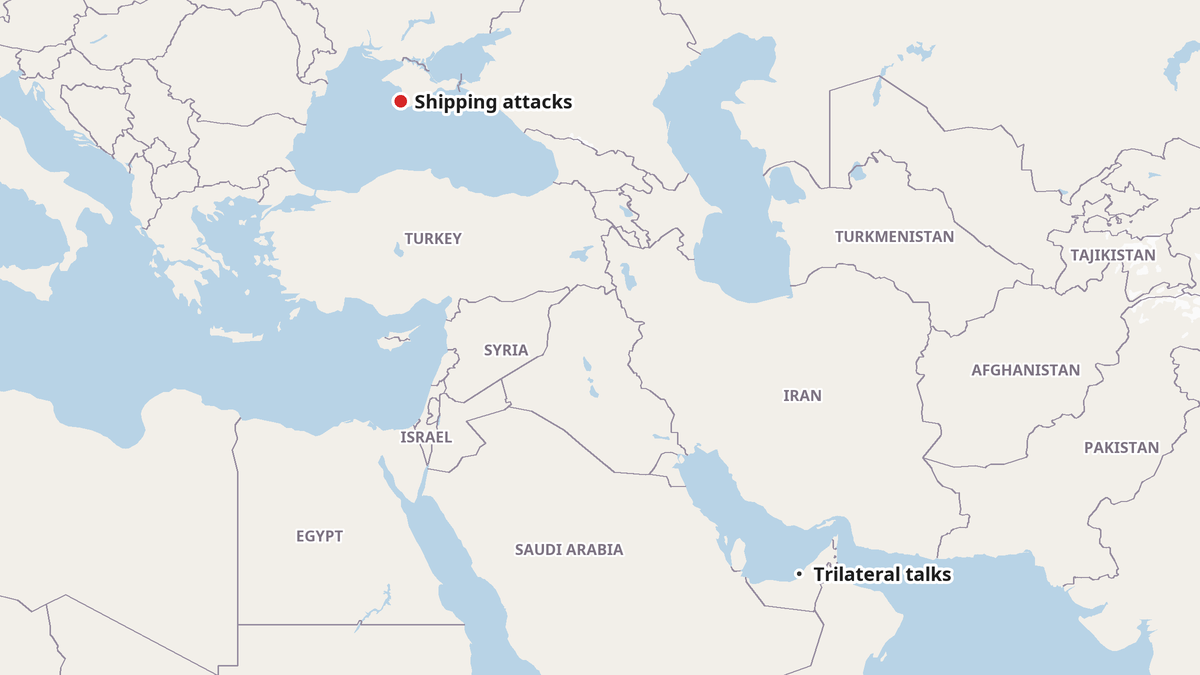
Nobody's expecting the Europeans inside the room. That's the headline from Abu Dhabi, where senior officials from the EU, NATO and key European capitals are flying in this week for U.S.-brokered talks on ending Russia's war on Ukraine. Two senior officials said the Europeans won't be at the main negotiating table. A German official said the format would be "determined as the discussions progress." The Kremlin has already voiced opposition to Europeans taking part directly. The three-way talks begin Monday.
At the table: Jared Kushner, son-in-law and adviser to U.S. President Donald Trump, and U.S. Special Envoy Steve Witkoff for Washington. Presidential aide Vladimir Medinsky leads the Russian side. Ukraine sends Rustem Umerov, head of Kyiv's foreign intelligence service, plus senior officials Kyrylo Budanov and David Arakhamia. A room of intelligence chiefs, envoys and a presidential aide, deciding what happens to millions of people who weren't invited.
The Brussels Apparatus Queues Up
Europe's delegation reads like a seating chart for a very expensive waiting room. National security advisers from France, the U.K., Germany and Italy. Senior officials from NATO, the European Commission and the European Council. Günter Sautter, German Chancellor Friedrich Merz's foreign and security policy adviser, coordinates the German-led "Berlin Format" and represents Germany in the E3 format. Merz said Sautter "is now devoting a significant portion of his workforce to diplomatic efforts to end this war." Sautter's line: no discussion of a future European security architecture before Russia agrees to a ceasefire.
Bjoern Seibert, Ursula von der Leyen's chief of Cabinet, goes for the Commission. He sat in earlier rounds in Miami and Oslo with Witkoff, where officials discussed security guarantees, territory and Ukraine's postwar recovery. Anna-Maria Boura, European Council President António Costa's chief foreign policy adviser, represents the Council, which was absent from earlier rounds. Emmanuel Bonne is Emmanuel Macron's chief diplomatic adviser. U.K. National Security Adviser Jonathan Powell is expected, though reports say he's on his way out of Downing Street.
And then there's Geoffrey van Leeuwen, NATO Secretary-General Mark Rutte's chief of staff. His job, an official said, is to "observe, report back" and make sure "NATO is aware of what's being said." Not to negotiate. To take notes.
A Fight Over Who Gets a Chair
The Italian presence came out of a squabble. Prime Minister Giorgia Meloni wrote to European Council President António Costa last week, complaining about the proliferation of negotiating formats on Ukraine. She wanted this week's informal gathering of EU leaders in Dublin to decide "once and for all, who sits at the negotiating table representing the European Union, and with what mandate." Costa agreed to put it on the agenda. Meloni also wrote: "I am not asking for a seat for Italy in this or that format." Italy's diplomatic adviser, Fabrizio Saggio, is in Abu Dhabi anyway.
The real anxiety is Kushner's phrase from last week: a "new European security architecture." Russian officials often use it to mean reducing NATO's presence in front-line nations and limiting Ukraine's armed forces. European capitals are worried about concessions made over their heads. The argument, in other words, is over who gets to carve up the map. The people living on it don't come up.
Black Sea: Money for Hubs, Not for the Dead
While the advisers flew east, von der Leyen opened her Romania visit with an announcement. The EU will help finance security costs after attacks on commercial shipping, blamed on Russia. "Threats, attacks and incursions are rising off the coasts of the Black Sea," she said. The Commission will "fast track the work on the Black Sea Maritime Security Hub, with a clear timeline for completion and dedicated funding of €50 million," plus an additional €10 million for Romania's search-and-rescue operations.
The hub is a joint control center run by Romania and Bulgaria, due to be fully operational by the end of the year. Romania is also getting €16.7 billion under the EU's SAFE arms loans program. Set that beside the search-and-rescue line: €10 million, against €16.7 billion for weapons.
Since early October, at least nine ships have been struck in the exclusive economic zones of Romania and Bulgaria. Four were sunk. 34 sailors are dead or missing. Romania has blamed Russia; Bulgaria has stopped short. Von der Leyen visits Varna on Tuesday.
Ceasefires Negotiated by Governments
Washington is steering talks on a Black Sea ceasefire and safe passage agreement. Secretary of State Marco Rubio said the U.S. is reviewing Turkish proposals forwarded in late October and is "open" to ideas from India. An agreement wouldn't end the conflict but would "solve a unique aspect" of it by easing the spillover on food security for vulnerable nations, Rubio said. EU foreign policy chief Kaja Kallas said on Oct. 21 the bloc is working with Turkey, India and food-importing countries on a freedom-of-navigation deal. Ukraine agreed. Russia rejected it.
Ukraine's Agriculture Minister Taras Vysotskyi said Kyiv is "preparing to keep our farmers operating without access to the deep-water Black Sea ports for the long term." Long term. Farmers plan for years of closed ports while envoys plan for the next communiqué.
The pattern holds from Abu Dhabi to Varna: intelligence chiefs, chiefs of staff and chiefs of Cabinet decide, and the people who sail, farm and fight absorb the result.
- ukraine peace talks
- abu dhabi
- russia ukraine war
- black sea shipping
- jared kushner
- steve witkoff
- ursula von der leyen
- european security architecture