
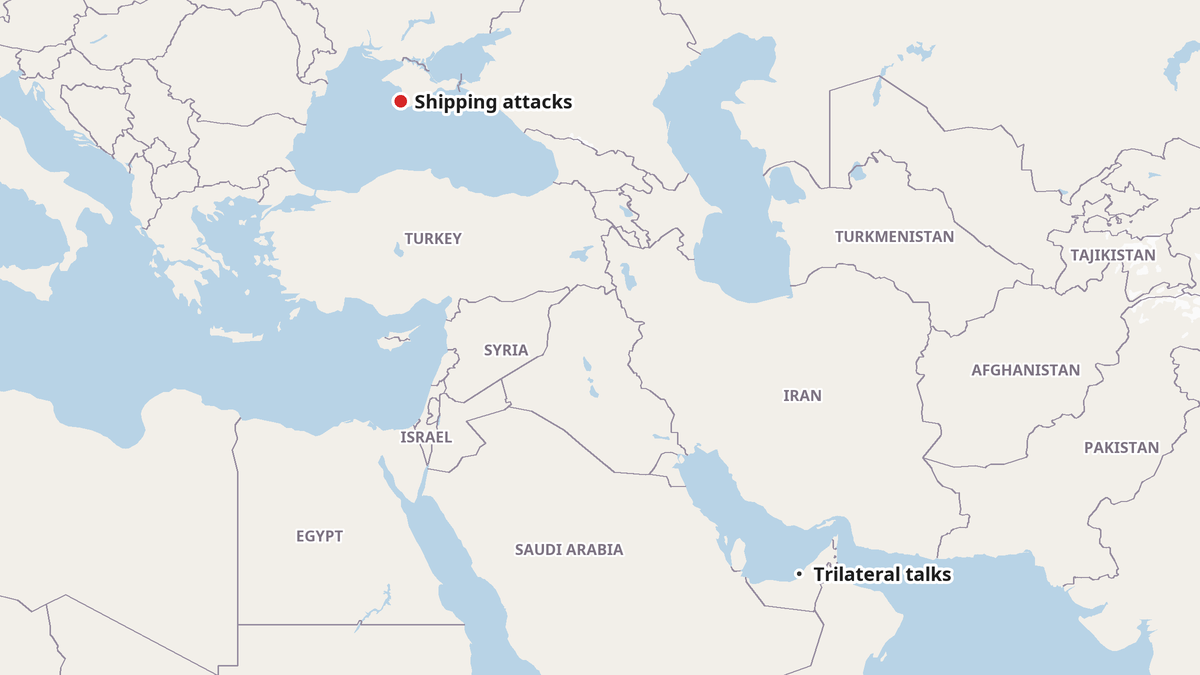
Senior officials from the EU, NATO and key European capitals are flying to Abu Dhabi this week for U.S.-brokered talks on ending Russia's war on Ukraine. They aren't expected to sit at the main table. The three-way negotiations begin Monday, and Europe's role is, at best, that of an interested observer.
That sits uneasily with what Europe has put on the line. Jared Kushner, son-in-law and adviser to U.S. President Donald Trump, said last week that discussions would focus on a "new European security architecture." It's a phrase Russian officials have often used to mean a reduced NATO presence in front-line nations and limits on Ukraine's armed forces. European capitals have noticed.
Who Is, and Isn't, in the Room
Ukraine will be represented by Rustem Umerov, head of Kyiv's foreign intelligence service, along with senior officials Kyrylo Budanov and David Arakhamia. Russia's delegation is led by presidential aide Vladimir Medinsky. Kushner and U.S. Special Envoy Steve Witkoff speak for Washington.
The European contingent is sizeable but sidelined. It includes national security advisers from France, the U.K., Germany and Italy, plus senior officials from NATO, the European Commission and the European Council. Two senior officials said the Europeans are not expected inside the room. A German official said the format would be "determined as the discussions progress." The Kremlin has voiced opposition to Europeans directly participating.
The presence of EU figures and an Italian representative follows a push by Prime Minister Giorgia Meloni. In a letter to European Council President António Costa last week, she warned of fragmentation and complained about the proliferation of negotiating formats on Ukraine. She called on this week's informal gathering of EU leaders in Dublin to decide "once and for all, who sits at the negotiating table representing the European Union, and with what mandate." Costa agreed to put the issue on the agenda. Meloni added: "I am not asking for a seat for Italy in this or that format."
Günter Sautter, German Chancellor Friedrich Merz's foreign and security policy adviser, represents Germany in the E3 format and coordinates the German-led "Berlin Format." Merz said last week Sautter "is now devoting a significant portion of his workforce to diplomatic efforts to end this war." Sautter's position is that there can be no discussion about a future European security architecture before Russia agrees to a ceasefire.
Fabrizio Saggio, Meloni's diplomatic adviser, attends for Italy. Geoffrey van Leeuwen, NATO Secretary-General Mark Rutte's chief of staff, will "observe, report back" and make sure "NATO is aware of what's being said," an official said. U.K. National Security Adviser Jonathan Powell is expected, though reports say he is on his way out of Downing Street. Bjoern Seibert, Ursula von der Leyen's chief of Cabinet, represents the Commission; he joined earlier rounds in Miami and Oslo with Witkoff, where officials discussed security guarantees, territory and Ukraine's postwar recovery. Anna-Maria Boura, Costa's chief foreign policy adviser, represents the Council, which was absent from earlier rounds. Emmanuel Bonne is Emmanuel Macron's chief diplomatic adviser.
The Black Sea Bill
While diplomats gather in the Gulf, the cost of the war is landing on EU members' coastlines. Von der Leyen announced Monday, at the start of her visit to Romania, that the EU will help finance some security costs after attacks on commercial shipping, blamed on Russia. "Threats, attacks and incursions are rising off the coasts of the Black Sea," she said.
The EU will "fast track the work on the Black Sea Maritime Security Hub, with a clear timeline for completion and dedicated funding of €50 million," plus an additional €10 million for Romania's search-and-rescue operations. The hub, announced last year, is a joint control center run by Romania and Bulgaria, expected to be fully operational by the end of the year. Romania is getting €16.7 billion under the EU's SAFE arms loans program.
The human toll is stark. Since early October, at least nine ships have been struck in the exclusive economic zones of Romania and Bulgaria. Four were sunk. Thirty-four sailors are dead or missing. Romania has blamed Russia; Bulgaria has stopped short. Von der Leyen is to visit Varna on Tuesday.
Washington Steers the Sea Talks Too
The U.S. is also steering talks on a Black Sea ceasefire and safe passage agreement. Secretary of State Marco Rubio said Washington is reviewing Turkish proposals forwarded in late October and is "open" to ideas from India. An agreement would not end the conflict but would "solve a unique aspect" of it by easing the spillover on food security for vulnerable nations, Rubio said.
EU foreign policy chief Kaja Kallas said on Oct. 21 the bloc is working with Turkey, India and food-importing countries on a freedom-of-navigation deal. Ukraine has agreed; Russia has rejected it. Von der Leyen said the EU backs Ukraine's call for a Black Sea ceasefire. Ukraine's Agriculture Minister Taras Vysotskyi said Kyiv is "preparing to keep our farmers operating without access to the deep-water Black Sea ports for the long term."
Why This Matters:
Europe is paying for security it doesn't control. Brussels is committing €60 million to Black Sea maritime protection, and member states are borrowing heavily for arms under SAFE, yet the architecture that will govern the continent's security is being discussed in a format where Europeans are, at most, briefed. Meloni's demand for a single, mandated EU voice is a question of democratic accountability: who speaks for 27 governments, and on whose authority? Sautter's insistence on a ceasefire first reflects a sovereignty concern shared by front-line states, which have the most to lose from any deal that thins NATO's presence. Without a credible European seat and credible European defence spending, the continent's interests will keep being negotiated by others. That's the fiscal and political price of fragmentation.
- ukraine peace talks
- abu dhabi
- russia ukraine war
- black sea shipping
- jared kushner
- steve witkoff
- ursula von der leyen
- european security architecture