
Zelenskyy said last week that "every power plant in Ukraine has been damaged in one way or another by attacks." Winter is setting in. Tomorrow, Tuesday, November 10, negotiators from the United States, Russia and Ukraine sit down in Abu Dhabi for the first three-way talks since February, with security guarantees topping the agenda.
The session runs two days, November 10-11, in the United Arab Emirates. Earlier rounds this year produced no visible progress toward ending what the base wire calls Europe's most devastating conflict since World War II, now in its fifth year. US envoy Steve Witkoff says Washington will bring the delegations together to discuss ending the war, post-war security agreements and de-escalation.
Who's In the Room, Who's Not
The guest list is the story. Kremlin foreign affairs adviser Yuri Ushakov was blunt when asked whether European envoys could attend: "No one is going to invite them to the negotiating table." If they fly there, he added, they won't be allowed into the room. French Foreign Minister Jean-Noel Barrot told RTL on Sunday that "The Europeans will be well represented. France will be in Abu Dhabi." He couldn't say who would be representing France.
The people whose homes sit on the front line get no seat at all. Neither do the conscripts, the evacuees, or whoever is queuing for water in the dark. Three delegations will discuss the future of a 1,200-kilometre front line, and the people on both sides of it are an agenda item, not participants.
Europe, meanwhile, can't pick a spokesperson. Kremlin spokesman Dmitry Peskov sneered that EU members "can't even decide yet who is authorized to speak on their behalf." Later this week European leaders gather in Dublin for an informal summit to debate exactly that. Italian Prime Minister Giorgia Meloni is, according to Politico, particularly frustrated that the EU has no plan to make sure its voice is heard. Norway's Prime Minister Jonas Gahr Støre says he's increasingly looked to the E3, Germany, France and the UK, to fill the role. Three capitals appointing themselves to speak for a continent: nobody voted on that.
On October 27, Finland's President Alexander Stubb and Støre phoned Putin for 90 minutes, speaking, they said, as Russia's Nordic neighbours and not for the EU. Denmark and Latvia were stunned and dismayed. Støre's defence: "Let's admit it. He is not isolated. The only voice reaching Moscow comes from Washington."
A Grand Deal, Details Pending
After meeting Putin's envoy Kirill Dmitriev at the White House on November 4, five days ago, Trump promised "a big agreement" that "is going to involve more than Ukraine," possibly all of Europe. Politico's Brussels Playbook podcast reports that this "big, beautiful deal" has European capitals on edge. Trump told CBS's 60 Minutes that Ukraine would "end up with a little bit different shape." Territory, in other words, gets redrawn at a table where the people living on it aren't seated.
Jared Kushner's stated aim is "permanent security consultations, reliable crisis communications, greater military transparency, reciprocal measures to reduce escalation risks." Putin, for his part, wants Ukraine out of four annexed regions, out of NATO bids, under strict military limits, and he wants a comprehensive deal, not a general halt. He says a pause would only let Ukrainian troops rest and restock. Zelenskyy refuses to cede ground Russia hasn't taken, and wants an immediate ceasefire first.
Støre called Abu Dhabi "a stepping stone" and listed possible outputs: a Black Sea ceasefire for grain, an energy infrastructure ceasefire, a front-line freeze, prisoner swaps. He also said sending a team and "not delivering anything" carries "a price."
Meanwhile, on the Ground
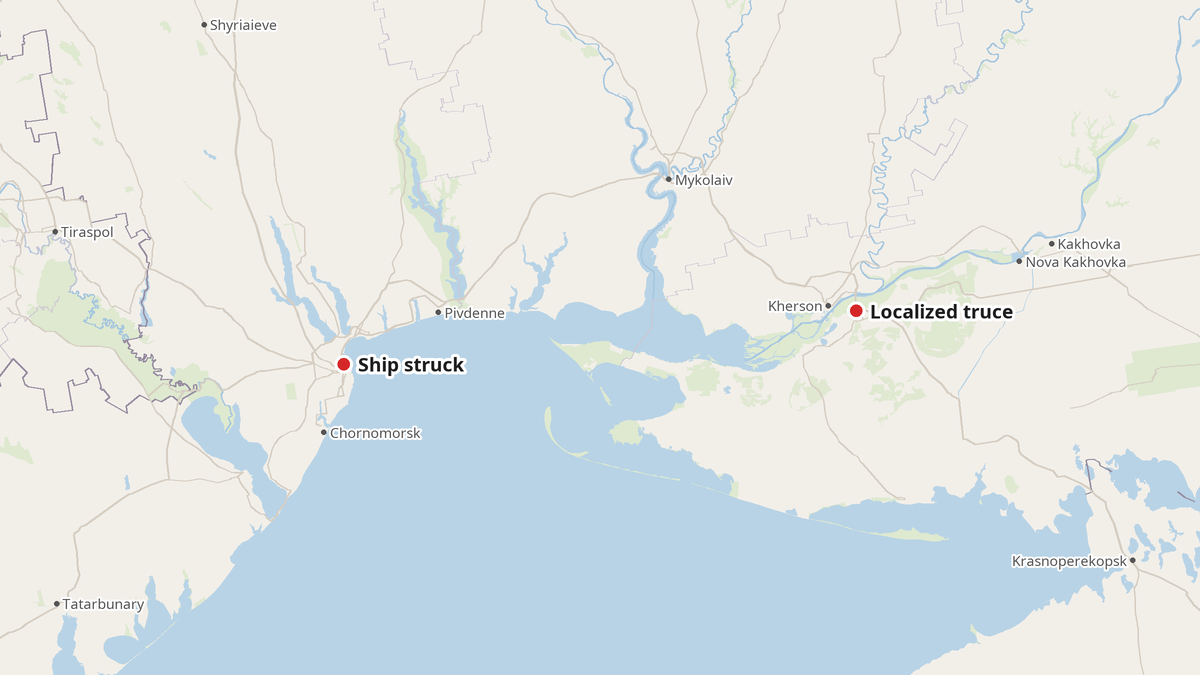
The one concrete relief this autumn came from below the negotiating tier: a weeklong localized truce around Russian-occupied Oleshky, brokered with help from US first lady Melania Trump, which let some residents out and let humanitarian supplies in. Both Moscow and Kyiv touted it as a model. Fighting kept raging along the rest of the front.
Russia has intensified strikes on Ukraine's power system as winter arrives, using ballistic missiles and faster jet-powered drones while Ukraine runs short of US-made Patriot interceptors. Russia's defence ministry says it hit a substation in Zhytomyr region and a container ship delivering weapons southwest of Odesa. Drones hit an industrial area in Kirishi, in Leningrad region, with 81 downed so far, governor Aleksandr Drozdenko said.
The dead are counted by hackers. Data leaked from Rosstat indicated at least 390,000 Russians killed, per the Moscow Times; the group Silent Crow claims 450,100, and the Belarus Cyber Partisans 393,881. Britain's chief of the defence staff, Air Chief Marshal Sir Richard Knighton, told the FT: "This is the most dangerous period I've known in my adult life."
The Electoral Footnote
Politico's podcast adds that EU foreign policy chief Kaja Kallas has a new adversary: French far-right presidential candidate Marine Le Pen, who, if she takes power in elections next year, wants to dismantle or drastically scale back the European External Action Service. Brussels apparatus versus nationalist apparatus. Pick your flag.
- ukraine peace talks
- abu dhabi
- russia ukraine war
- security guarantees
- volodymyr zelenskyy
- vladimir putin
- steve witkoff
- donald trump