
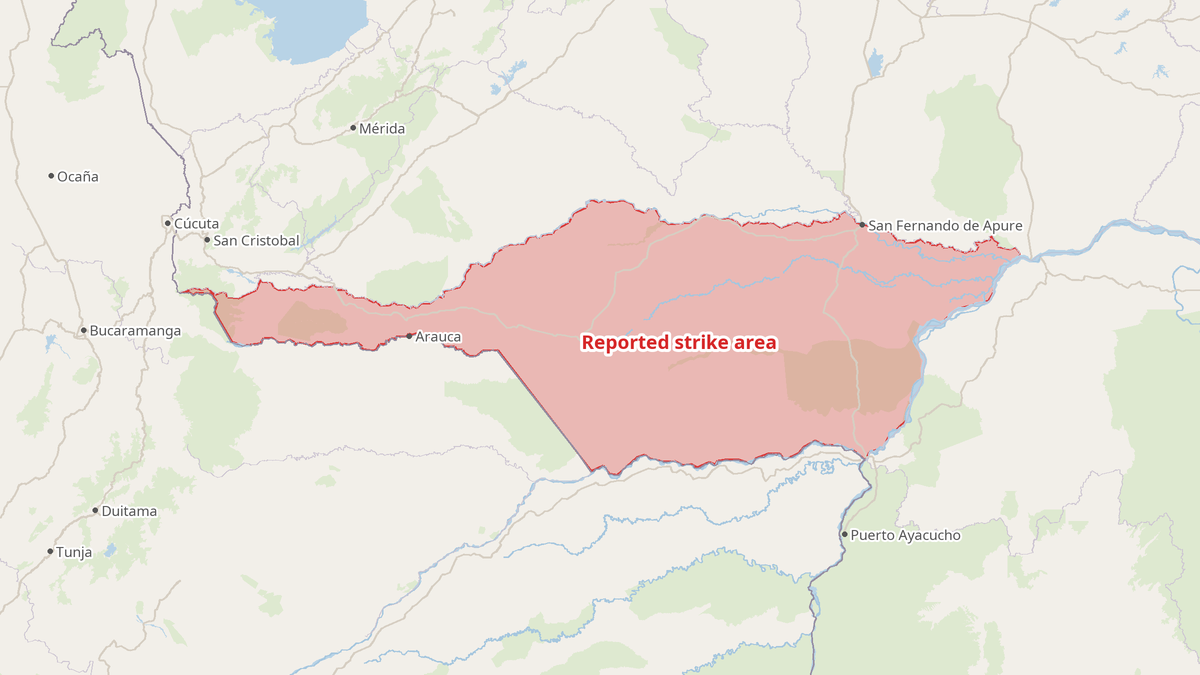
Venezuelan helicopters and drones struck an ELN camp near the Colombian border on October 30, and a rights group later reported at least 23 dead. Four U.S. officials said the United States provided intelligence and drone support. The governments in Caracas and Washington haven’t publicly confirmed a U.S. role, and neither had issued a formal account of the strike when the report was published.
The target was a forested camp in Apure state belonging to the National Liberation Army, or ELN, a Colombian rebel group on the U.S. terrorist list. Fundaredes, a Venezuelan rights group, said the camp was a cocaine distribution point. The strike placed the armed power of two governments at the center of an operation whose victims and circumstances remain incompletely documented.
The toll, without an official count
Fundaredes first reported nine deaths, then said 10 more bodies had been moved to San Fernando de Apure, the state capital. Its later count was at least 23. Juan Francisco García, the group’s coordinator in Apure, gave the earlier counts. The dead, Fundaredes said, included pilots, suppliers and relatives of ELN members.
There’s no official death toll. Colombian press reports cited morgue workers who recorded at least eight bodies in San Fernando de Apure, while reports differed on victims’ nationalities and the precise strike location. Fundaredes’ named list of victims could help establish the toll, the report said.
Basic questions about the operation also remain unanswered: it’s unknown who flew the drones, whether U.S. forces fired weapons, or whether the camp’s leaders were hit. No ELN statement had been found. Requests for comment to the U.S. State Department and the Venezuelan government had not been answered when the report was published.
Security cooperation, denials and interests
Four U.S. officials, speaking anonymously because the matter was sensitive, said the United States provided Venezuela with intelligence and drone support. A Venezuelan military source, also anonymous, gave a similar account to a news agency and said the CIA and FBI helped and the attack followed a U.S. order. Those claims remain unconfirmed by either government. Colombia’s defence authorities denied any part in the operation.
The report described the strike as a possible new step in security cooperation between Washington and Caracas after a U.S. operation removed Nicolás Maduro in January. Venezuela has been run by Acting President Delcy Rodríguez since that operation, and the two governments now work together on security, according to the report. Colombia’s government, led by President Abelardo de la Espriella, was conducting its own offensive against the ELN, putting the group under pressure on both sides of the border. The ELN has long used Venezuelan border territory as a hideout and cocaine route.
The report also noted the interests surrounding a safer border: oil companies with Venezuelan contracts could benefit. Proof of civilian deaths, it said, could bring congressional scrutiny and slow cooperation. The victims Fundaredes identified included relatives of ELN members, but the report did not establish which victims were civilians.
A market bets on the next escalation
At 11:17 p.m. ET on November 3, Polymarket traders put the probability of a U.S. invasion of Venezuela by December 31, 2026, at 3.1%. About US$276,000 had been traded on that contract and US$14.2 million across the whole market. The Rio Times described prediction markets as real-money bets that produce a live probability that can move within minutes of news, and said it presents them alongside polls and official results, not instead of them.
A statement from the State Department or Defense Department could confirm the U.S. role. For now, the strike’s toll has no official count, the governments haven’t provided a formal account, and the competing claims about who directed and carried out the operation remain unresolved.
- venezuela
- colombia
- eln
- apure state
- u.s. intelligence
- drone strike
- security cooperation
- fundaredes