
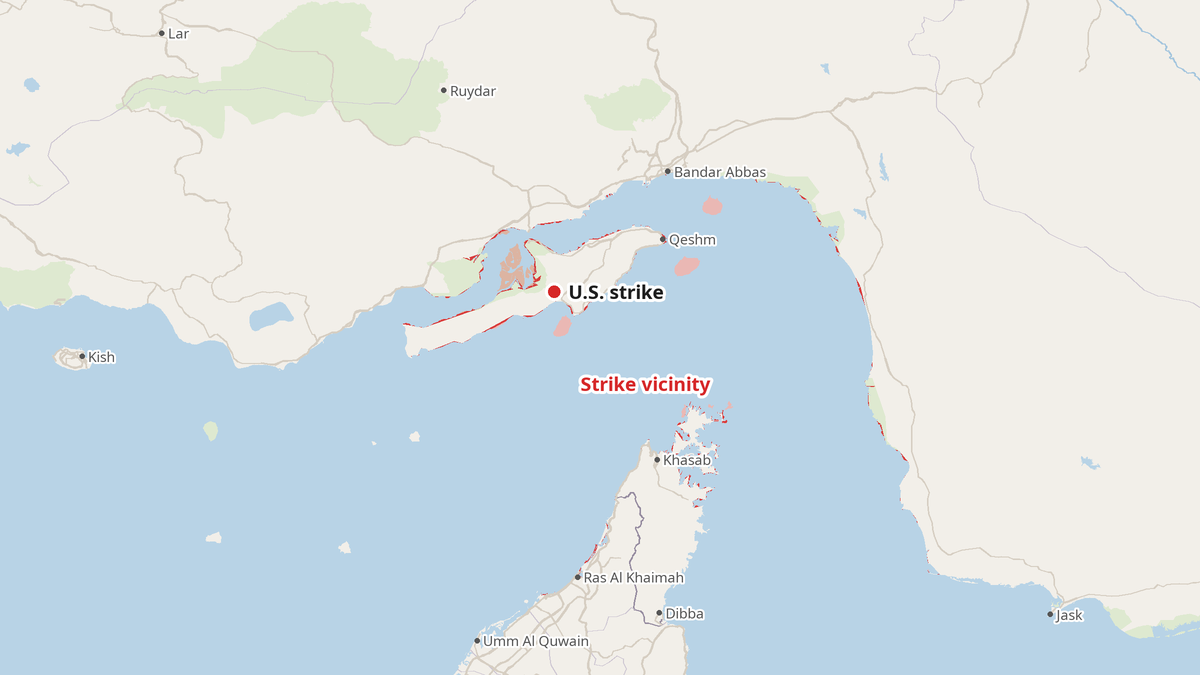
The United States struck Iranian targets near the Strait of Hormuz on Monday as thousands of U.S. troops remained in waters enforcing a blockade on tankers carrying Iranian oil. The operation came one day before U.S. midterm Election Day, with estimates putting the war’s cost at $47 billion and higher fuel prices weighing on the global economy.
Oil, blockade and the cost of war
A U.S. official said the strikes targeted Iranians using surface-to-air missiles against U.S. assets. Iranian state media reported explosions on Qeshm and Hengam islands and near Bandar Abbas. Qeshm is home to an underground missile site, a naval base and a major desalination plant; analysts described the island as the primary platform for Iran’s “asymmetric” naval power.
The U.S. blockade is intended to prevent tankers carrying Iranian oil from reaching the global market. Another aircraft carrier and thousands of additional troops were on their way to the Middle East. The war, launched by the United States and Israel on Feb. 28, triggered the closure of the Strait of Hormuz, surging oil and gas prices, and extensive damage to military, civilian and energy facilities around the Gulf.
Fortune reported recent estimates of the war’s cost at $47 billion, against U.S. national debt of $40 trillion. Budget hawks have called for reducing the deficit from 6% of gross domestic product to 3%. A Pew Research study the previous month found 14% of voters strongly approved of Trump’s handling of the conflict and another 20% somewhat approved.
Trump said the Iran conflict was “not a war” at the Lincoln Memorial Reflecting Pool on Nov. 2. “I don't know if you even call it a war because we haven't been doing any fighting for months,” he said. On Fox News’ “Hannity,” he called it a “soft war.” He also said he might strike Pickaxe Mountain, a suspected underground facility connected to Iran’s nuclear program: “But that's not a big deal. We can do it in literally one hour.”
Military power and election timing
A U.S. official told Fox News that the Qeshm strike responded to Iran firing at a U.S. aircraft and was “defensive,” not the start of renewed escalation. The Associated Press quoted an unnamed U.S. official describing the targets as “Iranians using surface-to-air missiles against US assets.” The Pentagon referred questions to U.S. Central Command, which did not immediately respond to USA TODAY’s request for comment.
The United States had not publicly disclosed strikes on Iranian military targets since Sept. 1, according to USA TODAY. Trump had previously said the United States would not strike Iran before the election, while repeatedly suggesting major operations could resume afterward. On Tuesday, he told “Fox & Friends” the United States would “see” what its next move was. “I'm not looking to, you know, kill lots of people, but if we have to, we'll have to,” he said.
The war and higher fuel prices were political vulnerabilities for Trump’s Republican Party ahead of the midterms. UBS’s Paul Donovan said Trump might become more aggressive in the Gulf war “once freed from the pursuit of popularity,” and said markets would watch for escalation “with wider economic consequences at home and abroad.”
Negotiations alongside military preparations
Qatar-led mediation sought to prevent a return to all-out war. Qatari mediators passed messages between Washington and Tehran and traveled to Tehran on Monday night to discuss a draft U.S.-Iran agreement with Iranian Foreign Minister Abbas Araghchi. Iran’s plan, submitted in September, remained the focus of discussions and could be shortened to include reopening the Strait of Hormuz and resuming talks on Iran’s nuclear program, Ministry spokesperson Esmaeil Baghaei said.
Araghchi said, “Consultations through mediators are very intensive. We have presented our conditions and proposals, and everything depends on the political rationality of Washington.” On Tuesday, a senior Iranian official told Reuters the countries remained far from a deal, though “mediators are working hard to narrow gaps between Tehran and Washington.”
Iran also opened its third military training center in Tehran on Monday and announced plans to train 1 million paramilitary volunteers nationwide. Ali Kowsari, the Basij’s deputy head for training, said 1,500 training bases would begin operating in cities and towns. Iran’s parliament speaker and chief negotiator, Mohammad Bagher Qalibaf, said the armed forces remained at the highest level of defensive readiness and warned that Washington would face “a new battlefield” if it made another “strategic miscalculation.”
- iran strikes
- qeshm island
- strait of hormuz
- united states
- iran
- u.s. midterm elections
- islamic revolutionary guard corps
- military operation