
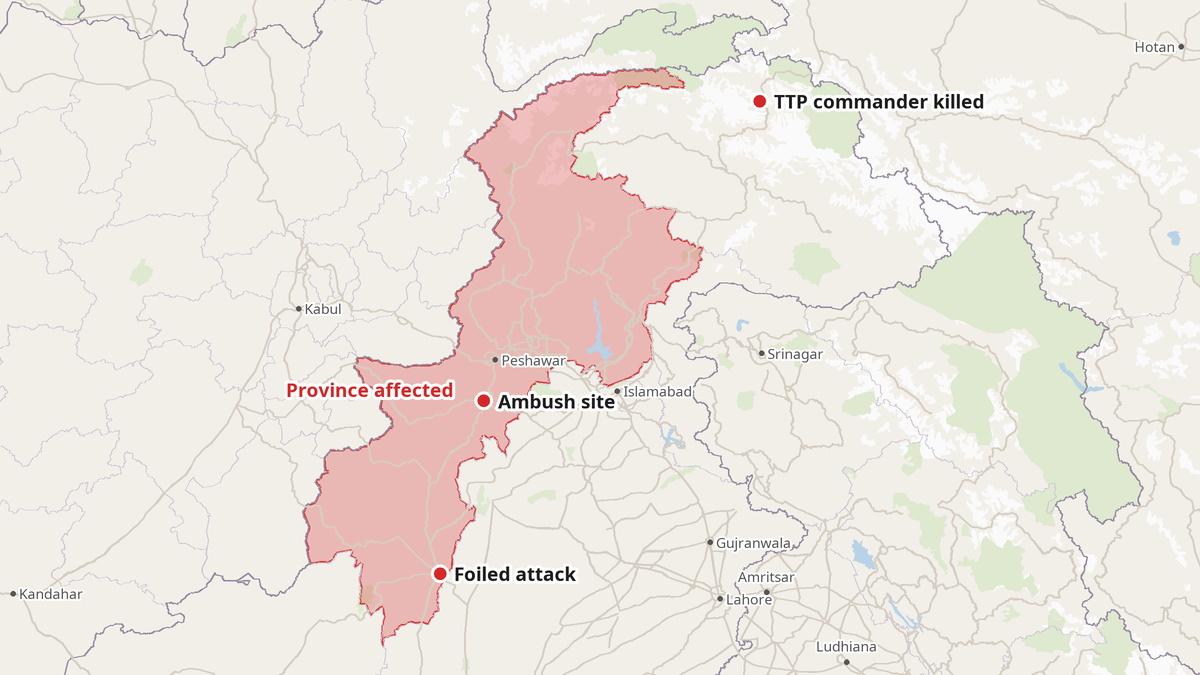
Ten police officers died on Wednesday when gunmen opened fire on a team returning from an operation against illegal gold mining in Kohat district, in Pakistan's northwest. Twelve more officers were wounded. A deputy superintendent of police and a sub-inspector were among the dead, according to Khyber Pakhtunkhwa provincial police.\n\nEighteen fighters were also killed in the ensuing violence. Bloomberg reported a combined death toll of 28.\n\nThe officers were leaving a mine in the Gumbat area, also given as Gambat, when armed men attacked. Hours later, the Pakistani Taliban claimed responsibility. A senior administrative official in Kohat told AFP that fighters set two police vehicles on fire. Two other police vehicles and one private vehicle were missing.\n\nA Force Under Sustained Fire\n\nThis wasn't an isolated strike. It was one more entry in a grim ledger.\n\nOn Oct. 8, Station House Officer Daud Khan and gunman Farhad were killed near the Karak-Kohat boundary. On Sept. 28, three traffic police died in Tank district. On Sept. 25, CTD Constable Muhammad Afaq was killed in Peshawar. And on Sept. 18, a blast and assault at Kohat Police Lines killed 15 police among 23 people.\n\nThe numbers behind those names are stark. ACLED data show attacks in Pakistan rose nearly fourfold, to 2,425 in 2025 from 658 in 2022. Security reports presented to the federal cabinet in October showed terrorist incidents in Khyber Pakhtunkhwa rose 195 per cent between March 2024 and September 2026. Of the 2026 attacks, 73 per cent targeted police and security personnel.\n\nPolice are the people most often standing between armed groups and ordinary communities. They're also the ones being killed most.\n\nOfficial Response\n\nThe day after the Kohat attack, police killed a wanted commander of the banned Tehreek-e-Taliban Pakistan, identified as Saifullah, in the Bara Sheikhhan area of Khyber district. Khyber Pakhtunkhwa Inspector General of Police Zulfiqar Hameed said Saifullah was wanted in several serious cases, had been declared a proclaimed offender, and had lived in Afghanistan for the past three years.\n\nPolice said he was involved in attacks on checkpoints in Maidanak and IED attacks at Ali Masjid in Jamrud, and had recently returned as commander of a terrorist formation. Two police personnel sustained minor injuries in a grenade attack.\n\n"The police personnel who killed the Khawarij commander in a successful operation and saved hundreds of innocent lives are an asset to the nation," Hameed said. He added that operations would continue until the country was cleared of the last terrorist.\n\nSeparately, a senior administrative official in the Orakzai area of Kohat said 10 fighters belonging to the Pakistan Taliban were killed in another operation in the district, and a large quantity of weapons was recovered.\n\nLate Wednesday night, attackers rammed an explosives-laden pick-up truck into the main gate of Band Korai police station in Dera Ismail Khan. The blast damaged the wall and a mosque. Police forced the attackers to retreat. No casualties were reported.\n\nThe Cross-Border Dimension\n\nSecurity forces say the violence emanates from Afghanistan. The Taliban government in Kabul rejects that claim. The TTP is separate from, but closely allied with, the Afghan Taliban, who returned to power 5 years ago. Relations between Islamabad and Kabul worsened after deadly border clashes 1 year ago.\n\nCivilians have paid a heavy price. Hundreds have been killed in fighting between the two countries over the past year, according to the UN mission in Afghanistan.\n\nWhy This Matters:\n\nThe numbers point to a security crisis that falls hardest on those asked to confront it. Police officers in Khyber Pakhtunkhwa are being killed in checkpoints, patrols and routine operations, and 73 per cent of this year's attacks have targeted police and security personnel. Every officer lost leaves a family behind and a gap in the public protection that communities rely on. Meanwhile, civilians on both sides of the Pakistan-Afghanistan border are dying in the wider conflict, according to the UN. Force alone hasn't reversed the fourfold rise in attacks. Sustained investment in policing, protection for those who serve, and diplomatic engagement between Islamabad and Kabul, ideally with multilateral backing, look increasingly central to any lasting answer.
- kohat
- khyber pakhtunkhwa
- pakistani taliban
- police attack
- illegal gold mining
- tehreek-e-taliban pakistan
- dera ismail khan
- terrorism