
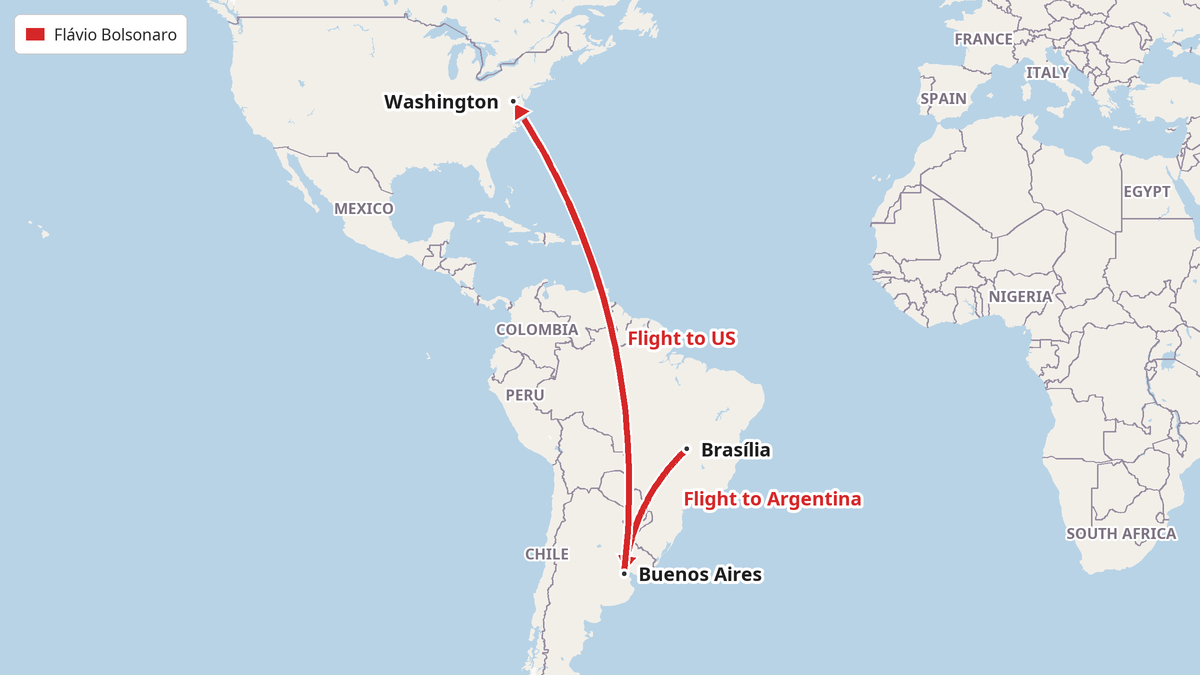
Brazil's Foreign Ministry summoned Argentina's charge d'affaires, Maria Emilia Cortes, on Thursday, after defeated presidential candidate Flávio Bolsonaro slipped out of Brazil, through northern Argentina, and onto a chartered aircraft bound for Miami. Sources inside the government told Reuters about the summons. Argentina's Foreign Minister Pablo Quirno denied on social media that his government had received any formal request for explanations.
That's the diplomatic theater. Here's what sat underneath it.
Who Has the Power
Bolsonaro lost Sunday's runoff by more than 4 million votes. Luiz Inacio Lula da Silva took 51.8 percent and a fourth non-consecutive term. After the vote, Bolsonaro was given a deadline to surrender his passports, and officials ordered him to stay in the country as part of an ongoing legal case. He's part of an investigation into a money-laundering scheme known as the Banco Master scandal, in which investigators are probing a multimillion-dollar payment he received from the bank's former head, Daniel Vorcaro, allegedly to finance a film about his father, former President Jair Bolsonaro. He denies wrongdoing and calls the case politically motivated.
So a man under court order, facing a money-laundering probe, travelled with his wife and two daughters through Argentina, boarded a chartered plane that passed through Ecuador, and landed at Opa Locka Executive airport in Miami. Most people facing a passport deadline don't get a charter flight and a friendly foreign government. Money and political connections move across borders far more easily than ordinary people do.
What They're Calling a Rescue
A spokesperson for Argentine President Javier Milei described the journey as a rescue. Bolsonaro, the spokesperson said, had escaped "from the claws of communism, which seeks to imprison all opposition figures." Bolsonaro later thanked Milei for his assistance, though he didn't say what that assistance was.
In Miami, he declared himself the "legitimate president-elect" of Brazil. He's refused to concede. Even his own Liberal Party has acknowledged Lula's victory. His evidence of electoral malfeasance is a Supreme Court decision to extend voting hours on Sunday, a move both campaigns had requested. His camp pointed to bad weather delaying voters in parts of Brazil. Lula's party raised concerns about efforts to restrict public transport on election day. Bolsonaro argued the extension disadvantaged voters in regions considered right-wing strongholds. The claim is unsubstantiated.
The Heavyweights Take Over
President Donald Trump's decision to grant Bolsonaro refuge inflamed tensions, according to Bloomberg's sourcing. Trump has suggested the election was "rigged," though he declined to "take sides" after the result was announced. He's also used sanctions and tariffs in response to the prosecution of Jair Bolsonaro, who was convicted in 2024 of plotting a coup to prevent Lula from taking power and sentenced to 27 years in prison.
Secretary of State Marco Rubio and Brazilian Foreign Minister Mauro Vieira spoke briefly on Friday on the sidelines of a Group of 20 foreign ministers' meeting in Atlanta. They agreed to meet again before the G-20 summit in December in Miami, people familiar with the matter said, asking not to be identified because the conversation was private.
Read that again. The people who'll settle this are foreign ministers, speaking privately, off to the side of a summit, on background. Nobody voted for that arrangement.
The Pattern
Lula and Milei's relationship has been strained since Milei took office in 2023, now his fourth year in office. Milei has repeatedly criticised Lula. Both countries recalled their ambassadors in August, about two months ago, after a series of public disagreements. This week's summons adds one more incident.
The lesson is in the logistics. Governments claim to hold sovereign authority over their borders, courts and citizens, but that authority bends for the right passenger. A court order is binding until a friendly state offers an airstrip. The legal case against Bolsonaro now depends on diplomacy among presidents, secretaries of state and charge d'affaires.
- flávio bolsonaro
- brazil argentina relations
- javier milei
- lula
- diplomatic tensions
- banco master
- marco rubio
- brazilian presidential election