
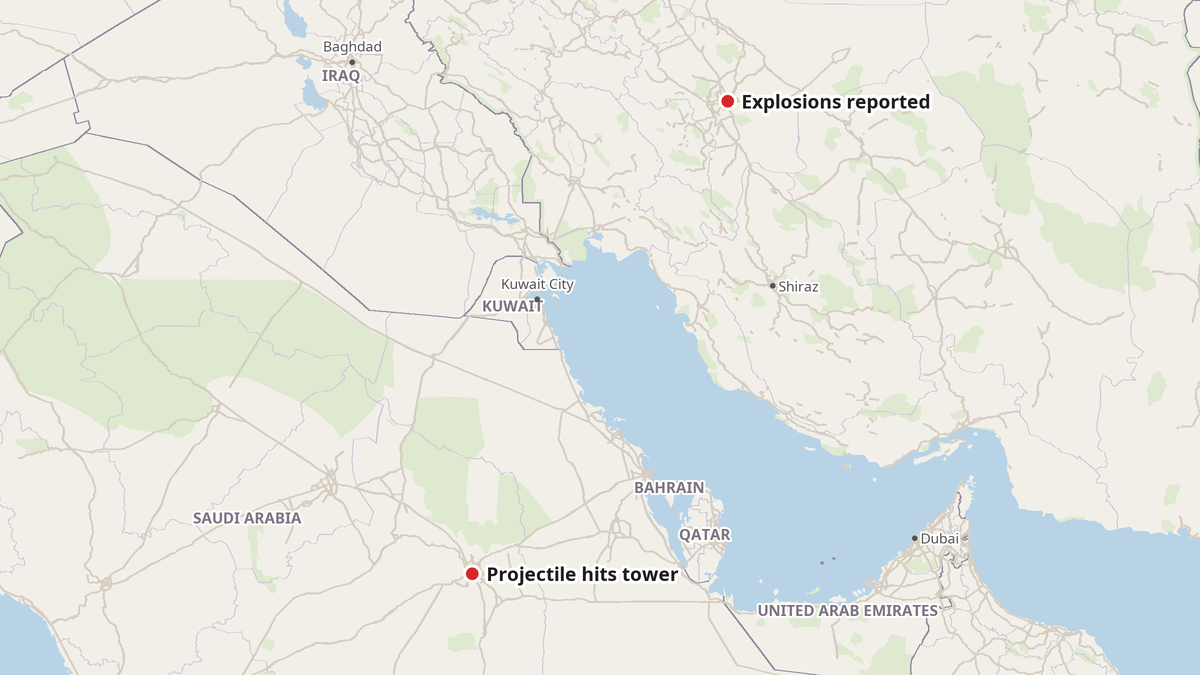
A projectile damaged a tower in Riyadh's King Abdullah Financial District on Sunday, Reuters reported, citing a witness and three people briefed on the matter. Saudi authorities didn't immediately respond to requests for comment. The report didn't identify where the projectile came from. Still, the strike on a civilian business district in a Gulf capital shows how far a war that began with US and Israeli attacks on Iran about nine months ago has spread beyond its original borders.
The Saudi-led coalition said its air defenses intercepted and destroyed two ballistic missiles launched toward Riyadh and two cruise missiles in the Riyadh and southern regions. Loud booms rolled across the capital after Saudi Civil Defense issued an early-warning alert. The agency later said the danger had passed.
The Humanitarian Picture
The sea is now a danger zone too. The UAE rescued 22 crew members from a cargo ship that caught fire in the Gulf of Oman, according to The National and Al Jazeera. The fire came after Iran's IRGC reported that two oil tankers had struck mines in the Strait of Hormuz. Mines don't distinguish between a warship and a merchant vessel, and the people aboard these ships are working sailors, not combatants.
Inside Iran, Al Jazeera cited state media describing blasts on Qeshm Island in the Strait of Hormuz and in Jask, Sirik and Bandar Abbas. Iranian media said explosions in Isfahan were related to controlled detonations. Separately, The National reported that Iran executed three men convicted of working for Israel and the US. And the US announced a plan to block Iran's land-based supply routes, expanding its months-long naval blockade of Iranian ports. The base reporting doesn't say what that will mean for ordinary Iranians, but a blockade of both sea and land routes is the kind of pressure that tends to land hardest on civilians.
Diplomatic Options
Inside Washington, the path forward is contested. The Wall Street Journal reported on November 8 that Trump's advisers remain divided over renewed strikes on Iran. Military leaders favor further operations. Vice President JD Vance and envoy Steve Witkoff are pursuing diplomacy.
Vance has led that effort, including sending a letter proposing renewed talks to Iran's security chief. The Washington Post reported that Washington has asked Beijing to help end the war, and that China has conveyed the message to Tehran. Qatar said US willingness to pursue a deal has survived the midterm elections. Its prime minister said mediation continued despite a recent slowdown, and Doha rejected reports portraying his remarks as an announcement that negotiations had failed. Iranian Foreign Minister Araghchi said he held talks with 12 foreign ministers to defuse tensions, The National reported, and the US renewed its travel warning to Americans in the region.
Voices From Tehran
The public rhetoric from Iran offers little sign of softening. Armed forces spokesman Abolfazl Shekarchi cast Trump's electoral setbacks as part of a larger story. "Political and electoral developments in the United States, and the successive defeats of the Trump administration and its allies in various arenas, are less the result of superficial fluctuations in domestic politics than a reflection of a larger, undeniable reality: defeat in the face of a powerful Iran's will," he said. He added that Washington's policies of military pressure, assassinations and threats had failed and that its threats had reached a dead end.
Lawmaker Ebrahim Azizi, a member of parliament's national security committee, said the US midterm results wouldn't affect Iran's nuclear strategy. He warned that any US or Israeli action would be met with a severe response.
Life inside Iran carries its own pressures. Hossein Shariatmadari, the supreme leader's representative at the hardline Kayhan newspaper, wrote that failing to enforce mandatory hijab rules amounted to "unwittingly siding with the enemy in the war." The Tehran oil refinery said electrical and technical problems activated its flare systems, causing dense smoke but no fire, and that fuel production continued. A group of Iranian lawmakers urged President Masoud Pezeshkian to nominate an intelligence minister. In Frankfurt, exiled prince Reza Pahlavi accepted Germany's Freedom Prize for the Iranian people on Saturday as tens of thousands rallied in the city.
Why This Matters: The war is nine months old and its edges keep widening: a damaged tower in Riyadh, mined shipping lanes, a rescued crew, an expanding blockade. Each new front puts more civilians at risk, from sailors to office workers to ordinary Iranians living under wartime pressure and executions. At the same time, the diplomatic channels are real. Vance's letter, Chinese messaging, Qatari mediation and Araghchi's calls with 12 foreign ministers all show that off-ramps exist. Whether they're used may depend on which camp inside Washington prevails, and on whether Tehran's defiant public line matches what its negotiators will accept. The gap between the two is where civilians pay.
- iran
- strait of hormuz
- us strikes on iran
- jd vance
- steve witkoff
- diplomacy
- saudi arabia
- naval blockade