
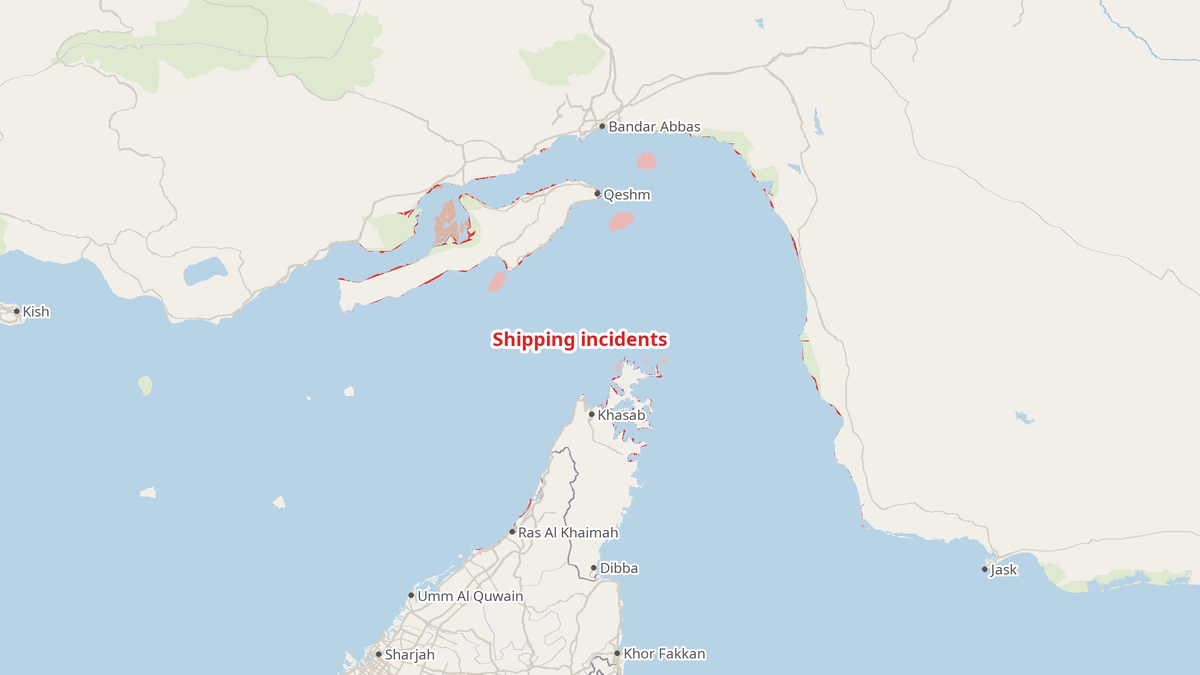
Two crude oil tankers caught fire after striking mines in the Strait of Hormuz late Sunday, Iranian state media reported. At an Iowa rally, President Donald Trump said he’d held back from striking Iran because he wanted to “save all those lives if I can.” Just hours earlier, he’d said that “at some point we’re going to have to give them the hammer.”
That contradiction hangs over the region on the eve of the US midterm elections. Diplomacy is moving in Doha. Military planning is moving everywhere else.
Mariners and Civilians in the Crossfire
The Islamic Revolutionary Guard Corps Navy said the two tankers “exploded after striking mines” while traveling on what it called an “unauthorised route.” Separately, the United Kingdom Maritime Trade Operations agency reported that two unknown projectiles hit a tanker in the Arabian Gulf at 23:47 GMT Sunday, about 72 nautical miles east of Ras Al-Khafji, Saudi Arabia. All crew were accounted for, and no environmental impact was reported. Saudi Arabia and the UAE condemned the attacks on maritime targets. Gulf nations had already condemned Friday’s attack on a Qatari LNG carrier.
US Central Command accused Iran of deliberately striking civilian infrastructure and residential neighborhoods in neighboring Gulf countries, rejecting Foreign Minister Abbas Araghchi’s denial. CENTCOM also alleged that Iranian attacks at sea had killed more than 20 civilian mariners in recent months. Independent sources haven’t verified that toll.
The conflict began February 28 and is now in its eighth month. The base reporting gives no casualty figures for people inside Iran and no account of what the fighting has meant for ordinary Iranians. That gap is part of the picture: the war’s human cost on every side remains poorly documented, even as its price at the pump becomes a campaign issue.
Trump called higher oil and petrol prices “a very small price to pay” for security. Brent crude traded around $112 a barrel Monday, after oil had exceeded $100 amid disruptions to Gulf shipments. For households in the Gulf and beyond, the strait’s closure isn’t abstract. Adipec chairman Abdulmunim Al Kindy put it plainly: “When energy flows are disrupted, the effects reach into supply chains, businesses, prices and people’s everyday lives.”
A Two-Day Plan in Doha
Iranian negotiators spent a third consecutive day in talks with Qatari mediators on November 1. Araghchi said the sides had “reached a two-day plan”: on day one, the US implements a set of measures; on day two, Hormuz reopens and transit returns to its previous state. The proposal cuts an earlier seven-day plan to 48 hours.
It’s not a deal. Araghchi said consultations were ongoing, but a definitive result “depends on the answers the opposing side gives to our questions.” Washington hasn’t publicly accepted the proposal. Iran has asked for the release of frozen assets, an end to the US naval blockade of its ports, sanctions relief and a comprehensive end to the fighting. Secretary of State Marco Rubio said Trump “hasn’t made a decision” on new strikes and added, “nor do we take any of it lightly.”
Iran’s security chief Mohsen Rezaei said he’d received a letter from Vice President JD Vance seeking to revive talks. Tehran hadn’t responded.
Pressure for Strikes After the Vote
Diplomacy is proceeding alongside military planning. Axios cited a US and an Israeli official who said Prime Minister Benjamin Netanyahu pressed Trump on Saturday for strikes immediately after the November 3 midterms, while Trump wanted negotiations to continue. The Israeli source called the call “tough”; the American source called it “direct.” Advisers told The Atlantic a new round of attacks could “come soon” after the vote.
The Jerusalem Post reported that more than 10 US military transport aircraft landed at Israeli air bases in the past week, and that US and Israeli officials disagreed about objectives. Netanyahu continued to discuss regime change; Gen. Dan Caine reportedly considered that a “pipe dream” at this stage. Trump reportedly wants a brief, possibly three-day operation. Some Israelis, including former defense minister Yoav Gallant, have argued that only a ground operation could neutralize buried highly enriched uranium.
Iranian officials are warning of a wider war. Army spokesman Mohammad Akraminia said another war could last longer than the last and extend beyond the Middle East. Revolutionary Guards spokesman Hossein Mohebbi said there would be “no geographical limitations.” Former foreign minister Manouchehr Mottaki went further: “If another war starts against Iran, it will spread to Europe.”
The UAE’s Anwar Gargash offered a sober reading from Manama: “It is not the interest of the region to go through another round.” His government is pursuing a diplomatic breakthrough while “braced for the worst.”
Why This Matters: The next 48 hours may decide whether a negotiated reopening of Hormuz or a new round of bombing comes first. Reporting suggests Iran adapted to earlier strikes, reopening damaged sites within days and shifting to smaller, more frequent attacks. That pattern points to a conflict airpower alone may not end, and one in which civilians, mariners and Gulf residents have already paid a price. International law protects civilian shipping and neighborhoods alike, but it hasn’t prevented either. A war launched, paused and threatened again on an electoral calendar leaves millions across the region waiting on decisions made far from their homes.
- iran
- united states
- strait of hormuz
- donald trump
- israel
- iran war
- nuclear negotiations
- oil prices