
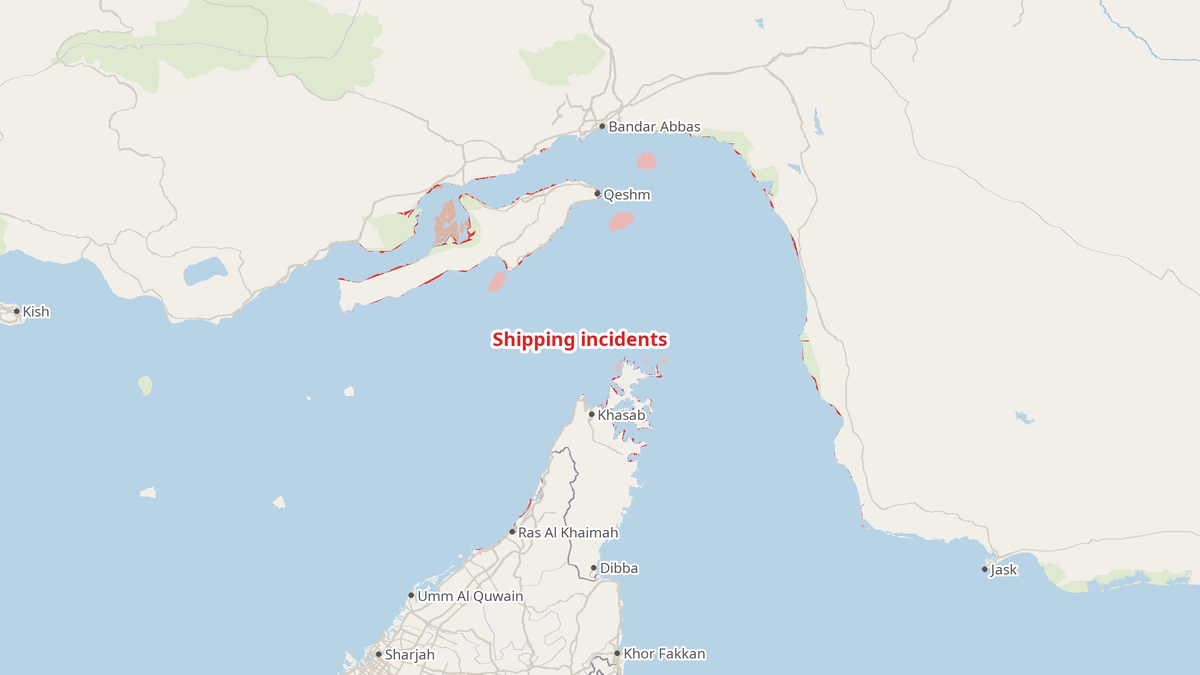
Two crude oil tankers caught fire after hitting mines in the Strait of Hormuz late Sunday, Iranian state media reported, on a route the Islamic Revolutionary Guard Corps Navy called "unauthorised." The IRGC said the vessels "exploded after striking mines." Hours earlier, the United Kingdom Maritime Trade Operations agency said a separate tanker in the Arabian Gulf was hit by two unknown projectiles about 72 nautical miles east of Ras Al-Khafji, Saudi Arabia. All crew were accounted for. Saudi Arabia and the UAE condemned the attacks on maritime targets.
The incidents landed in the eighth month of a war that began on February 28, and they came as Tehran's officials made explicit threats of a wider fight.
The Threat Picture
Iranian army spokesman Mohammad Akraminia warned that another war could last longer than the previous one and extend beyond the Middle East. Revolutionary Guards spokesman Hossein Mohebbi said there would be "no geographical limitations" to the battlefield. Manouchehr Mottaki, a former foreign minister now sitting in parliament, went further. "If another war starts against Iran, it will spread to Europe," he said. "Removing geographical limitations means our missiles will reach Europe." He accused the United Kingdom, Italy, Portugal and Germany of allowing the United States to use military bases to attack Iran.
US Central Command rejected Foreign Minister Abbas Araghchi's denials, accusing Iran of deliberately striking civilian infrastructure and residential neighborhoods in neighboring Gulf countries. CENTCOM also alleged Iranian attacks at sea had killed more than 20 civilian mariners in recent months. That toll hasn't been independently verified. Gulf states also condemned Friday's attack on a Qatari LNG carrier.
Anwar Gargash, diplomatic adviser to the UAE president, said the Emirates hoped diplomacy would succeed but was "braced for the worst." "It is not the interest of the region to go through another round," he told a conference in Manama.
Diplomacy Under Pressure
Iranian negotiators were in Doha on November 1 for a third straight day of talks with Qatari mediators. Araghchi described a revised two-day plan to reopen Hormuz: on day one, the United States implements a set of measures, and on day two the strait reopens. It shortens an earlier seven-day proposal. He conceded that no definitive agreement exists and that Washington hasn't publicly accepted it. Tehran has asked for the release of frozen assets, an end to the US naval blockade of its ports, sanctions relief and a comprehensive end to the fighting.
Iran's security chief Mohsen Rezaei said he had received a letter from Vice President JD Vance seeking to revive talks. Tehran hasn't responded.
President Donald Trump, at an Iowa rally Sunday, said he was holding back to avoid casualties. "At some point we're going to have to give them the hammer," he said, adding that Iran should make a deal or "we'll just end it." He said the US had "obliterated" Iran's nuclear enrichment capacity, navy, air force and anti-aircraft radar. Secretary of State Marco Rubio said Trump hadn't decided on new strikes and preferred a diplomatic resolution.
Washington and Jerusalem Differ on Aims
Axios cited one US and one Israeli official saying Prime Minister Benjamin Netanyahu pressed Trump on Saturday for strikes immediately after the November 3 midterms, while Trump wanted negotiations to continue. The Israeli source called the call "tough"; the American source called it "direct."
The Jerusalem Post reported a deeper split over objectives. Netanyahu continues to discuss regime change, with Mossad Director Roman Gofman working on plans to advance it, according to sources. The IDF's focus was described as reducing specific threats. Gen. Dan Caine, the Joint Chiefs chairman, considers regime change a "pipe dream" at this stage. Trump reportedly wants a brief, possibly "clean" three-day operation, a prospect the Post said worries some US officials.
The military problem is concrete. Pickaxe Mountain, a suspected underground nuclear complex, isn't yet operational, but the Post said it's unclear whether Israeli or US aircraft could destroy it even with 30,000-pound bunker-busters. It sits deeper than Fordow, which took 12 Massive Ordnance Penetrator bombs. The Institute for Science and International Security warned that if Iran moved highly enriched uranium and centrifuges there and made it operational, it could potentially produce a weapon without detection or any means of stopping it from the air.
Iran has also adapted. After strikes caused cave-ins at underground missile facilities in early 2026, Iranian bulldozer crews reopened areas within days, sometimes in under a day. Tehran dispersed missile crews, shifted to smaller and more frequent attacks, and in early 2026 destroyed US bases in several countries, causing at least $5 billion in damage.
The Economic Squeeze
Brent crude traded near $112 a barrel Monday and West Texas Intermediate near $102 as Iran-Qatar talks continued. Trump called higher fuel prices "a very small price to pay" and said they'd fall "very, very shortly." The Jerusalem Post reported that Trump and non-military advisers worry another round of fighting could hurt Republicans at the polls. The Atlantic reported advisers say new attacks could "come soon" after the midterms. Adipec chairman Abdulmunim Al Kindy called the moment "quite possibly the most consequential in a generation."
Why This Matters: Iran's officials are openly threatening European capitals while their naval forces mine a waterway that carries a major share of the world's oil. That's the behavior of a state that believes it can set the terms of any settlement. A deal that reopens Hormuz but leaves buried enriched uranium and an unfinished underground complex untouched would leave the central threat in place, and Washington and Jerusalem don't yet agree on what the military goal even is. The Gulf states most exposed to Iranian fire are preparing for the worst while hoping for the best. From a security standpoint, the question isn't whether to talk but whether any agreement can be verified against a regime that has repeatedly rebuilt what was destroyed within days.
- iran
- united states
- strait of hormuz
- donald trump
- israel
- iran war
- nuclear negotiations
- oil prices