
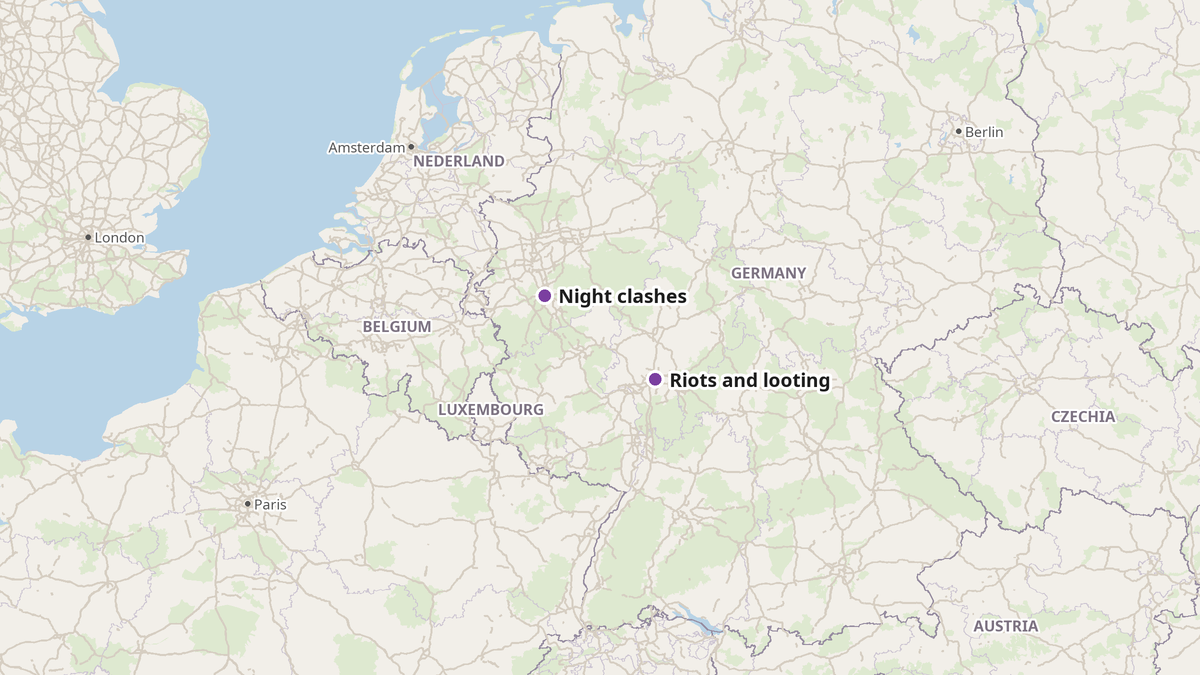
More than 100 police officers were injured in Frankfurt on Saturday night when hooded rioters attacked them with Molotov cocktails, looted stores and smashed shop windows after a youth demonstration, Hesse's interior minister Roman Poseck said on Sunday. Fifty-four people, aged between 13 and 29, were arrested.
The unrest followed a day of largely peaceful protest. More than 100,000 mostly young people marched across Germany on Saturday, October 31, demanding more public money for education, housing and climate protection, and lower living costs. The youth initiative "Gen Z regelt" — roughly "Gen Z's got this" — put the turnout at 120,000, according to bne IntelliNews. Marchers also opposed spending cuts, crumbling schools and any return to compulsory military service.
What Happened in Frankfurt
Frankfurt was the main flashpoint. Poseck told a press conference that hooded rioters damaged 17 stores, five of which were looted. Police deployed 1,300 officers and used water cannon. Frankfurt police described "violent riots", with rocks and bottles thrown at emergency services alongside the petrol bombs. Authorities sealed off Die Zeil, the city's main shopping street. One person suspected of breaking into a gun store and stealing two weapons was arrested, and the weapons were recovered.
"I am shocked by what I have seen, and there is no point in sugar-coating it. Let me make this very clear: Things cannot go on like this," Poseck said.
He said most of those arrested were German nationals, but added that police estimate they are dealing with between 1,000 and 1,500 violent troublemakers, "predominantly from an immigrant background". Hesse governor Boris Rhein said the violence "will not go unpunished" and that anyone behaving like the attackers "places themselves outside our society". The situation calmed by early Sunday morning after police cordoned off the city centre.
Violence Beyond Hesse
Disorder spread to other cities. Police used water cannon in Cologne. In Berlin, protesters attacked officers with bottles and pyrotechnics. In Hamburg, police said they were "repeatedly pelted with stones, fireworks and other objects" before organisers called the march off early.
Federal Interior Minister Alexander Dobrindt of the Christian Social Union promised consequences. "I expect there to be severe penalties. We are not prepared to accept, in the slightest, that such incidents and such rioting should take place here," he told reporters. He told Bild that the rioters and looters "will be identified and held accountable".
Dobrindt accused "violent left-wing groups and troublemakers from the immigrant community" of hijacking peaceful demonstrations. Reuters noted he gave no evidence for the claim and did not say which groups had joined the marches. He said a strategy built on a large security presence across multiple locations had proved effective, and that border controls had been tightened before the protests over fears that extremist groups from abroad could exploit them.
The Organisers' Response and the Political Backdrop
"Gen Z regelt" distanced itself on Instagram from "any form of violence, as well as violent acts by other groups or individuals" who were not part of the demonstrations.
The grievances run through current budget politics. Germany's new military service law, passed in December 2025, is bringing compulsory service back step by step, and school students walked out in more than 100 cities against it in September, bne IntelliNews reported. Chancellor Friedrich Merz told the Bundestag on October 14: "Not a single euro that flows to Ukraine is being diverted from social spending and education spending in our country." The German rallies followed similar youth-driven demonstrations in France, which helped inspire rallies in Portugal, Italy and Germany.
Why This Matters:
Public order is the baseline of state authority, and Saturday night tested it in four of Germany's largest cities. Hesse's own police assessment — that 1,000 to 1,500 violent troublemakers were mostly from an immigrant background — puts integration and public security back on the national agenda, though Dobrindt's wider claims came without supporting evidence. The political test for Berlin is twofold: follow through on the promised prosecutions, and answer the budget grievances that drew 100,000 young people onto the streets peacefully. With conscription returning and Merz insisting Ukraine aid isn't squeezing domestic spending, the government now has to prove both claims, to a generation that doubts them.
- gen z protests
- germany
- frankfurt
- riots
- police
- protests
- military service
- alexander dobrindt