
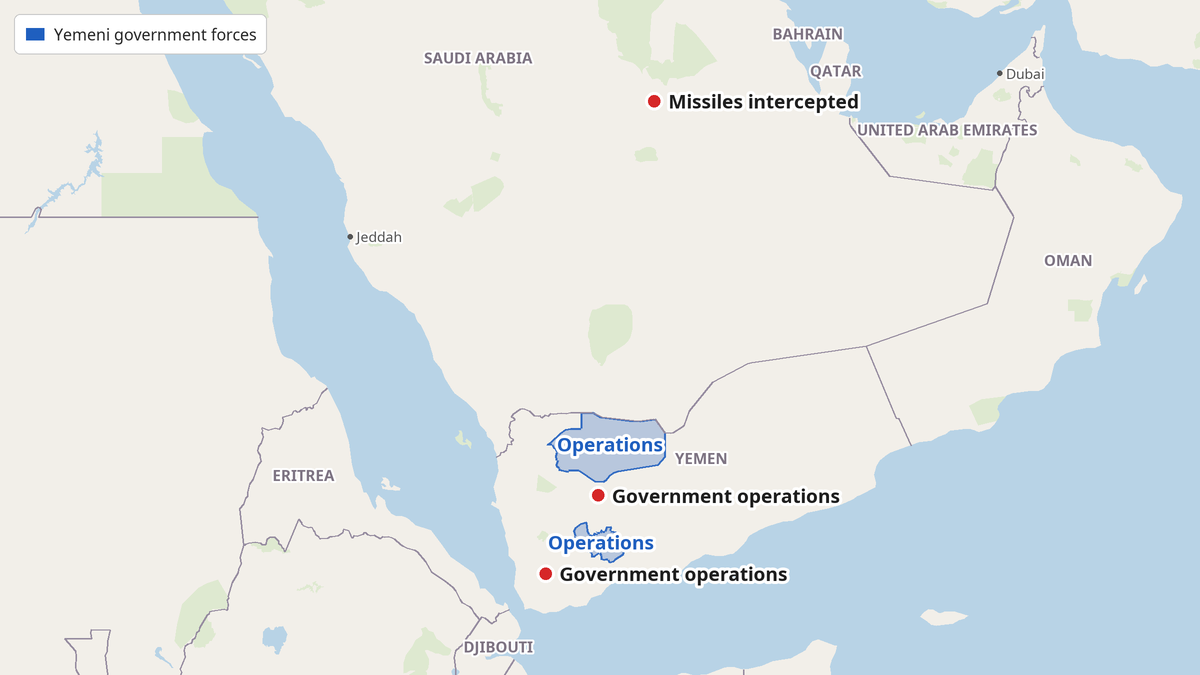
Seven hundred seventy-three artillery bombardments. Forty-four drone strikes. Thirty-seven rocket attacks. Twenty-three air strikes. That's the daily tally Yemen's Saudi-backed government forces posted on X on Wednesday, courtesy of spokesperson Majed Abdullah al-Nuzaili, who counted it all as a productive day's work. By his figures, the barrage killed and wounded 138 Houthi fighters and damaged 86 heavy weapons and military vehicles.
Read the number again. One hundred thirty-eight fighters, killed and wounded lumped together, in a single sum. The spokesperson didn't say how many of each. He didn't say who else was standing near the 86 damaged vehicles. And operations, al-Nuzaili added, continue in al-Jawf, Marib, al-Bayda, Taiz and the southern sectors. That's a lot of map for a government that needs a Saudi sponsor to hold it.
The Apparatus Keeps Score
Notice the format. A military communiqué on a social media platform, structured like a quarterly earnings report: inputs on one side, enemy losses on the other, a closing line promising more. The war arrives as a spreadsheet. Whoever lives in those districts doesn't appear in it.
The other side of the ledger isn't any gentler. Middle East Eye reported separately that the Houthis, who are aligned with Iran, are bombing Saudi Arabia while they look to extend their territory in Yemen. Territory is the operative word. Ansar Allah, "Supporters of God" in Arabic, wants more ground to govern, which is the same ambition the internationally recognised government and its Riyadh patrons hold. Two armies, two chains of command, one shared objective: control of the people who live under the shells.
Tehran Offers a Seat at the Table
Then came Mohammad Bagher Ghalibaf, Iran's parliament speaker and top negotiator, speaking to Al Jazeera. On the fighting between the Saudi-backed government forces and the Houthis, he said "no one should interfere." Then he added: "If both the government in Yemen and Saudi Arabia were to ask for our help, we would certainly offer our assistance to help resolve their conflict."
Sit with that for a moment. The patron of one party announces that nobody should interfere, then volunteers to help. Iran previously offered to facilitate talks between Saudi Arabia and the Houthis in October, about one month ago, following a series of deadly attacks on the kingdom. The pitch is always the same. The fire brigade is also selling the matches, and it'd be glad to mediate if everyone would just sign here.
Who Gets Counted
The base reporting contains no figure for civilian casualties. It contains no quote from anyone living in Marib or Taiz, no testimony from a family near an artillery position, no word from a humanitarian group or a local committee. Every voice in the record belongs to a spokesperson, a speaker of parliament, or a news outlet relaying their claims. The people on the receiving end are present only as arithmetic: the wounded, the killed, the damaged.
This is how state violence gets reported when the reporters have no one else to call. A government posts its numbers. A rival power posts its offers. A wire service passes both along. The 773 bombardments land somewhere, on someone, and the people there never get a statement of their own.
Only one mention of talks appears in the record, and it comes from a power that wants to be the broker. No ceasefire, no resolution, no enforcement, no one who answers to the people under the artillery. The fighting continues across five fronts. The communiqués will keep coming, each one tidier than the last.
- houthis
- yemen
- saudi arabia
- yemeni government forces
- iran
- mohammad bagher ghalibaf
- majed abdullah al-nuzaili
- military strikes