
More than 333,000 people have been displaced in Yemen since the start of August, including over 24,000 in the past week alone, the UN Office for the Coordination of Humanitarian Affairs said. The figure lands as the Houthis claim fresh strikes on Saudi oil and military sites and the Security Council demands they stop.
Those numbers describe families on the move in a country where a UN-brokered truce, reached four years ago, had largely frozen the fighting. It no longer holds. Hostilities resumed in July, about four months ago, and the war is now tangled up with a far wider regional conflict that began in February, when the US and Israel attacked Iran. The conflict is now in its ninth month.
The Humanitarian Picture
The displacement data is the clearest measure of what the renewed fighting costs ordinary Yemenis. OCHA's count runs from the beginning of August, meaning most of those 333,000 people fled after the truce collapsed. The latest weekly tally of 24,000 shows no sign the flow is slowing.
The Security Council took that into account on Thursday. It voted unanimously to extend Yemen-related sanctions for a year, including asset freezes and travel bans, and extended the mandate of the UN Panel of Experts on Yemen. The measures, the council said, "shall not apply to humanitarian assistance or supplies for basic needs of civilians, without negatively affecting legitimate trade activities."
Escalation on the Saudi Front
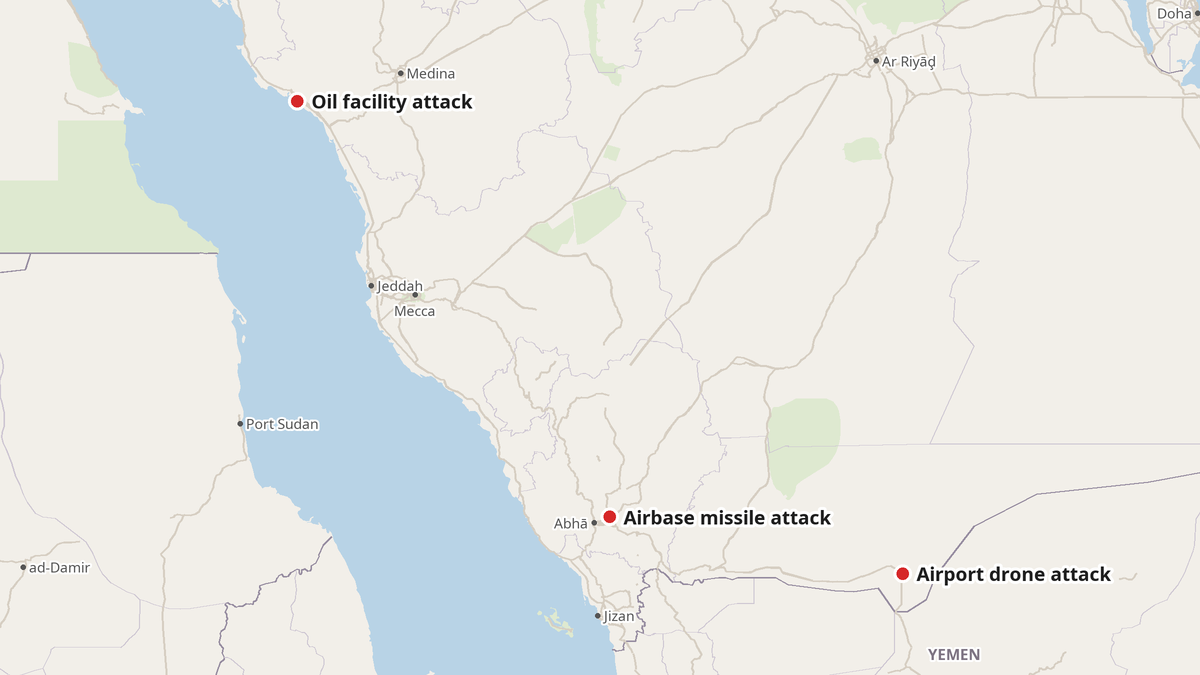
Houthi military spokesperson Yahya Saree said in a post on X that the group targeted Pumping Station No. 7 on the Saudi East-West oil pipeline with a drone and the Yanbu oil facility with a ballistic missile. He also claimed strikes on Sharurah airport and Khamis Mushait airbase, saying a missile there "scored a direct hit." He said Saudi Aramco's headquarters in Riyadh was targeted too, though no damage was immediately reported. The Houthis did not say which day the attacks took place, and Saudi Arabia did not immediately respond to a request for comment.
The Saudi-led coalition said it intercepted and destroyed two drones, one over the Riyadh region and one in the Eastern Province. On Wednesday night it reported destroying two ballistic missiles aimed at western Saudi Arabia, plus two more drones in the south and around Mecca. Saudi civil defence said missile debris fell in the village of Sabouha, about 35 kilometres (22 miles) from the holy city. Saree rejected the Mecca claim as a "grave falsehood." The Houthis have repeatedly denied targeting Mecca and Medina.
The stakes reach well beyond Yemen's borders. Riyadh says it has rerouted about 4 million barrels of crude a day through the East-West pipeline to Yanbu, roughly 4% of global supply. That pipeline has shielded Saudi Arabia, the world's biggest exporter, from the worst of the wartime shutdown of the Strait of Hormuz. It is also a repeated Houthi target. On Monday Saudi Arabia said an attack sparked a fire but did not affect operations. The escalation also threatens the Bab el-Mandeb Strait, a key shipping route linking the Red Sea and the Gulf of Aden.
Diplomatic Options
The council's resolution condemned the Houthis' military escalation, their cross-border and maritime attacks on Saudi Arabia, and their threats to commercial shipping. It called on "all parties to refrain from escalatory actions and to resolve differences and disputes through negotiation," and backed the territorial integrity of both Saudi Arabia and Yemen.
China's ambassador, Fu Cong, framed the sanctions narrowly. "The council sanctions are merely a means, not an end in themselves," he said, expressing hope that "the situation in Yemen will de-escalate as soon as possible." Separately, Saudi Foreign Minister Faisal bin Farhan Al Saud discussed the attacks and de-escalation efforts with Chinese Middle East envoy Zhai Jun, according to Al Jazeera.
A quieter dispute is playing out in Europe. Saudi Arabia is pressing the European Union to adopt a Parliament resolution designating the Houthi movement a "terrorist organisation," Reuters reported, citing sources. European officials told Reuters they worry such a move could undermine a future peace process. EU spokesperson Anouar El-Anouni said the bloc is in regular contact with Riyadh but declined to discuss specifics.
Britain has chosen a security-first line. Minister of State for the Middle East Stephen Doughty told Asharq Al-Awsat the attacks were appalling and that firing missiles and drones at airports and places where civilians live and work was unacceptable. He said Britain has deployed air-to-air refuelling aircraft, fighter jets and military advisers to support Saudi defensive operations, and that Saudi Arabia has the right to defend itself.
On the ground, the Saudi-backed side insists it is advancing. Yemen's Defence Ministry, citing the Presidential Leadership Council, said the battle against the Houthis was moving toward its "desired objectives," per the Saba news agency. A ministry meeting in Marib governorate reviewed operations, including coordination among units in the Dawn of Yemen offensive.
Why This Matters: The war began in 2014 when the Houthis seized Sanaa, and Saudi Arabia intervened the following year, 11 years ago now. A truce bought four years of relative calm. Its collapse is now measured in people: more than 333,000 uprooted since August. The diplomatic record shows a gap between what the Security Council demands and what exists on the ground. Sanctions carve out humanitarian aid, and European officials are weighing whether a terrorist designation would close the door on talks. With Saudi oil exports now routed through a pipeline the Houthis keep hitting, and a key shipping lane under threat, the fighting's costs spread beyond Yemen's civilians. Yet it is those civilians, with no say in the escalation, who are paying first.
- houthi
- saudi arabia
- aramco
- east-west pipeline
- yemen
- drone attacks
- un security council
- yanbu