
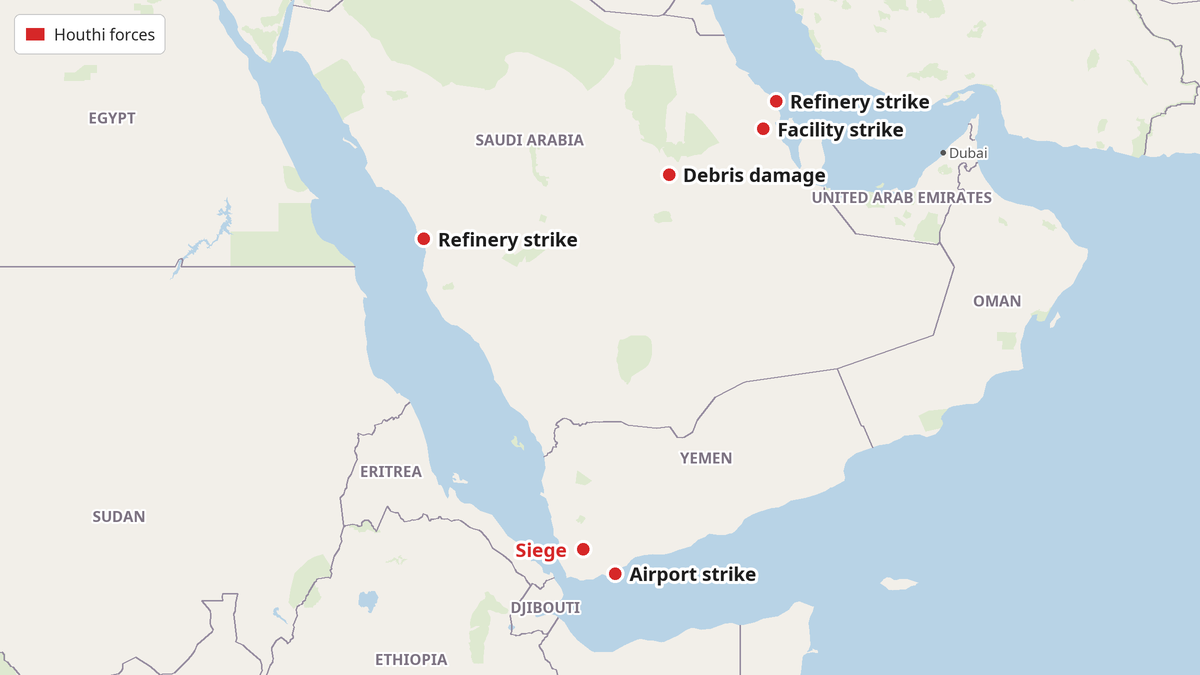
More than 800,000 people in and around Taiz remained cut off from food and other life-saving aid as the United Nations said Houthi detentions of 71 U.N. staff had made humanitarian operations in parts of Yemen under Houthi control “untenable.” On Friday, Yemen’s Houthi forces also claimed six attacks on Saudi airports, oil facilities and a military position, while Saudi air defenses intercepted ballistic missiles fired toward Riyadh. Across front lines and command structures, civilians faced the consequences.
Missiles and official accounts
Houthi spokesperson Yahya Saree said in a statement posted on X that the attacks targeted the Ras Tanura oil refinery, an Aramco facility in Abqaiq, King Khalid International Airport in Riyadh, King Fahd International Airport in Dammam, the Rabigh oil refinery and a Saudi military headquarters in the Najran region. The group said the attacks responded to recent Saudi strikes on Houthi-held areas.
The claims about disrupted air traffic in Dammam and casualties among soldiers and officers in Najran were reported by Gulf News, which identified the spokesman as Yahya Sarea and said his televised statement aired on Houthi-run al-Masirah TV. Al Jazeera reported no independent corroboration of the Houthi claims and no Saudi confirmation of strikes on the six sites.
The Saudi-led coalition said its air defenses intercepted and destroyed two ballistic missiles fired toward Riyadh on Thursday evening. Coalition spokesman Turki al-Maliki gave that account. Saudi Civil Defence said shrapnel wounded one Saudi citizen and damaged a house and a vehicle in the capital. Warnings about potential threats had been issued in Riyadh and Al-Kharj governorates and in Najran city; Arab News reported that the danger was declared over about 20 minutes later.
The coalition said on Wednesday that it intercepted and destroyed a ballistic missile launched toward Taif. On Tuesday evening, debris from two intercepted ballistic missiles damaged a building, a construction project and a vehicle in Riyadh. Gulf News also reported the coalition’s earlier statement that Saudi air defenses intercepted three Houthi ballistic missiles, two aimed at Riyadh and one at the Eastern Province.
Taiz: aid behind the lines
Shirin Yaseen, associate spokesperson for U.N. Secretary-General Antonio Guterres, said the detentions “directly affect millions of people in need.” Some detainees had been held for years, their families without news of their fate; “We have cases of people who died in detention,” she said. The Houthis accuse detainees of espionage without providing evidence, and the U.N. rejects the accusation.
Yaseen said releasing detainees alone wouldn’t resolve the humanitarian crisis. “What we need is more: we need access, we need the fighting to stop, and we need humanitarians to get into these areas and deliver to those who need it, wherever they need it.” The U.N. has no presence inside Taiz city and relies on Yemeni aid workers working with local and international nongovernmental organizations. The World Food Programme estimated that about three-quarters of the more than 800,000 people cut off in Taiz depended on humanitarian assistance.
The Houthis intensified the siege in early October after taking the road connecting Taiz with Aden, the seat of Yemen’s internationally recognized government. Taiz has been under varying degrees of Houthi siege since 2015. The U.N.’s human rights chief, Volker Turk, warned of a looming catastrophe unless aid was allowed in. Asked about Human Rights Watch’s assessment that the blockade might amount to a war crime, Yaseen declined to give a legal characterization.
Diplomacy, without access
The conflict dates to late 2014, when the Houthis seized Sanaa and much of northern Yemen; the Saudi-led coalition intervened in 2015 in support of the Yemeni government. The two sides have exchanged cross-border attacks in recent weeks. Gulf News reported that the Houthis said 27 people were killed in Saudi airstrikes on Houthi-held areas. Arab News said a missile strike on King Khalid Airport on Oct. 10 killed 13 travelers and injured more than 300.
Meanwhile, Saudi Arabia, Turkiye and Pakistan sent senior representatives to a meeting with Iran earlier in the week. An Iranian press release carried by Fars said participants agreed to continue discussions to strengthen cooperation among the four regional countries. Saudi Arabia’s foreign ministry stressed “the importance of opening channels of negotiation to prevent a return to military escalation.”
Yemen’s internationally recognised government called on the U.N. Security Council to take “deterrent and punitive measures” over Houthi attacks on Aden International Airport. The U.N. special envoy for Yemen, Hans Grundberg, also held talks in Moscow with Russian deputy foreign minister Alexander Alimov and other senior officials about developments and prospects for a political settlement. In Taiz, Yaseen said, talks continue. Aid access and the fighting remain the immediate obstacles.
- houthi attacks
- saudi arabia
- yemen
- ballistic missiles
- riyadh
- saudi-led coalition
- humanitarian aid
- taiz