
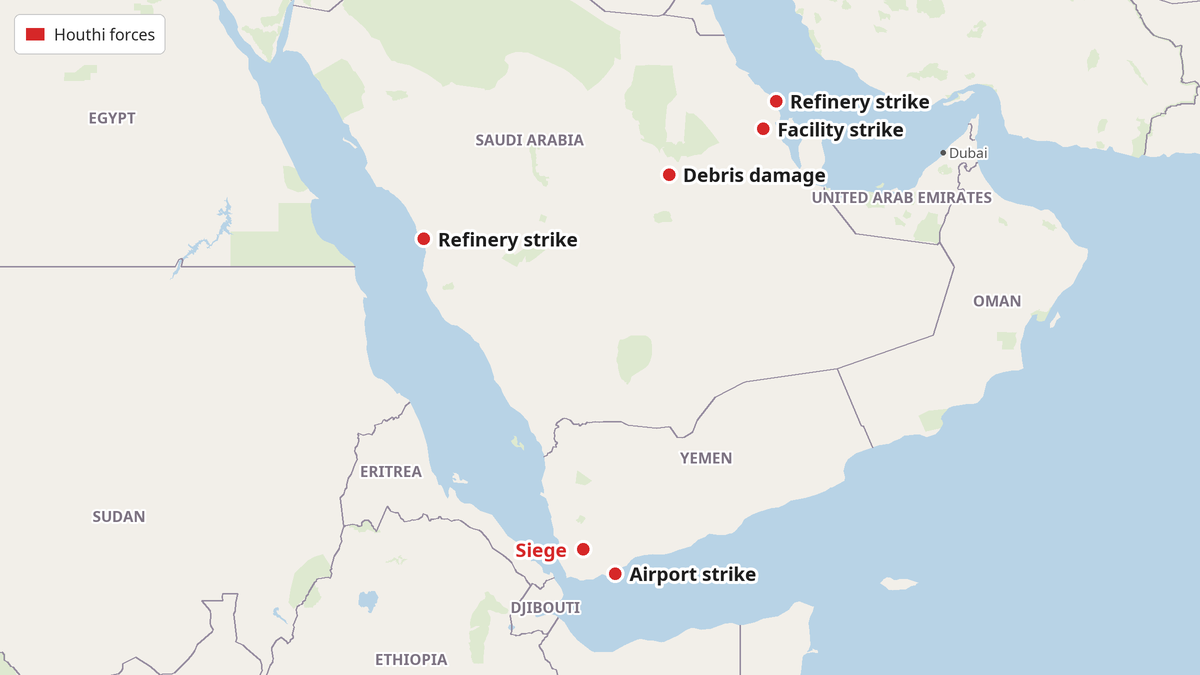
More than 800,000 people in and around the besieged city of Taiz remain cut off from food and other life-saving aid, the United Nations said, even as Houthi missiles and Saudi interceptors dominated the headlines on Friday. About three-quarters of those trapped depend on humanitarian assistance, according to the World Food Programme.
The siege tightened in early October, when Houthi forces took the road linking Taiz with Aden, the seat of Yemen's internationally recognized government. Taiz, Yemen's third-largest city, has been under varying degrees of Houthi siege for more than 10 years. Human Rights Watch said the Houthis were depriving civilians there of essential food, water and medicine in an action that may amount to a war crime. The U.N.'s human rights chief, Volker Turk, warned of a looming catastrophe unless aid is allowed in.
The Humanitarian Picture
The U.N. has no presence inside Taiz city. It relies on Yemeni aid workers, who work with local and international nongovernmental organizations. And across Houthi-held territory, the U.N. says its own operations have become "untenable" because the group has detained 71 U.N. staff.
Shirin Yaseen, associate spokesperson for Secretary-General Antonio Guterres, told Arab News the arbitrary detentions "directly affect millions of people in need." She said some detainees have been held for years, their families without news of their fate. "We have cases of people who died in detention," she said. The Houthis accuse the detainees of espionage without providing evidence. The U.N. rejects the accusation.
Yaseen was careful not to overstate what a prisoner release would achieve. It would "make a huge difference" to the detainees and lift colleagues' morale, she said, but access and ongoing fighting remain the core obstacles. "I wish that there was a simple answer to this question but it's not, honestly, black and white," she said. "What we need is more: we need access, we need the fighting to stop, and we need humanitarians to get into these areas and deliver to those who need it, wherever they need it." Asked whether the Taiz blockade amounts to a war crime, she declined to offer a legal label. "I'm not a legal expert," she said. "But I know what we want: We want the parties to stop fighting and the people who are in need of aid to get that aid."
Missiles Over Riyadh
The cross-border exchange added to the strain. Houthi spokesperson Yahya Saree said in a statement on X that the group had attacked six Saudi targets: the Ras Tanura oil refinery, an Aramco facility in Abqaiq, King Khalid International Airport in Riyadh, King Fahd International Airport in Dammam, the Rabigh oil refinery and a military headquarters in the Najran region. The group said the strikes answered recent Saudi attacks on Houthi-held areas. Al Jazeera reported no independent corroboration of the claims and no Saudi confirmation that the six sites were hit.
Saudi-led coalition spokesman Turki al-Maliki said air defenses intercepted two ballistic missiles fired toward Riyadh on Thursday evening. Saudi Civil Defence said one Saudi citizen was wounded by shrapnel, and a house and a vehicle were damaged. Arab News described the wounds as minor. On Tuesday evening, debris from two other intercepted missiles damaged a building, a construction project and a vehicle in the capital. Arab News also reported that a missile strike on Riyadh's King Khalid Airport on Oct. 10 killed 13 travelers and injured more than 300.
Civilians in Yemen are also paying. Gulf News reported that the Houthis said 27 people were killed in Saudi airstrikes on Houthi-held areas. The claim is unverified in the base reporting, and the two sides have traded cross-border attacks in recent weeks. Yemen's government separately asked the Security Council to take "deterrent and punitive measures" to stop Houthi attacks on Aden International Airport.
Diplomatic Options
There were signs of diplomacy elsewhere. Iran's security chief, Mohsen Rezaei, hosted a meeting in Tehran with Saudi Defence Minister Khalid bin Salman, Pakistan's army chief Asim Munir and Turkish intelligence chief Ibrahim Kalin. The meeting concluded Monday, and participants agreed to keep talking. Saudi Arabia's foreign ministry stressed "the importance of opening channels of negotiation to prevent a return to military escalation."
U.N. special envoy Hans Grundberg, meanwhile, finished a visit to Moscow, where he discussed prospects for a political settlement with Russian deputy foreign minister Alexander Alimov. Yaseen said Grundberg stressed that coordinated regional and international support was "indispensable" to a comprehensive settlement.
Why This Matters: The conflict that began when the Houthis seized Sanaa in late 2014, more than 11 years ago, is again spilling across borders, but the heaviest burden is falling on people with no say in it: hundreds of thousands in Taiz cut off from food and medicine, and detained aid workers whose families wait for news. Missile exchanges and interceptions draw the headlines, yet the U.N. keeps returning to the same unglamorous demands: access, an end to fighting, and respect for international humanitarian law. Regional talks in Tehran and Moscow offer a thin channel for de-escalation. Whether they reach Taiz is the open question.
- houthi attacks
- saudi arabia
- yemen
- ballistic missiles
- riyadh
- saudi-led coalition
- humanitarian aid
- taiz