
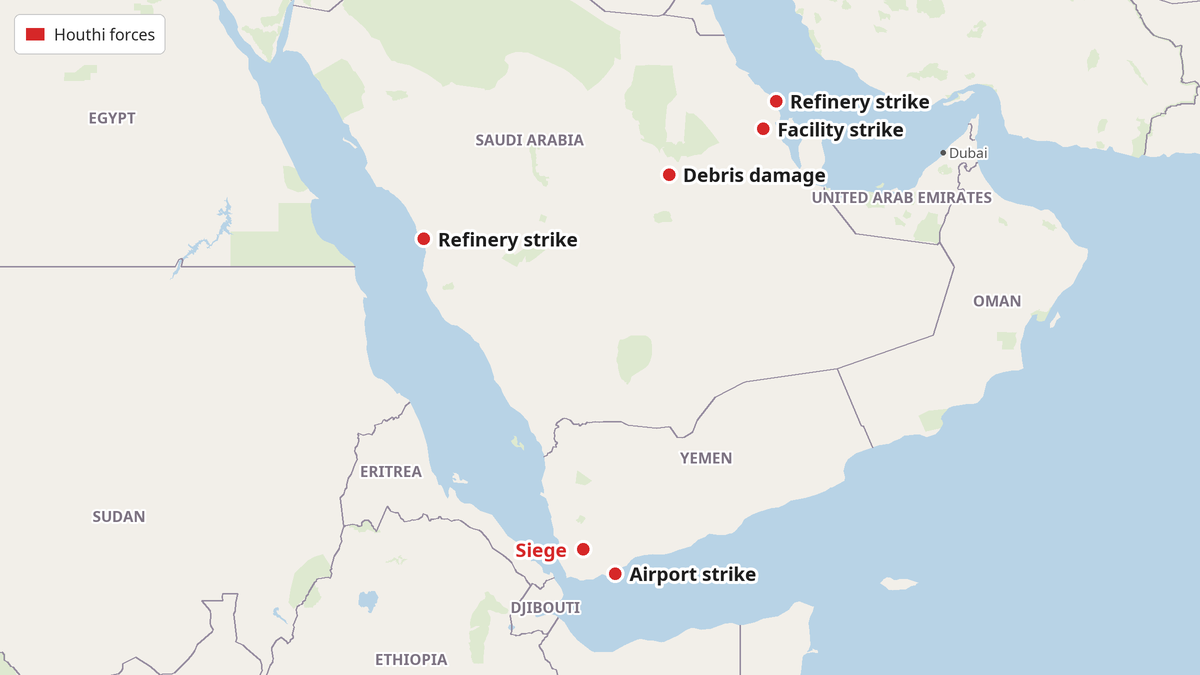
Yemen’s Houthi forces claimed six attacks on Saudi airports, oil facilities and a military position on Friday, while Saudi air defenses intercepted ballistic missiles fired toward Riyadh. Shrapnel wounded one person in the capital and damaged a house and a vehicle, Saudi Civil Defence said.
The claims named airports and energy infrastructure as targets. Al Jazeera said it had no independent confirmation of the Houthi claims, and Saudi Arabia hadn’t confirmed that the six sites were struck.
Airports and Oil Facilities Named as Targets
Houthi spokesperson Yahya Saree said the attacks targeted the Ras Tanura oil refinery with a ballistic missile, an Aramco facility in Abqaiq with a missile, and King Khalid International Airport in Riyadh with multiple missiles. He also named King Fahd International Airport in Dammam, the Rabigh oil refinery and a Saudi military headquarters in the Najran region.
The Houthis said a drone attack disrupted air traffic at the Dammam airport and that the Najran attack caused casualties among soldiers and officers. Gulf News reported those claims and identified the spokesman as Yahya Sarea, saying his televised statement aired on Houthi-run al-Masirah TV. The group said the attacks answered recent Saudi strikes on Houthi-held areas.
The Saudi-led coalition said its air defenses intercepted and destroyed two ballistic missiles fired toward Riyadh on Thursday evening. Coalition spokesman Turki al-Maliki gave that account. Saudi Civil Defence said shrapnel wounded a Saudi citizen and damaged a house and vehicle. Arab News described the injuries as minor and reported that authorities issued warnings in Riyadh and Al-Kharj governorates and in Najran city before declaring the danger over about 20 minutes later.
The coalition said on Wednesday that it intercepted and destroyed a ballistic missile launched toward Taif. On Tuesday evening, debris from two intercepted ballistic missiles damaged a building, a construction project and a vehicle in Riyadh. Gulf News also reported an earlier coalition statement that Saudi air defenses intercepted three Houthi ballistic missiles, two aimed at Riyadh and one at the Eastern Province.
Civilian Risks and the Taiz Siege
Arab News reported that a missile strike on Riyadh’s King Khalid Airport on Oct. 10 killed 13 travelers and injured more than 300. It said weeks of attacks had targeted airports, energy infrastructure and cities across the kingdom, and that the attacks prompted international condemnation of the Houthis.
The cross-border attacks come amid a prolonged conflict. Yemen’s conflict dates to late 2014, when the Houthis seized Sanaa and much of northern Yemen; the Saudi-led coalition intervened in 2015 to support the Yemeni government. The two sides have exchanged attacks in recent weeks. Gulf News reported the Houthi claim that Saudi airstrikes on Houthi-held areas in Yemen killed 27 people.
The Houthis have also tightened their siege of Taiz. The United Nations said detentions of 71 U.N. staff made humanitarian operations in areas controlled by the group “untenable,” while more than 800,000 people in and around besieged Taiz remained cut off from food and other life-saving aid. The World Food Programme estimated about three-quarters of those people relied on humanitarian assistance.
Regional Diplomacy and Humanitarian Access
Shirin Yaseen, associate spokesperson for U.N. Secretary-General Antonio Guterres, said the detentions “directly affect millions of people in need.” She said the U.N. was pressing for the Houthis to release its personnel, former staff, civil society workers and diplomatic mission employees. Some detainees had been held for years, with their families receiving no news of their fate. “We have cases of people who died in detention,” Yaseen said.
Yaseen said releasing detainees alone wouldn’t resolve the crisis, citing the need for aid access and an end to fighting. The U.N. has no presence inside Taiz city and relies on Yemeni aid workers who work with local and international nongovernmental organizations. The Houthis accuse detainees of espionage without providing evidence; the U.N. rejects the accusation. U.N. human rights chief Volker Turk warned of a looming catastrophe unless aid was allowed in.
The Houthi announcement also came amid diplomacy in Tehran. Saudi Arabia, Turkiye and Pakistan sent senior representatives to a meeting with Iran that concluded on Monday. A Fars-carried Iranian press release said participants agreed to continue discussions to strengthen cooperation among the four regional countries. Saudi Arabia’s foreign ministry stressed “the importance of opening channels of negotiation to prevent a return to military escalation.”
- houthi attacks
- saudi arabia
- yemen
- ballistic missiles
- riyadh
- saudi-led coalition
- humanitarian aid
- taiz