
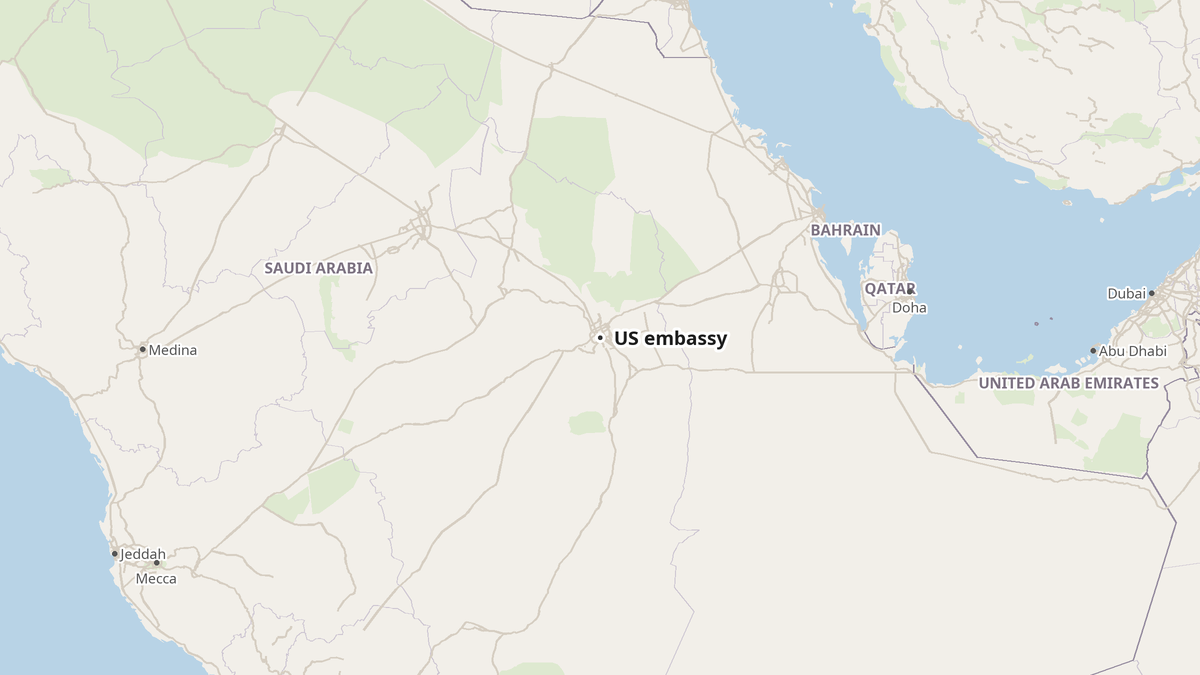
The United States ordered non-emergency government employees and their family members to leave Saudi Arabia effective October 23, the US embassy in Riyadh said on Friday, citing Houthi attacks on civilian airports and other critical infrastructure.
Eight days after that departure order took effect, the facts on the ground are plain. Iran's Yemeni proxy is striking airports, a presidential palace complex and, by the coalition's account, launching drones toward one of Islam's holiest cities.
The Terror Threat
The embassy didn't soften its language. US government employees now require special authorization to use Saudi airports following what it called recent missile and drone attacks. It warned American citizens to expect potential further attacks, airspace closures, flight cancellations and other travel disruptions.
The targets are civilian. On October 8, 2026, 23 days before today, smoke and flames rose from King Khalid Airport in Riyadh after Yemen's Iran-backed Houthis said they had attacked it. A social media video screengrab captured the aftermath. The Houthis claimed the strike themselves.
Airports are where pilgrims, workers and families arrive and depart. They aren't military bases. The embassy's own warning treats the risk to ordinary air travel as serious enough to pull dependents out of the country.
Iran's Proxy Network
The base reporting describes the Houthis as Iran-aligned and Iran-backed. It also places the Yemen fighting inside a larger frame: the clashes between the Houthis and the Saudi-led coalition backing Yemen's government have intensified in recent weeks, opening what the report calls a volatile new front in the wider US-Israeli war on Iran.
That framing matters. This isn't a stand-alone Yemeni dispute. It's one more front opened by a proxy tied to Tehran, widening a war that already involves the United States and Israel on one side and Iran on the other.
Yemen's government armed forces spokesperson said the Houthis attacked Aden airport and the Maashiq presidential palace complex with ballistic missiles. The statement gave no details on casualties, damage, or whether the missiles hit their intended targets. Those gaps remain unanswered.
Holy Sites in the Crosshairs
The Saudi-led coalition said it intercepted and destroyed a drone launched by the Houthis over Saudi Arabia's Medina region. Medina is home to one of Islam's holiest sites and is visited by millions of Muslim pilgrims each year.
A drone aimed at that region puts millions of worshippers within range of an Iranian-backed militia's weapons. The coalition says its air defenses stopped this one. The embassy's warning of further attacks suggests Washington doesn't expect it to be the last.
What Washington's Order Signals
An ordered departure is not a routine advisory. It removes non-emergency personnel and their families from a country the United States counts as a partner, and it restricts how remaining American employees move through the kingdom's airports.
The embassy cited the safety risks directly: missile and drone attacks on civilian airports and critical infrastructure. Those are the Houthis' chosen targets, and the base reporting gives no indication of de-escalation. The fighting, it says, has intensified in recent weeks.
For American families in Riyadh, the consequence is concrete. They are leaving because an Iran-aligned militia is firing ballistic missiles and drones at the infrastructure of civilian life across the Arabian Peninsula.
- us saudi arabia
- houthi attacks
- saudi arabia
- yemen
- riyadh
- non-emergency staff
- us embassy
- missile attacks