
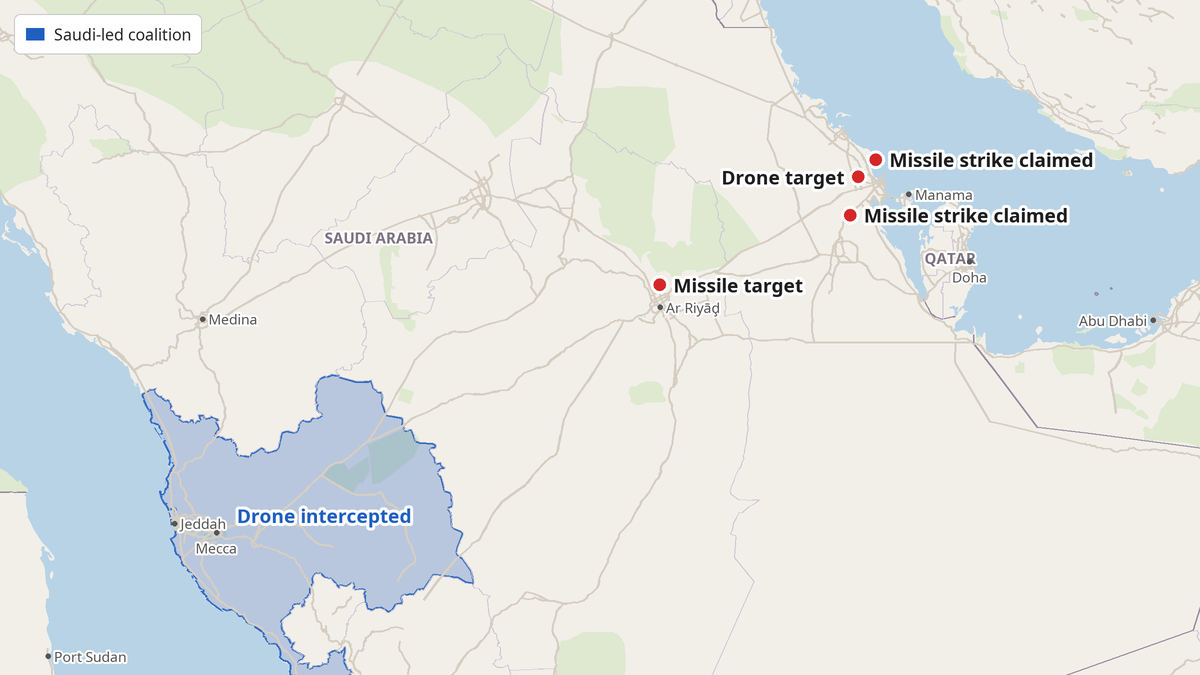
Yemen’s Houthi forces said Friday they carried out six operations against Saudi oil facilities, airports and a military position. The Saudi-led coalition said it intercepted and destroyed a drone over the Mecca region. The Houthis denied launching any attack toward Saudi Arabia that morning, calling the coalition’s account false. The group has repeatedly denied targeting Mecca and Medina, Islam’s two holiest cities.
The timing matters. The strikes came four days after Iran’s security chief hosted a meeting in Tehran aimed at strengthening regional cooperation.
The Security Picture
Houthi military spokesman Yahya Saree described the claimed targets in detail: the Ras Tanura refinery and Saudi Aramco facilities in Abqaiq, both in the Eastern Province, and the Rabigh refinery on the Red Sea coast. He said missiles targeted King Khalid International Airport in Riyadh, while a drone targeted King Fahd International Airport in Dammam, disrupting air traffic. Saree said another operation struck a command center for Saudi military forces in the southern border region of Najran, causing casualties among soldiers and officers.
Saree said the attacks answered recent Saudi strikes on Houthi-held areas in Yemen. Al Jazeera reported that he described the targets as vital commercial and military infrastructure, stretching from Saudi Arabia’s east and west coasts to Riyadh and Najran. No independent source corroborated the Houthi claims, and Saudi authorities hadn’t immediately confirmed the reported hits on oil facilities and airports.
The coalition gave a more concrete account of Thursday’s events. Its air defences intercepted two Houthi ballistic missiles fired toward Riyadh that evening. Saudi Arabia’s Civil Defence said shrapnel wounded one Saudi citizen in Riyadh and damaged a house and a vehicle. Earlier Thursday, the coalition said it had intercepted three ballistic missiles, two headed toward Riyadh and one toward the Eastern Province. Authorities sent warning alerts about possible incoming threats in Riyadh, al-Kharj governorate and Najran city.
The drone over the Mecca region marked the latest in a series of cross-border attacks involving drones and missiles against Saudi military installations, airports and energy infrastructure. Saree posted on X that the group had carried out no operation toward Saudi territory that morning. He insisted its operations targeted oil facilities and military bases.
Diplomacy Without Effect
On Monday, Iran’s security chief Mohsen Rezaei hosted representatives of Saudi Arabia, Turkiye and Pakistan in Tehran. Al Jazeera described the three visiting states as members of the Mecca defence alliance. Saudi Defence Minister Khalid bin Salman, Pakistan’s army chief Asim Munir and Turkish intelligence chief Ibrahim Kalin attended. An Iranian press release carried by Fars news agency said participants “agreed to continue discussions to strengthen cooperation between the four regional countries,” and that the meeting focused on “peace and security in the region.”
Saudi Arabia’s foreign ministry stressed “the importance of opening channels of negotiation to prevent a return to military escalation.” Al Jazeera reported that Houthi attacks continued despite the positive statements and the agreement to resolve regional differences through dialogue. Gulf News said the Houthis and Saudi Arabia had exchanged cross-border attacks in recent weeks.
The internationally recognised Yemeni government, for its part, asked the UN Security Council to take “deterrent and punitive measures” to stop Houthi attacks on Aden International Airport. Gulf News reported that the Houthis said 27 people were killed in Saudi airstrikes on Houthi-held areas in Yemen, a figure the reports didn’t independently verify.
Background
Yemen has been in conflict since late 2014, nearly 12 years as of October 30, 2026, when the Houthis seized the capital, Sanaa, and much of northern Yemen. The Saudi-led coalition intervened in 2015, about 11 years ago, to support the Yemeni government. The group that took Sanaa is now firing ballistic missiles at Riyadh while its patron’s security chief hosts talks on regional peace.
Why This Matters: The attacks put civilian infrastructure, from airports to refineries, in the crosshairs of an armed group that keeps firing even as its regional backer hosts talks about stability. For Riyadh, the reported strikes on energy sites and the Mecca-region drone carry strategic and religious weight, while the Houthi denial leaves the coalition’s account contested. For anyone weighing dialogue with Tehran, the sequence offers a data point: diplomatic language on Monday, missiles on Thursday. Whether diplomacy can restrain an armed group that answers to its own command remains the open question for Saudi planners and Gulf states whose airports and energy exports sit within range.
- houthi forces
- saudi arabia
- drone interception
- missile attacks
- saudi oil facilities
- riyadh
- mecca region
- yemen conflict