
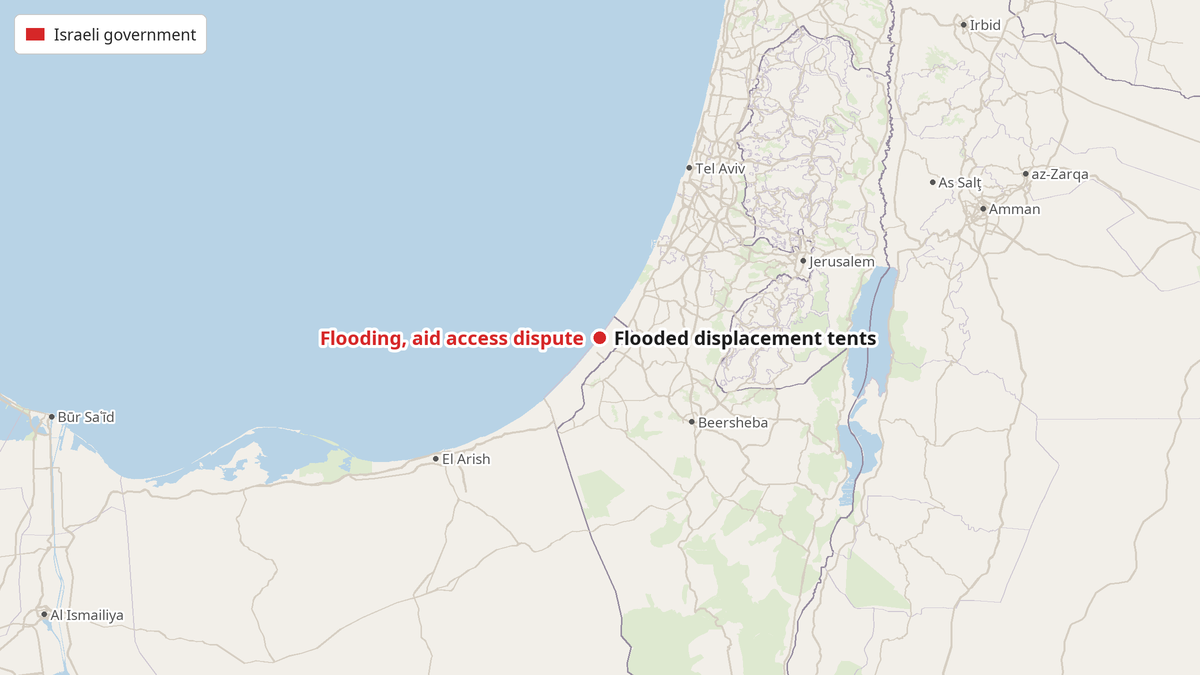
Youssef Abu Amer, 73, spent the night bailing water out of his tent in northern al-Mawasi, west of Khan Younis. The first storm of the winter had hit Gaza. "We're fighting every drop that falls from the sky," his son Mohammed, 45, told The New Arab.
Heavy rain and strong winds struck the Gaza Strip from the evening of November 6 and through the weekend, flooding the shelters and tents of tens of thousands of displaced Palestinians. The storm also brought down weakened buildings, hit humanitarian facilities and disrupted essential services, according to the UN's OCHA.
On Monday, the Board of Peace, an international body led by U.S. President Donald Trump, called on the Israeli government to "immediately" authorize and facilitate humanitarian supplies into Gaza, citing the approaching winter as an emergency. The board acknowledged that Jerusalem has taken steps to provide for Gazans' winter needs but said this "remains insufficient."
Civilian Toll
The numbers are stark. Mohammed Salha, director of the Palestinian NGOs Network in Gaza, told The New Arab that about 350,000 people were left without shelter in the first storm, after some 70,000 tents were flooded or damaged. Gaza's Government Media Office reported the same tent figure. Salha said around 1,000 sites are at high or very high risk of flooding.
The structures people fled to are failing, and so are the buildings they left behind. The Ministry of Public Works and Housing estimates that about 3,000 buildings in Gaza are at risk of collapse. After the storm, the Civil Defence warned that nearly 2,000 could fall at any moment. Gaza's health ministry, whose figures are accepted by the United Nations, says more than 74,000 people have been killed. Most of the enclave's 2.1 million people have been displaced, in the fourth year since the war began.
Maysa al-Farra, 46, put it plainly: "These tents are a recipe for a slow death." Human rights defender Dr Hussein Hammad called the flooding an "unprecedented humanitarian catastrophe."
The Supply Gap
Israel's Defense Ministry unit COGAT says it has moved a good deal of material. On Monday it said more than 91,000 tents and 8,200 trucks carrying winter supplies have entered Gaza since the implementation of a winterization plan, run in partnership with the Board of Peace, the International Committee of the Red Cross, UNICEF and other international organizations.
Palestinian and UN-linked figures describe a gap between that effort and what's needed. As of November 1, the UN-led shelter cluster estimated that families needed about 121,000 tents and 561,000 tarpaulins. Aid groups had about 2,800 tents in stock inside Gaza.
Salha said Israel allows in about 35 percent of the trucks agreed under the humanitarian protocol of the ceasefire deal, and only about 20 percent of those carry aid. More than 50,000 tents, he said, are waiting on the Egyptian side of the border. He said supplies for health, education, shelter and food cover no more than 17 percent of needs.
Pressure and Blame
The Board of Peace didn't direct its message at Israel alone. It stressed that Hamas has failed to meet its obligation to lay down its arms and has thus "compounded the challenges facing Gaza's civilian population." It called on all parties to fulfill their commitments, warning that those who fail to do so "will bear responsibility for the consequences." Israel's governing coalition, led by Prime Minister Benjamin Netanyahu, has also blamed Hamas, according to a Middle East Eye opinion piece.
That piece, whose views are the author's and not Middle East Eye's editorial policy, went further. It said 65 percent of people in Gaza, more than one million, live in tents or makeshift shelters, and that 150,000 donated tents sit in Egypt awaiting Israeli permission to enter. The author argued Israel must face sanctions, noting that the UK recently amended its Global Human Rights and International Humanitarian Law Sanctions Regulations to allow sanctions on those who block humanitarian aid. The piece cited a letter from dozens of politicians to Foreign Secretary Ed Miliband last month, and called the Board of Peace an "opaque concoction."
The tent counts differ depending on who's counting, and the base reporting doesn't reconcile them. What's not in dispute is the storm's effect: families bailing out canvas shelters in the dark, with cold weather still ahead.
Why This Matters: A ceasefire has held for about one year, yet hundreds of thousands of people face winter in tents that can't survive a single storm. The dispute over how many trucks and tents get through, and who bears responsibility, is playing out while civilians absorb the cost. Even a U.S.-led body is publicly telling Israel its efforts fall short, while also faulting Hamas for refusing to disarm. For anyone hoping to rebuild a political path out of this war, conditions like these make it harder: displaced, exposed and dependent families are not a foundation for stability. The gap between pledged aid and delivered aid is now measured in lives at risk each time it rains.
- gaza humanitarian aid
- gaza flooding
- board of peace
- israel
- hamas
- winter storm
- humanitarian supplies
- gaza shelter