
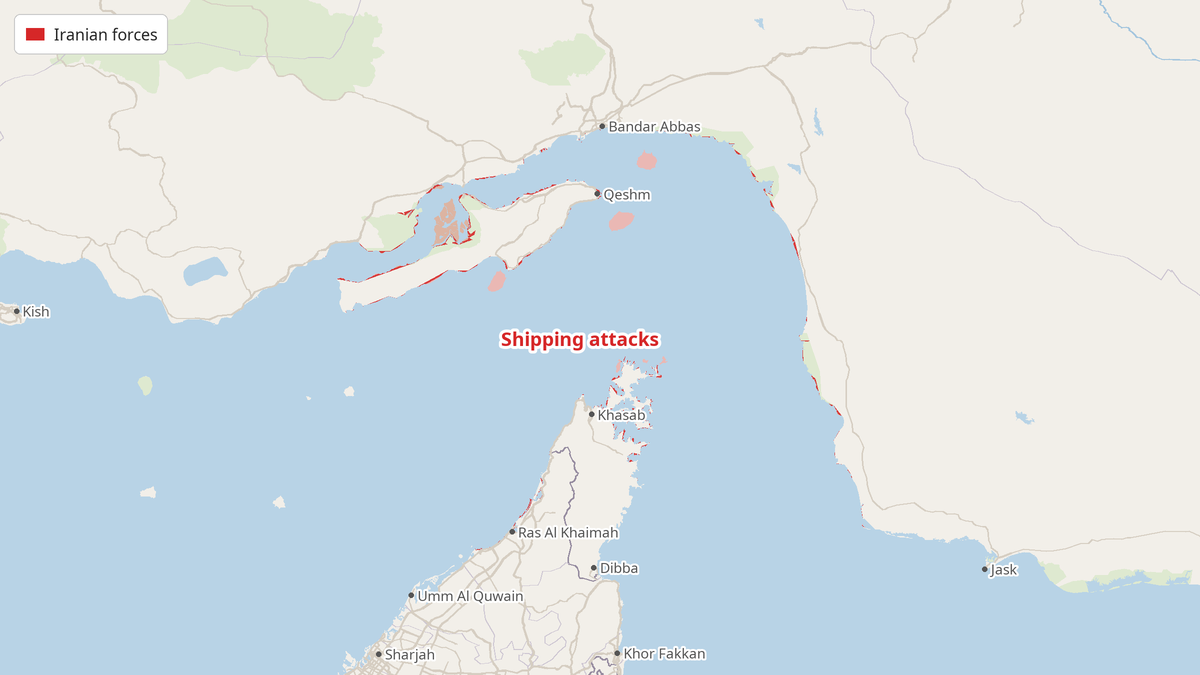
Iran has stepped up attacks on tankers in the Strait of Hormuz, even as about 8 million barrels of oil still leave the waterway each day under a U.S. naval escort. The contest centers on who commands the strategic passage and the oil moving through it. People and economies tied to that flow have no seat at the table.
Who Controls the Waterway
The United Kingdom Maritime Trade Operations confirmed at least six strikes on shipping in the past week. Iran has claimed more attacks, at a pace not seen since the war began. Tehran says it won't let ships undermine its claim to the oil chokepoint, while U.S. naval forces escort tankers through the strait.
Vortexa, a maritime firm, said Iran has specifically targeted some of the busiest ships, which have made repeated trips through the area. The figures make the power struggle plain: millions of barrels move daily, armed forces escort them, and vessels become targets in a fight over control.
Iran has also targeted U.S. bases in Bahrain and Kuwait in recent days. The attacks were described as an escalation meant to challenge the current status quo. That status quo includes a U.S. military escort for oil shipments and American bases across the region. When missiles and drones enter the picture, state power is no abstract debate.
The base account reports no grassroots response, mutual-aid effort, or community organizing in the strait or around the bases. Instead, it describes governments, military forces, tankers and analysts. No one outside those institutions appears to decide how the confrontation should end or how its costs should be shared.
Pressure, Risk and the Deadlock
Trump has signaled he’s content to let the war remain cold while America’s economic pressure campaign squeezes Iran. That pressure sits alongside the naval escort and attacks, leaving ordinary people outside the negotiating room as state leaders weigh the cost of prolonging the confrontation.
Hamidreza Azizi, senior Iran analyst at the International Crisis Group, told Al Jazeera: “The two sides have very different calculations about the costs of prolonging the confrontation.” He added: “As economic pressure mounts, Iran may become increasingly willing to take military risks to break the deadlock.” The analysis describes governments using economic pressure and military risk as instruments, while people exposed to the consequences don't set the terms.
Lead Iranian negotiator Mohammad Bagher Ghalibaf addressed parliament on Sunday and warned the United States that lawmakers had been told by Supreme Leader Mojtaba Khamenei to end the current stalemate. “We will not remain in a state of 'neither war nor peace,'” Ghalibaf said. “It makes absolutely no difference to us whether the United States wants negotiations or war.”
The account describes no election or legislative remedy. Parliament appears as the venue for Ghalibaf's warning, not as a forum where people affected by the conflict can direct policy. The choices on offer remain negotiations, economic pressure and war, all managed by state leaders and military institutions.
The Escalation Ladder
Kristian Coates Ulrichsen, a Middle East expert at Rice University's Baker Institute, told the Wall Street Journal that the attacks signal Iran has rebuilt its missile and drone launchers and stands prepared for all-out war to resume. He said: “The attacks on Kuwait and Bahrain are a signal that Iran retains both the capability and the intent to target US partners across the Gulf and are a reminder to leaders in the Gulf states that they remain vulnerable to retaliation for U.S. actions in the Strait of Hormuz.”
Coates Ulrichsen added: “As the Trump administration continues its buildup of force in the region, the attacks are a reminder that the US does not have a monopoly on the escalation ladder.” Leaders and military powers may trade warnings over who can raise the stakes. Tankers keep crossing under escort, while the people living under that contest remain absent from the decisions.
- iran
- strait of hormuz
- oil tankers
- bahrain
- kuwait
- u.s. military bases
- missile attacks
- oil shipping