
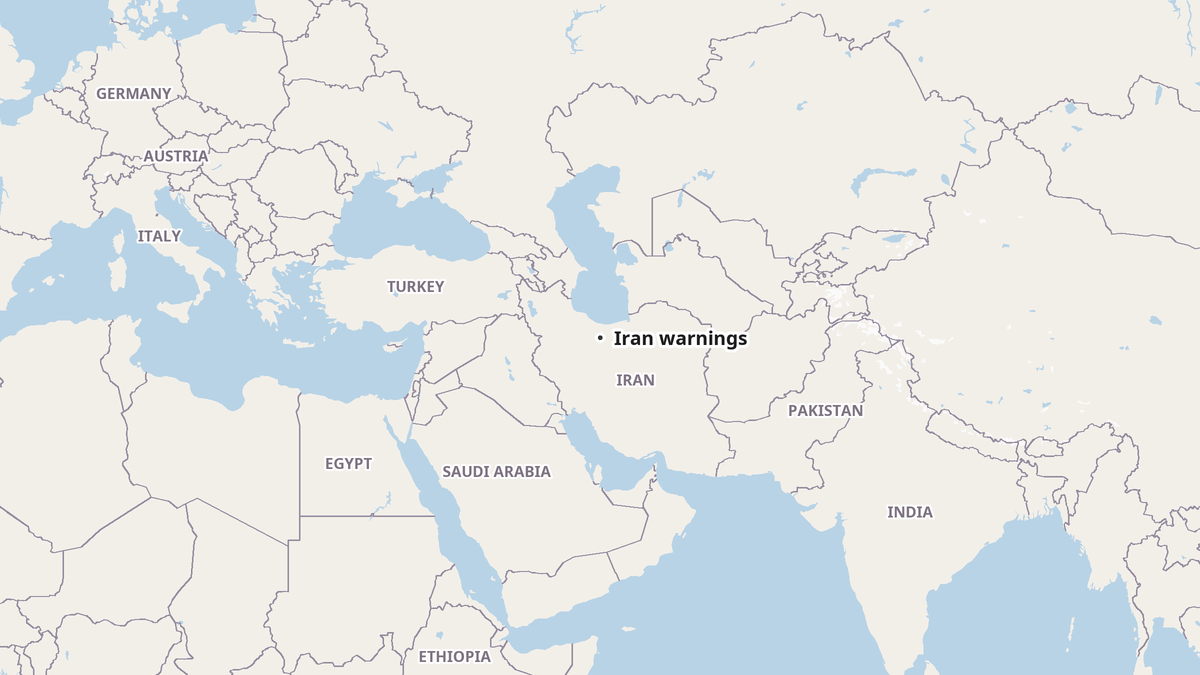
Mohsen Rezaei, a former commander-in-chief of the Islamic Revolutionary Guard Corps, warned on X that every military base involved in any new US attack on Iran, "from West Asia to Europe, will be a legitimate target for Iran's lethal strikes." His closing line was blunt: "NO SAFE DISTANCE. NO SAFE HAVEN. NO IMMUNITY." The post came as Israel reportedly readied an attack and US-Iran diplomacy remained stalled.
The Threat Picture
Rezaei went further in a separate interview with Lebanon-based Al Mayadeen, broadcast Wednesday. He said Iran would not confine retaliation to nearby American bases. Installations in European countries could be hit, he said, if US aircraft used them to launch strikes on Iran. He also mentioned remote islands that Washington might consider beyond Iranian missile range.
He claimed Iran's offensive and defensive capabilities are now considerably stronger than when the war began. No independently verifiable evidence supports that. Gulf News noted that the statement is a warning of potential retaliation, not confirmation that Iran has selected or attacked specific European installations. Iran hasn't published an authenticated operational target list.
The warning isn't coming from nowhere, though. The hardline newspaper Kayhan previously named several American and NATO-linked installations that could be exposed in a wider conflict. The US Air Force earlier confirmed drone sightings over Ramstein Air Base in Germany. Meanwhile, Iran's IRGC chief stated that missile development will continue despite threats and sanctions.
Diplomatic Dead End
Rezaei said Tehran isn't currently negotiating directly with Washington. Iran, he said, will not surrender its enriched uranium stockpile or transfer it abroad. Reuters reported that Iran had submitted a nuclear proposal through Qatar, while Tehran insists Washington must first address its seven conditions for ending the conflict. Iran rejected a US proposal to transfer its stockpile of 60 percent enriched uranium to a third country.
Parliament Speaker Mohammad Bagher Ghalibaf, the current lead negotiator, told Al Jazeera that the Strait of Hormuz will "never return" to its status prior to the US-Israel war on Iran. "The ball is now in the American court," he said. "What stands in the way of an agreement is our lack of trust in the United States."
Al Jazeera's Resul Serdar Atas, reporting from Tehran, said the leadership has been discussing whether to appoint the hawkish Rezaei as chief negotiator. "In Tehran, there have been voices saying that if this status quo goes on for quite a long period of time, Iran will not wait and might take pre-emptive action," Atas said. Ghalibaf has spoken of moving beyond "no war, no peace" through "sustainable deterrence" if negotiations fail.
Washington's Pressure Campaign
President Trump has said he is prepared to return to waging war if a diplomatic track offered by Qatar fails. Secretary of State Marco Rubio said the administration's economic pressure campaign is proving so effective that resuming large-scale military operations is unnecessary. Gulf News said he made the remark on November 10, after Republicans suffered losses in the November 3 midterm elections, nine days ago. Al Jazeera's Alan Fisher, in Washington, said the White House doesn't see the need to restart large-scale engagement "unless Iran crosses red lines," and that "there is some movement behind the scenes as far as negotiating a settlement."
Vice President JD Vance asked Rezaei for a meeting in an October letter, according to a report cited by i24NEWS. Trump has authorized Vance to pursue renewed negotiations aimed at ending the war, which is viewed as a political liability for Republicans.
On the ground, US Central Command said forces "continue to work around the clock" keeping the Strait of Hormuz open to commercial shipping while strictly enforcing an "ironclad" naval blockade against Iran. In a November 11 statement, CENTCOM said it was also working to stop the IRGC from using overland routes and the Caspian Sea to move advanced weapons systems, dual-use technology, sanctioned materials and illicit revenue. That effort builds on Task Force Iron Gate, announced five days ago.
Markets reacted. Brent futures settled $1.27, or 1.39 percent, higher at $92.76 after Tehran rejected the US proposal. West Texas Intermediate gained 49 cents to $86.53.
The Regional Dimension
Iran's foreign ministry on Wednesday designated Argentina's navy and air force as terrorist organisations. That followed a similar move by Buenos Aires; in late March, about seven months ago, Argentina designated the IRGC a terror organisation, citing its support for Hezbollah.
Why This Matters: Tehran is publicly widening the potential battlefield to US and NATO-linked sites in Europe while refusing to give up its 60 percent enriched uranium. That combination leaves little room for a deal built on trust, which Ghalibaf himself says is missing. From a security standpoint, the blockade and interdiction work, including efforts to choke IRGC weapons and revenue routes, are the leverage keeping Washington from a choice between war and concession. If hardliners like Rezaei take over the negotiating file, the gap between Iran's stated demands and any verifiable limit on its nuclear program could widen. Israel and Gulf states, already absorbing missile debris and proxy threats, have the most to lose from a deal that leaves the stockpile in Iranian hands.
- iran
- mohsen rezaei
- us iran nuclear talks
- strait of hormuz
- us military bases
- irgc
- oil prices
- marco rubio