
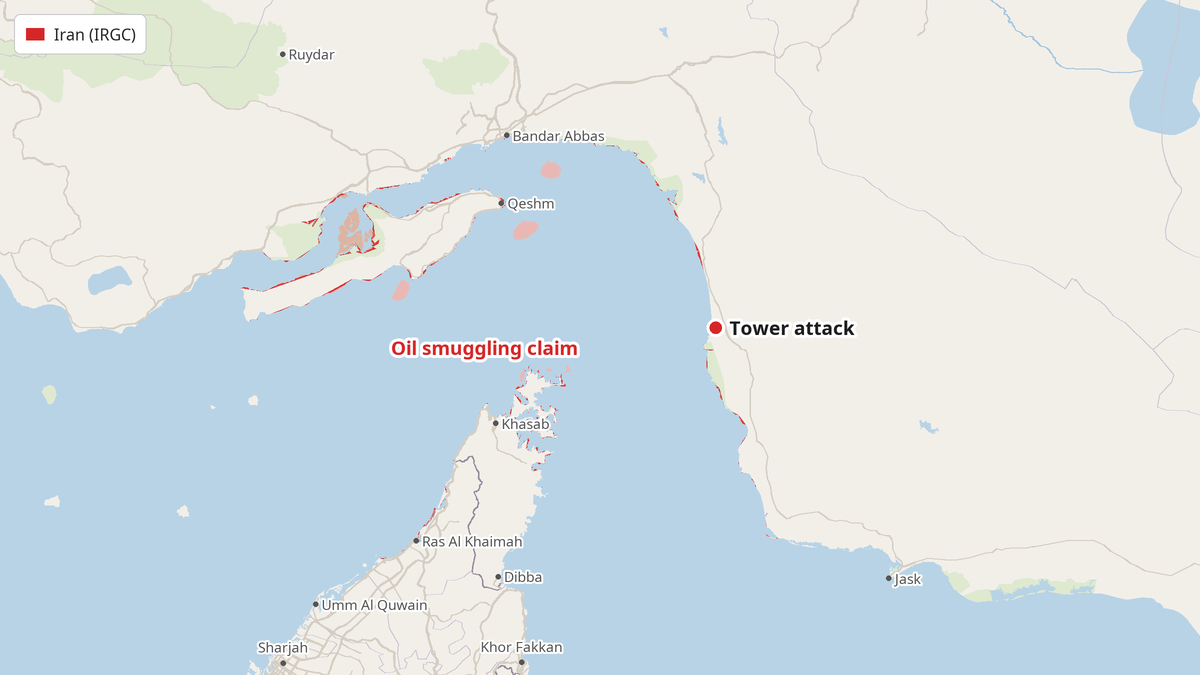
Iran's Islamic Revolutionary Guard Corps said Friday its Aerospace Force "targeted and destroyed" a US early-warning radar installation on the island of Bahrain, home to the headquarters of the US Navy's Fifth Fleet. Neither Washington nor Manama has confirmed the claim. It couldn't be independently verified.
"A few hours ago, IRGC Aerospace Force fighters targeted and destroyed the US aggressors' early-warning radar on the island of Bahrain in response to the enemy's air aggression against a telecommunications tower in Sirik," the Guards said in a statement carried by Tasnim, Fars and Iranian state media. The IRGC called the strike "a serious warning" and demanded an end to what it called "aerial provocations and oil smuggling in the Strait of Hormuz." Then came the threat: "Should these violations and acts of aggression recur, the IRGC Aerospace Force stands in full readiness to engage without limits." The Guards also threatened harsher measures against companies it accused of being "misled by the United States."
The Security Picture
The claim, if accurate, would be the first time since early September that Iran has claimed an attack on American military assets in a Gulf country. AP described it as the first Iranian report of targeting a facility in Bahrain since September. During the war, which began with US and Israeli strikes on February 28 and is now in its ninth month, Iran hit US bases in neighboring Arab nations, including Bahrain. AFP reported that US bases and equipment in the Gulf were repeatedly targeted earlier in the eight-month war.
The trigger, by Tehran's account, was a Thursday strike on a telecommunications tower in Sirik, a town in Hormozgan province. Sirik sits on the Hormuz coast and hosts part of Iran's radar and communications network monitoring the waterway, according to RFE/RL, which said the town has been hit repeatedly since the war began. Here's a detail worth noting: IRNA and Tasnim reported Sirik came under "enemy fire" without naming an attacker, and the IRGC statement stopped short of directly blaming the United States. Tehran retaliated against a US facility for an attack it never explicitly attributed to Washington.
Bahrain has been one of Iran's strongest critics in the Gulf, AP noted. Gulf states bore the brunt of Tehran's wrath after the war began. Iran restricted shipping through Hormuz and struck airports, seaports, energy facilities and American assets in US-allied countries. On November 12, Iran's army said two oil tankers caught fire after hitting naval mines in the eastern part of the strait, saying the vessels had entered a "prohibited and unsafe zone." RFE/RL reported numerous recent explosions on ships from drone attacks or mines.
Diplomatic Dead End
Washington maintains a naval blockade of Iranian ports, in place since April 13, and US Central Command says it is still strictly enforcing it. AFP reported that in August the United States announced an "economic asphyxiation" campaign aimed at curbing Iran's trade and financial flows. CENTCOM said last month it had helped Gulf countries export 1.5 billion barrels of oil since the summer via Hormuz.
President Donald Trump said Thursday he wouldn't hesitate to strike again if Iran threatened American allies or vessels. "No. No hesitation," he told Hugh Hewitt on Salem News Channel. On November 12 he wrote on Truth Social: "We don't need a deal with Iran. Those days have long since passed. We've got their money, Hundreds of Billions of Dollars, and we've got their Strait!" He has also asked Vice President JD Vance, who spent months leading efforts to secure a cease-fire and revive nuclear talks, to turn his attention elsewhere.
Iran's own signals are muddled. Parliament speaker and chief negotiator Mohammad Bagher Ghalibaf told Al Jazeera on Wednesday that Tehran was waiting for Washington's response to seven conditions, saying "the ball is now in the American court." He insisted the strait would not return to its pre-war status and that Iran would keep demanding a role in managing passage. Security chief Mohsen Rezaei, meanwhile, said any military bases involved in renewed US attacks, including those in Europe, would become legitimate targets. Analyst Shayan Samii told RFE/RL's Radio Farda that when Foreign Minister Abbas Araqchi says Iran will negotiate while Rezaei says there will be no talks until America accepts Tehran's conditions, world leaders conclude there is "no reliable decision-maker" in the Islamic republic. According to RFE/RL, those conditions include ending the US blockade, releasing frozen Iranian assets, and halting fighting on all fronts.
What Comes Next
Israeli public broadcaster KAN reported Thursday that CENTCOM had advised Israel to prepare for a possible resumption of operations against Iran. A CENTCOM official called the report "pure speculation," telling Anadolu there had been no change to US force posture. Al Jazeera, citing Israeli media, reported that Israel's security cabinet had reportedly ordered the military to step up preparations for a possible attack.
Samii described Trump's approach as "neither war nor negotiation," adding that Trump "has not taken military intervention off the table." Al Jazeera reported that Trump is prepared to return to war if the Qatari-mediated diplomatic track fails, while Secretary of State Marco Rubio says economic pressure is working well enough that large-scale military operations are unnecessary. AFP reported Washington has appeared to dial back threats of renewed strikes after Republican losses in recent midterm elections, in part due to the war's unpopularity.
Why This Matters: The episode shows how thin the line is between a frozen conflict and an active one. A claimed strike on the host of the Fifth Fleet, aimed at an American early-warning system, targets the sensors that protect shipping and Gulf partners. Iran is pairing that action with an open-ended threat to "engage without limits" while its negotiators, by one analyst's account, send contradictory messages. From a security standpoint, the concern is straightforward: a regime that maintains its demand for a managing role over Hormuz, strikes Gulf-hosted US assets when it feels provoked, and threatens bases as far away as Europe leaves little ground for guarantees. Gulf states and Israel are left to plan around what Tehran does, not what its diplomats say.
- iran
- irgc
- bahrain
- strait of hormuz
- us military
- donald trump
- sirik
- air strike