
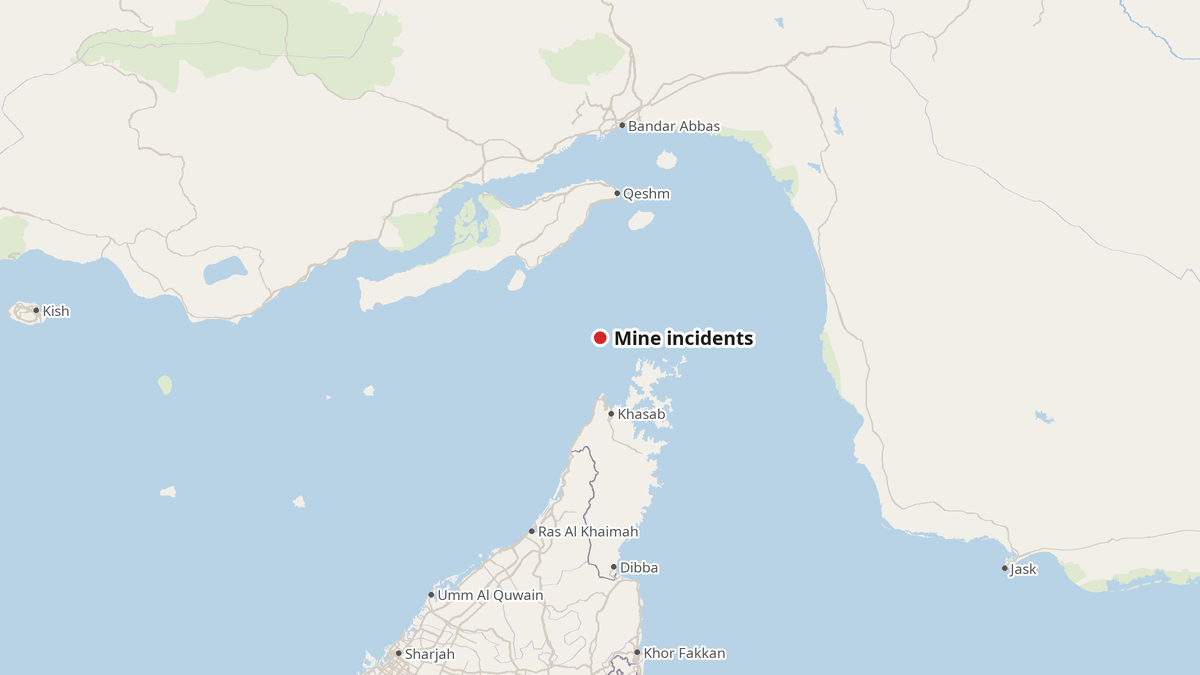
Iran's Islamic Revolutionary Guard Corps navy said three tankers caught fire after striking mines in the Strait of Hormuz, while another vessel hit naval mines in the eastern part of the waterway. The IRGC said the tankers were attempting to cross an unauthorized route, had switched off radar and navigation systems, and ignored warnings. It wasn't clear who laid the mines or whether anyone was injured.
The United Kingdom Maritime Trade Operations separately reported a vessel on fire about 25 nautical miles northeast of Khasab, Oman, while travelling outbound through the strait. The cause, the crew's condition, the extent of damage and any environmental impact hadn't been established. UKMTO advised vessels to transit cautiously and report suspicious activity while authorities investigated.
Incidents in a critical waterway
The IRGC said the three tankers hit mines while crossing the unauthorized route in the 24 hours before its statement. It said the vessels were abandoned on the southern shores of the strait. The account did not identify who placed the mines, and the cause of the separately reported fire remained undetermined.
The United States said its naval blockade of Iran was effective and that no Iranian ship had crossed the strait. Iran's UN ambassador, Amir-Saeid Iravani, told the UN Security Council that Washington and its supporters were responsible for insecurity in Hormuz and disruption to regional shipping. He said the blockade violated the UN Charter and threatened civilians' access to food, medicine, fuel and other essential goods, describing the measures as “collective punishment” against the Iranian people.
The State Department said the G20 discussions in Atlanta were expected to address threats to freedom of navigation, energy and food security, and supply chains. A State Department official said ministers would discuss energy and supply-chain issues and “identify ways to collectively address the impact of geopolitical tensions on economic security.” The official added: “Energy is foundational for economic growth around the world.”
US military options and regional deployments
The Wall Street Journal reported that the US military's top commander overseeing the Middle East met President Donald Trump at the White House on Thursday and presented military options concerning Iran. Defense Secretary Pete Hegseth and Joint Chiefs Chairman Dan Caine attended, and US Central Command chief Adm. Brad Cooper presented the options. Reuters said it couldn't immediately independently verify the report.
The meeting came as Washington and Jerusalem were reported the previous week to be considering a “short but intensive operation” of renewed strikes on Iran after the November 3 US midterm elections. Military drills had ramped up, with Iranian energy sites, nuclear facilities, and missile and drone arsenals as targets in the report. Trump could still decide against military action.
Analysts monitoring open-source flight-tracking data reported that more than 10 US military transport aircraft landed at Israeli airbases in southern Israel over the previous week. Most recent cargo flights departed Biggs Army Airfield in El Paso, Texas, for the Israeli Air Force's Nevatim and Ovda airbases. Other US military cargo flights went to American bases in Jordan, Saudi Arabia, Qatar and Kuwait. The planes' contents were unknown, though they were thought to be connected to US efforts to bolster regional air defences. The Wall Street Journal reported Wednesday that the US military was sending a Patriot battery from Texas to strengthen those defences.
Negotiations continue amid competing claims
Iran confirmed Thursday that it had received a letter from US Vice President JD Vance but hadn't responded, the semi-official Tasnim news agency reported. The acknowledgment followed a Wall Street Journal report that Vance had sent a letter to Iranian security chief Mohsen Rezaei to revive peace negotiations. Tasnim said Tehran continued to insist that seven conditions it had set for the United States be met, adding that “any position that contradicts this framework is unacceptable.” The agency didn't detail the conditions.
Trump said Wednesday that Vance's outreach concerned helping Iran obtain medical supplies. Asked whether he had directed Vance to contact Iran to restart peace negotiations, Trump said, “No.” He added: “What that is is they need help with medical supplies and various things.”
A Times of Israel report citing The Washington Post said US intelligence viewed working with Iran's Supreme National Security Council head Mohsen Rezaei as Washington's best option to head off renewed fighting. An official familiar with the matter told the Post that Vance's letter urged a return to negotiations focused on each country's national interests: Washington's aim of preventing a nuclear-armed Iran and Tehran's interests in its economy and sovereignty. The official said Vance urged Iran to send negotiators “empowered” to discuss and resolve the nuclear issue. Rezaei hadn't responded, and his longstanding hardline stance toward the United States cast doubt on his willingness to pursue a deal.
A Kremlin spokesman told Al Jazeera that Russia was ready to mediate if requested. Qatari mediators also returned to Tehran on October 30 as part of efforts to reach a US-Iran deal, an official briefed on the talks told Reuters. The mediation talks were coordinated with the United States.
- strait of hormuz
- iran
- united states
- islamic revolutionary guard corps
- maritime mines
- military tensions
- peace negotiations
- mohsen rezaei