
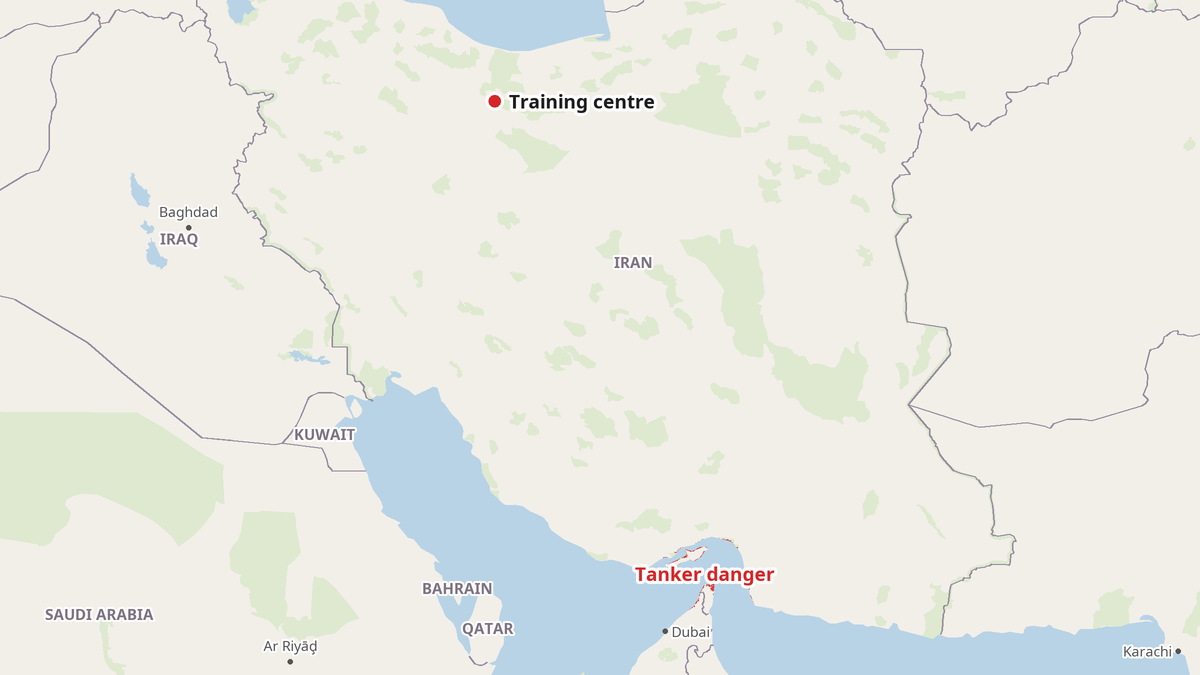
Iran opened a third military training centre in Tehran and announced plans to train one million paramilitary volunteers nationwide, as the United States confirmed strikes on an Iranian anti-aircraft facility near the Strait of Hormuz. The announcement and strike put two state military apparatuses on display; the waterway and its shipping lanes are where their threats and claims collide.
Training, strikes and demands
Members of the Basij, a paramilitary force affiliated with Iran's Islamic Revolutionary Guard Corps, attended the centre's opening. Two other centres opened in Tehran in August and September. Iran's military mobilisation came amid fears of renewed conflict with the United States and Israel.
President Donald Trump said the United States struck the facility on Qeshm Island early Tuesday. He called it a “minor attack” that “wasn't war,” and said, “We watched it get built. As soon as it was completed, we hit it last night.” US officials described the strikes as “defensive” and said they followed Iranian fire at an American aircraft. Trump said, “I'm not looking to ... kill lots of people,” adding, “If we have to, we'll have to.” He also told the Financial Times, “We seem to be getting everything we want.”
Iran said it would reopen the Strait of Hormuz over two days if the United States met seven demands, including lifting sanctions and ending the US naval blockade. Mohsen Rezaei, secretary of Iran's Supreme National Security Council, wrote on X that the US response was “not convincing,” and said the United States must address Iran's conditions. “Only in this case will the Strait of Hormuz be reopened,” he wrote.
Majed al-Ansari, a spokesperson for Qatar's Ministry of Foreign Affairs, said talks continued and both sides “remain committed to the negotiation process.” Qatar was facilitating the “real-time exchange of proposals between” Washington and Tehran. Negotiations continue alongside military threats, with no agreement reported.
Claims over the waterway
The Islamic Revolutionary Guard Corps said four oil tankers were destroyed after striking naval mines while trying to pass through a prohibited lane south of the strait. It said the tankers remained ablaze and two other vessels were detained. The United Kingdom Maritime Trade Operations separately reported that two unidentified projectiles struck a tanker's engine room northeast of Oman's coastal village of Limah. No casualties were reported, and the reports said it couldn't be independently verified whether the incidents were linked.
The IRGC also claimed its air-defense forces shot down a US-made MQ-9 drone over the strait, calling it the 56th such aircraft it had downed. It said its naval and aerospace forces had inflicted “heavy blows on the enemy.” The claims about the tankers and drone weren't independently verified in the reports.
Iran's supreme leader, Mojtaba Khamenei, ordered the military at the weekend to respond immediately to any threat without geographical limits and update its list of targets. Iranian officials suggested European countries and undersea cables in the Gulf could be targeted. The order broadens the stated reach of military response; the report doesn't describe any such targets being hit.
Threats, elections and the cost of escalation
Gulf News reported that Trump warned the United States could launch a major strike involving a “heavy hit.” Speaking to Fox News, he said, “We have to do something large,” and, “They will never have a nuclear weapon.” He acknowledged that higher petrol prices hurt Republicans in the midterm elections, saying voters “didn't like it” when they paid more for fuel. He said Iran played a part in the Republican defeat, while claiming voters understood “the importance of what I've done with Iran.”
Iran's chief negotiator, Mohammad Bagher Ghalibaf, said Americans voted “NO TO WAR” after Democrats' midterm gains. “Conscience or the cost of living, Americans said NO TO WAR, and we endorse this message,” he wrote on X. He also said the Islamic republic was “ready for battle with its finger on the trigger.” Deputy Foreign Minister Kazem Gharibabadi said Tehran retained the right to “legitimate self-defence.” President Masoud Pezeshkian said the government was seeking a solution “through dialogue” and that “no one will benefit from this war” if it reignited. He said the supreme leader had granted the government new powers to negotiate previously “off-limits” issues.
Reports cited by Gulf News described US-Iran talks as “stalled” and said US officials had strike plans ready from as early as Wednesday. The Wall Street Journal reported Trump had “leaned toward” a large attack after the Nov. 3 midterms but hadn't decided. There was no US confirmation of an attack plan, and Gulf News noted that the “imminent” framing came from open-source accounts. Tracker accounts also said a “second wave” of aircraft was underway, but that wasn't independently confirmed, and flight data didn't establish what the aircraft carried.
Washington was reportedly “rapidly replenishing” THAAD and Patriot anti-missile batteries in southern Israel ahead of a possible Iranian ballistic-missile response. One report said at least 10 US military cargo planes landed at Ovda and Nevatim air bases, most departing from Fort Bliss in Texas. The Wall Street Journal reported the United States was sending a Patriot battery from Texas. CENTCOM commander Adm. Brad Cooper briefed Trump on options, reportedly including a short, intense campaign. Tracker accounts said Kiryat Shmona and Safed had opened public shelters and Iran was repositioning missile launchers in western Iran; Israeli outlet Walla reported “no unusual rise” in US aircraft arrivals over the past week.
A Saudi-led coalition said it intercepted three drones targeting Saudi territory. Yemen's Houthi group said it launched drone and ballistic-missile attacks on an airport and an airbase in southwestern Saudi Arabia. The US Embassy in Yemen also accused the Houthis of killing Mohammed Al Shami, a UN Human Rights Office staff member, while he was detained, and called for the immediate and unconditional release of detained UN, diplomatic and humanitarian staff.
John Mearsheimer questioned whether another short bombing campaign could achieve Washington's aims. “If the 40-day bombing campaign didn't work, how is the three-day bombing campaign going to work?” he asked, warning that Iranian retaliation could draw the United States into a longer confrontation and increase damage to the global economy. The people living under these competing military commands get no place in the negotiations described here; the report records their threats, plans and the cost of fuel instead.
- iran
- strait of hormuz
- united states
- islamic revolutionary guard corps
- military escalation
- qeshm island
- donald trump
- military training