
Two oil tankers burned in the eastern Strait of Hormuz on Thursday after hitting naval mines, Iran's army said, the latest sign of how a war now in its ninth month keeps spilling onto the shipping lanes and into the Gulf states that sit beside them. On Friday, Iran's Islamic Revolutionary Guard Corps added another jolt, claiming it had destroyed a US early-warning radar installation in Bahrain. Neither Washington nor Manama has confirmed the claim, and it could not be independently verified.
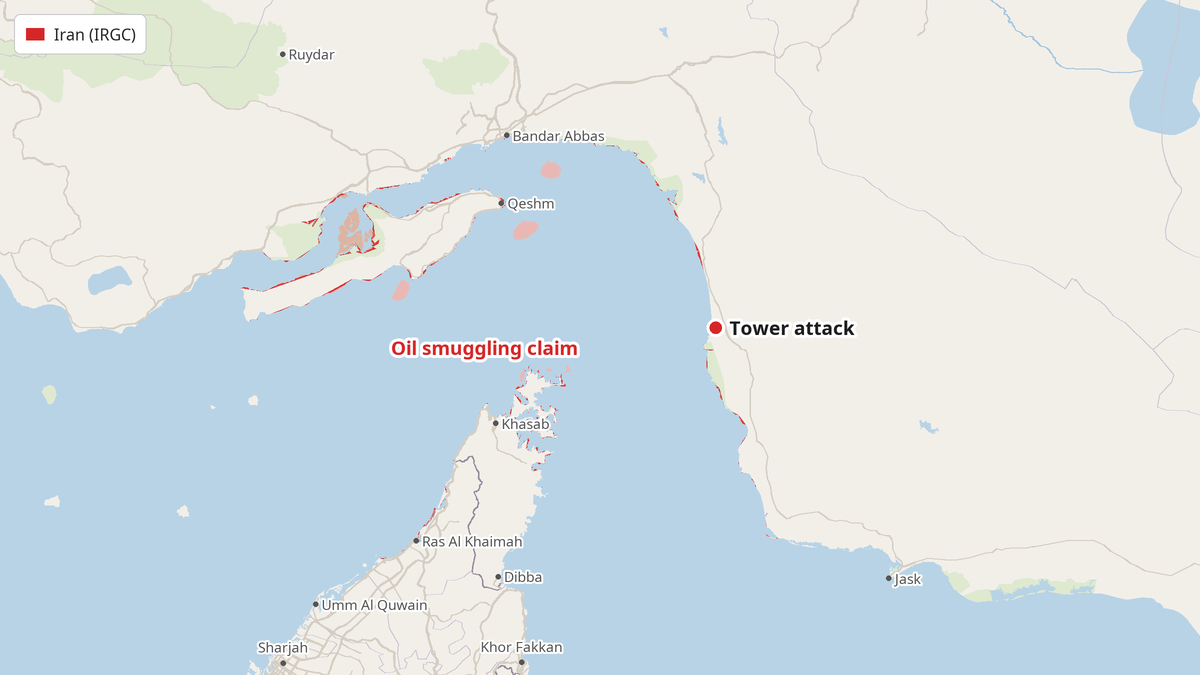
The Guards said the strike answered what they called an air attack on a telecommunications tower in Sirik, a southern Iranian port town in Hormozgan province. "A few hours ago, IRGC Aerospace Force fighters targeted and destroyed the US aggressors' early-warning radar on the island of Bahrain in response to the enemy's air aggression against a telecommunications tower in Sirik," the statement said. It warned that "should these violations and acts of aggression recur, the IRGC Aerospace Force stands in full readiness to engage without limits." The Guards also threatened harsher measures against companies they accused of being "misled by the United States."
Civilian Infrastructure in the Crossfire
Iran's official IRNA agency reported that Sirik was hit by "enemy fire" on Thursday. It named no attacker and gave no details of damage or casualties. Tasnim also reported the town had come under fire, without saying who was responsible. The IRGC statement itself stopped short of directly blaming the United States for the Sirik attack.
Sirik sits on the Hormuz coast and hosts part of Iran's radar and communications network monitoring the waterway. According to RFE/RL, it has been hit repeatedly since the war began with US and Israeli strikes on February 28. Telecommunications towers serve ordinary people as well as military planners, and the base reporting offers no word on who or what was affected on the ground.
The Gulf has absorbed heavy punishment already. After the US and Israel launched attacks on Iran on February 28, Iran restricted shipping through Hormuz and struck infrastructure including airports, seaports, energy facilities, landmarks and American assets in US-allied countries. Bahrain, home to the US Navy's Fifth Fleet headquarters, has been one of Iran's strongest critics. Reuters reported the new claim was the first time since early September that Iran has claimed an attack on American military assets in a Gulf country.
A Blockade, a Strait and No Deal
The exchange came as Washington and Tehran remain locked in confrontation over Hormuz. The US maintains a naval blockade of Iranian ports, and Iran continues to restrict shipping through the waterway. AFP reported that in August Washington announced what it called an "economic asphyxiation" campaign aimed at curbing Iran's trade and financial flows.
President Donald Trump signaled little appetite for compromise. "We don't need a deal with Iran. Those days have long since passed. We've got their money, Hundreds of Billions of Dollars, and we've got their Strait!" he wrote on Truth Social on November 12. In the same post, he said he had asked Vice President JD Vance to "focus his complete and total attention" on what he called corruption and crime in Democratic-run cities and states. Vance had spent months leading US efforts to secure a cease-fire and revive nuclear talks with Iran.
On Thursday, Trump told Hugh Hewitt he would not hesitate to strike again if Iran threatened American allies or vessels. "No. No hesitation," he said. "If I saw things going the other way, I would do that. And it's possible I would do it right now."
Mixed Signals, Rising Risk
Shayan Samii, a US-based national security analyst, told RFE/RL's Radio Farda that Trump appeared to be pursuing a policy of "neither war nor negotiation." "Trump is now trying to achieve through economic pressure what a military intervention would not bring him," Samii said. "He has not taken military intervention off the table." He also said contradictory messages from Tehran undercut its credibility, with Foreign Minister Abbas Araqchi saying Iran will negotiate while security chief Mohsen Rezaei says there will be no talks until America accepts seven conditions. According to RFE/RL, those include ending the US naval blockade, releasing frozen Iranian assets, and halting fighting on all fronts.
Iranian parliament speaker and chief negotiator Mohammad Bagher Ghalibaf told Al Jazeera on Wednesday that "the ball is now in the American court," saying Iran had conveyed its position through Qatari mediation. Rezaei warned Thursday that military bases involved in any renewed US attacks would become legitimate targets, including those in Europe.
The military temperature is rising on the other side too. Israeli public broadcaster KAN reported that US Central Command had advised Israel to prepare for a possible resumption of operations against Iran. A CENTCOM official dismissed the report as "pure speculation," telling Anadolu there had been no changes to US force posture. AFP reported that Washington has appeared to dial back threats of renewed strikes after the defeat of Trump's Republican party in recent midterm elections, in part due to the war's unpopularity.
Why This Matters: The strait is where this war's costs land on people who never chose it: crews on burning tankers, Gulf communities hosting bases that Iran has repeatedly targeted, and civilians whose communications and ports sit inside contested military networks. With the US blockade in place for roughly seven months and Iran restricting passage, the standoff has hardened rather than eased. Diplomacy hasn't vanished, since Qatari mediation continues and Iran says it awaits a US reply, but the sidelining of Vance, Iran's conflicting public messages and each side's threats of renewed attacks leave little room for error. A single misjudged strike could turn a tense stalemate into a wider war, and ordinary people across the Gulf would pay for it first.
- iran
- irgc
- bahrain
- strait of hormuz
- us military
- donald trump
- sirik
- air strike