
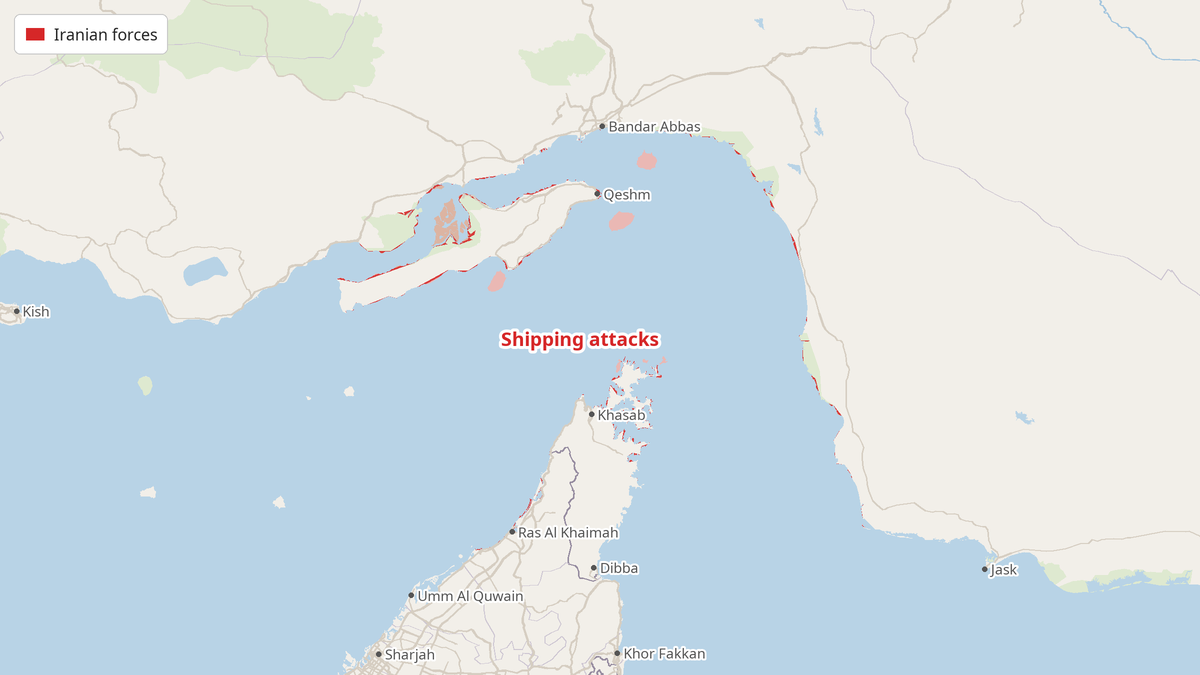
Iran has confirmed additional attacks on shipping in the Strait of Hormuz as strikes on tankers and U.S. bases in Bahrain and Kuwait expose Gulf partners to retaliation, a regional expert says. Military pressure and economic sanctions are deepening a confrontation with no resolution in sight.
The United Kingdom Maritime Trade Operations confirmed at least six strikes on tankers. Iran has claimed additional attacks at a pace not seen since the war began. About 8 million barrels of oil still leave the strait each day under a U.S. naval escort.
Shipping Under Attack
Iran says it won't allow ships to undermine its claim to the oil chokepoint. Its attacks aim to stop oil flowing and reclaim control of the waterway, even as escorted shipments continue to pass through.
Vortexa, a maritime firm, said Iran has specifically targeted some of the busiest ships making repeated trips through the area. That focus puts vessels carrying oil through the strait at the center of the confrontation over control of the route.
The U.S. naval escort has kept oil moving. But confirmed tanker strikes and Iran's claims of further attacks show that the fight over passage through the waterway continues.
Gulf Partners Face Retaliation
Iran has also targeted U.S. bases in Bahrain and Kuwait. Experts described those attacks as an escalation aimed at challenging the current status quo, extending the confrontation beyond tankers moving through the strait.
Kristian Coates Ulrichsen, a Middle East expert at Rice University's Baker Institute, told the Wall Street Journal that the attacks signal Iran has rebuilt its missile and drone launchers and is prepared for all-out war to resume.
“The attacks on Kuwait and Bahrain are a signal that Iran retains both the capability and the intent to target US partners across the Gulf and are a reminder to leaders in the Gulf states that they remain vulnerable to retaliation for U.S. actions in the Strait of Hormuz,” Coates Ulrichsen said.
That warning links the consequences of U.S. actions to the administration's military buildup. “As the Trump administration continues its buildup of force in the region, the attacks are a reminder that the US does not have a monopoly on the escalation ladder,” he added.
Pressure and the Stalemate
Trump has signaled he's content to let the war remain cold while America's economic pressure campaign squeezes Iran. Yet the latest attacks come as Iran seeks to challenge the existing situation through military action.
Hamidreza Azizi, senior Iran analyst at the International Crisis Group, told Al Jazeera that “the two sides have very different calculations about the costs of prolonging the confrontation.” He warned economic pressure could alter Iran's military choices.
“As economic pressure mounts, Iran may become increasingly willing to take military risks to break the deadlock,” Azizi said. His assessment ties the pressure campaign to the risk of further escalation, rather than treating economic measures and military decisions as separate questions.
Lead Iranian negotiator Mohammad Bagher Ghalibaf addressed parliament on Sunday and warned the United States that Supreme Leader Mojtaba Khamenei had told lawmakers to end the current stalemate.
“We will not remain in a state of 'neither war nor peace,'” Ghalibaf said. “It makes absolutely no difference to us whether the United States wants negotiations or war.”
Why This Matters: The attacks put Gulf partners and ships moving oil through the Strait of Hormuz at the center of a confrontation whose costs aren't confined to the United States and Iran. U.S. naval escorts have kept about 8 million barrels of oil moving through the strait each day, but they haven't ended the attacks. Economic pressure also shapes the calculations: Azizi warns it may make Iran more willing to take military risks. Coates Ulrichsen's warning leaves Gulf leaders facing their vulnerability to retaliation for U.S. actions.
- iran
- strait of hormuz
- oil tankers
- bahrain
- kuwait
- u.s. military bases
- missile attacks
- oil shipping