
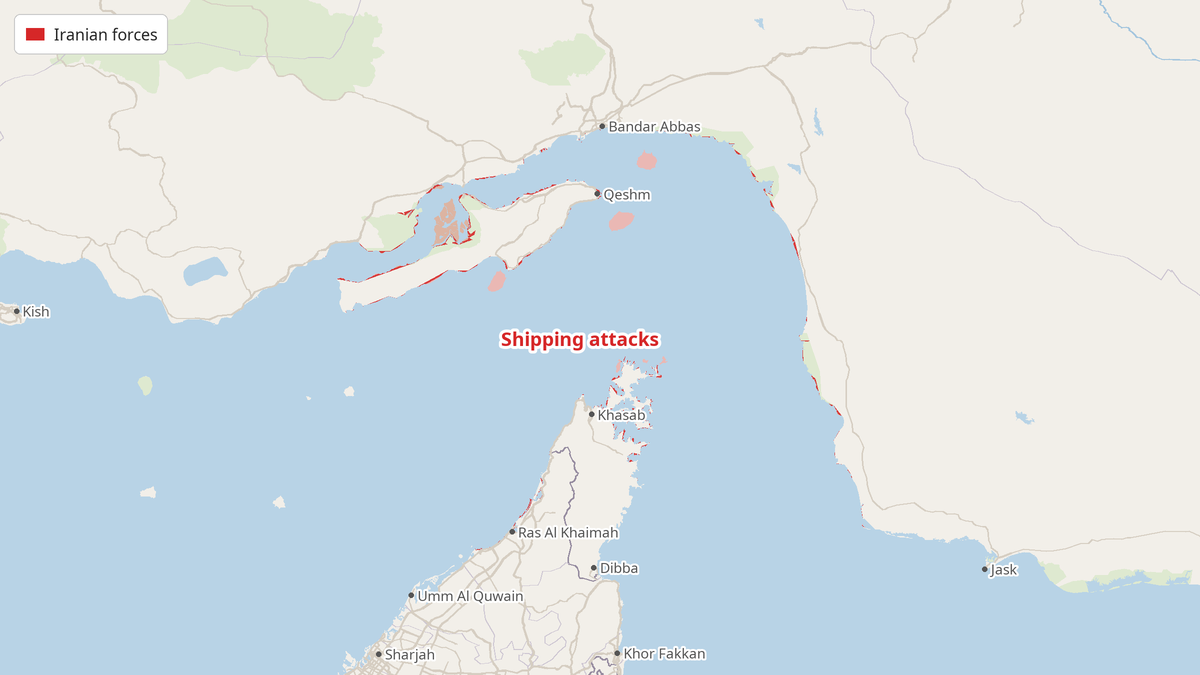
Iran has stepped up attacks on oil tankers in the Strait of Hormuz and targeted U.S. bases in Bahrain and Kuwait, challenging a shipping route where about 8 million barrels of oil still exit each day under U.S. naval escort.
At least six strikes on shipping were confirmed by the United Kingdom Maritime Trade Operations in the past week. Iran has claimed more attacks, at a pace not seen since the war began. Tehran says it won't allow ships to undermine its claim to the oil chokepoint.
The attacks put commercial shipping and American security interests under pressure at the same time. Iran says it wants to stop the flow of oil and reclaim control of the waterway, while the U.S. escort continues to protect oil moving out of the strait.
Oil Shipping Under Attack
The Vortexa maritime firm said Iran has specifically targeted some of the busiest ships in the area. Those vessels have been making repeated trips through the strait, placing them on a route Tehran is trying to control.
The confirmed strikes establish a threat to vessels using the waterway, although Iran claims its attacks have gone beyond those confirmed by the United Kingdom Maritime Trade Operations. Oil continues to leave under the U.S. naval escort despite Tehran's stated opposition.
Iran's attacks on U.S. bases in Bahrain and Kuwait were described as an escalation intended to challenge the current status quo. They extend the confrontation beyond the tankers moving through the strait.
Kristian Coates Ulrichsen, a Middle East expert at Rice University's Baker Institute, told the Wall Street Journal that the attacks also signal Iran has rebuilt its missile and drone launchers and is prepared for all-out war to resume.
“The attacks on Kuwait and Bahrain are a signal that Iran retains both the capability and the intent to target US partners across the Gulf and are a reminder to leaders in the Gulf states that they remain vulnerable to retaliation for U.S. actions in the Strait of Hormuz,” Coates Ulrichsen said.
Economic Pressure and Military Risk
Trump has signaled he is content to let the war remain cold while America's economic pressure campaign squeezes Iran. The attacks come as that pressure continues and Tehran seeks to break the current stalemate.
Hamidreza Azizi, senior Iran analyst at the International Crisis Group, told Al Jazeera: “The two sides have very different calculations about the costs of prolonging the confrontation.”
“As economic pressure mounts, Iran may become increasingly willing to take military risks to break the deadlock,” Azizi added.
Lead Iranian negotiator Mohammad Bagher Ghalibaf addressed parliament on Sunday and warned the United States that lawmakers had been told by Supreme Leader Mojtaba Khamenei to end the stalemate. His remarks left open the prospect of either negotiations or war.
“We will not remain in a state of 'neither war nor peace,'” Ghalibaf said. “It makes absolutely no difference to us whether the United States wants negotiations or war.”
Coates Ulrichsen pointed to the limits of American control over the confrontation as the Trump administration continues its buildup of force in the region. “As the Trump administration continues its buildup of force in the region, the attacks are a reminder that the US does not have a monopoly on the escalation ladder,” he said.
Why This Matters: The security of a commercial oil route is now tied to an active U.S. naval escort: about 8 million barrels continue to exit the Strait of Hormuz each day while Iran targets tankers and claims control of the chokepoint. Iran's strikes on U.S. bases in Bahrain and Kuwait also expose American partners to the confrontation, with Coates Ulrichsen warning that Gulf states remain vulnerable to retaliation for U.S. actions in the strait. Economic pressure remains central to Trump's approach, but Azizi warns that mounting pressure may make Iran more willing to take military risks. Keeping oil moving and protecting U.S. partners remain immediate security stakes.
- iran
- strait of hormuz
- oil tankers
- bahrain
- kuwait
- u.s. military bases
- missile attacks
- oil shipping