
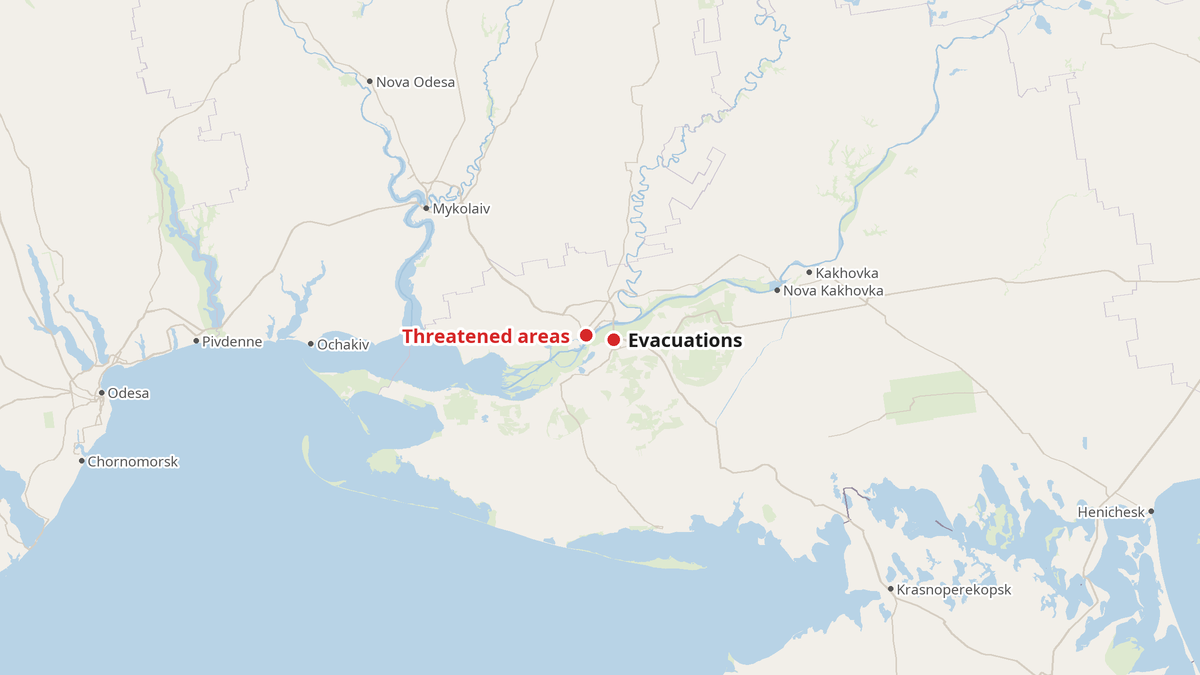
A six-day ceasefire in Ukraine’s Kherson region ended on Sunday night after Ukraine said it had evacuated 167 more civilians from threatened areas, including 22 children and 21 people with limited mobility. Neither side reported violations during the truce, and no extension was announced.
Evacuations from Oleshky
The ceasefire allowed hundreds of residents to leave Russian-occupied Oleshky in a rare joint operation between Kyiv and Moscow. About 2,000 civilians were in the city when the truce began. Residents were offered a choice: evacuation to Ukrainian-controlled territory, evacuation to Russian-occupied territory, or remaining in Oleshky with replenished food and medical supplies.
Ukraine’s General Staff said the latest evacuation involved civilians from threatened areas across the southern Kherson region. “Units of civil-military cooperation of the 'South' group of forces, in cooperation with representatives of local authorities, evacuated 167 civilians to safer points in the Kherson region,” it wrote on Telegram. The group included people who needed special assistance because of limited mobility.
Oleshky is under Russian occupation, on the front line and facing a humanitarian crisis. Civilians there lacked basic necessities. France 24 reported that residents who had requested evacuation were reunited with loved ones in Ukraine on Saturday, October 31.
The truce applied to Oleshky and the surrounding area. It was due to expire at 10:59 p.m. Ukraine time, or 20:59 GMT. A Ukrainian official told AFP that Russia reportedly refused Kyiv’s Foreign Ministry proposal to extend it.
Movement during the truce
Melania Trump said on social media that the ceasefire had given residents “the freedom to move” and access to food, clean water and medicine. She added that it had provided “a renewed sense of dignity without the constant threat of attack” and said, “Let Oleshky become the starting point for lasting peace.” The truce followed mediation efforts by Melania Trump and involved Pope Leo XIV.
Kremlin spokesman Dmitry Peskov, quoted by Russian news agencies, said Moscow viewed positively the operation in Oleshky and coordination between the two countries’ human rights commissioners. The operation enabled residents to choose where to go or remain in the city as the ceasefire held.
As the truce neared its end, Kherson Governor Oleksandr Prokudin urged residents to stay alert and avoid areas near the Dnipro River. “The intensity of Russian strikes there remains high, and the threat to life is extremely high,” he wrote on Telegram. He referred to the areas and settlements as “red zones.”
Fighting continues elsewhere
Residents in Kherson city, one of the remaining areas of the region still controlled by Ukraine, remained calm. “Don't be afraid, keep holding on,” Oleksandr Knyha, head of the Mykola Kulish Kherson Regional Academic Music and Drama Theater, told an audience as he opened a concert. Knyha is from Oleshky and used to commute to Kherson for work. “That's also what keeps me here,” he told the Associated Press.
The ceasefire ended as attacks continued elsewhere. Ukrainian President Volodymyr Zelenskyy said Russian strikes on Sunday left hundreds of thousands of households without power, with Russia continuing to target Ukraine’s energy systems before winter. Ukraine’s State Emergency Service said a Russian drone strike at a vocational school in Vinnytsia killed three people, including a 13-year-old girl, and wounded four others.
Ukraine’s Air Force said Russian forces attacked with 433 drones overnight; 371 were destroyed or suppressed. The ceasefire was described as the longest multi-day truce between Russia and Ukraine. No violations were reported during its six days.
- kherson region
- oleshky
- ceasefire
- evacuations
- ukraine
- russia
- humanitarian crisis
- melania trump