
Paraguayan prosecutors raided the summer mansion of ousted President Santiago Peña on Sunday and found an armored vault hidden behind a false wall that they couldn't open. The discovery deepened what is fast becoming the country's biggest political and financial crisis in recent years, one that has frozen the savings of roughly three million people.
The Ministerio Público said at a press conference on Monday that the vault is "de gran complejidad" (of great complexity) and "se abrirá con el equipo adecuado" (will be opened with the right equipment), according to prosecutor Silvia González. Investigators also found computers, other devices and documents that "podrían ser importantes" (could be important).
The Vault and the Search
The search began shortly before 7 p.m. on Sunday at the property in the Ciervo Cuá neighborhood of San Bernardino, in the department of Cordillera, about 50 kilometers from Asunción. It resumed at 7 a.m. Monday. Prosecutors Silvia González, Christian Benítez and Elena Fiore led the operation.
Benítez said investigators opened only the first door leading to the vault. The second security barrier held. According to ABC Color, the system is "level 7" and requires at least four mechanisms: facial or iris recognition, fingerprint, numeric code and multilock-style keys. What's inside remains unknown.
Prosecutors are weighing three options. The first is a controlled detonation. "Estamos analizando la posibilidad de armar una detonación controlada, si es que no hay otra manera de abrir" (We're analyzing the possibility of setting up a controlled detonation, if there is no other way to open it), Benítez said. He acknowledged the blast could damage the contents and the structure, noting there's a swimming pool above the vault. The second option is bringing in Peña's wife, Leticia Ocampos, to see whether her iris is authorized in the recognition system. Relatives aren't obligated to cooperate, Benítez noted. Bringing Peña himself isn't currently under consideration.
Investigators are working on the hypothesis that it could be a panic room. Peña's defense made no comment on the search or the vault.
The House and the Loans
The mansion sits at the center of the case. According to the charging document, on May 13, 2024, while he was president, Peña received two simultaneous loans from Ueno Bank totaling 3,548 million guaraníes (567,254 dollars) to build it. Monthly installments of 239 million guaraníes (38,250 dollars) were equivalent to six times his presidential salary. Construction cost about 7,700 million guaraníes, roughly 1.2 to 1.3 million dollars according to ABC Color. A journalistic investigation put the mansion's value at about 2 million dollars.
Peña has defended himself before. In January 2025, facing criticism over the house, he said he has "worked since he was 18" and considered himself "una persona honesta, trabajadora," according to Última Hora.
Public Money, Private Bank
Ueno Bank, a private digital bank, was intervened by the Central Bank on November 3, six days ago. About three million clients lost access to their accounts. Al Jazeera reports the central bank stepped in after discovering Ueno had breached minimum solvency requirements. The bank had made 146 million dollars in questionable loans to companies linked to its owner, and its corrected accounts showed capital had fallen below half the legal minimum.
The exposure of public money was staggering. Pension funds from the Instituto de Previsión Social, which manages retirement for private-sector workers, had deposited about 355 million dollars there. Al Jazeera, citing the indictment and reports, says Ueno held approximately 850 million dollars in public funds by June.
Legislators accused Peña of using his political influence to steer hundreds of millions of dollars in public funds into Ueno while regulators overlooked risky insider lending. The impeachment charges allege that Peña held a stake in Ueno's holding company, which he divested under pressure last year, and appointed a former Ueno executive to run the central bank that regulated it. Lawmakers also accuse him of letting the state pension fund deposit 355 million dollars at the bank, beyond legal limits. Peña has maintained that the bank's difficulties were a regulatory matter.
Removal and Charges
The Senate removed Peña on Friday, November 6, three days ago, rejecting his attempt to resign a day earlier. The vote was unanimous according to Al Jazeera, or 44 of 45 according to Clarín. Vice President Pedro Alliana was sworn in and is expected to serve out the remainder of the term until August 2028.
On Saturday, Judge Humberto Otazú ordered Peña held in preventive detention, saying the measure was necessary to ensure he remained in Paraguay during the investigation. Prosecutors charged him with breach of trust (lesión de confianza), as instigator, and administration for personal gain (administración en provecho propio), as perpetrator. Prosecutors said he could face up to 20 years in prison if found guilty, according to the Associated Press; Al Jazeera says each offense could carry up to 10 years. They calculate damage of about 809 million dollars, the sum of state deposits in the bank, not a proven loss.
Peña denies the charges. His lawyer, Ricardo Preda, said Peña would plead not guilty and cooperate with investigators. "What sets a serious country apart is not that its banks don't fail, but how it responds," Preda said Friday. "If there is one thing that undermines confidence in the financial system, it is attempting to oust the president without evidence."
The probe reaches beyond the presidency. Al Jazeera identifies Carlos Carvallo, who previously headed Ueno, as charged with breach of trust, producing false public documents and administration for personal gain, and ordered into pretrial detention.
The Cost to Ordinary Savers
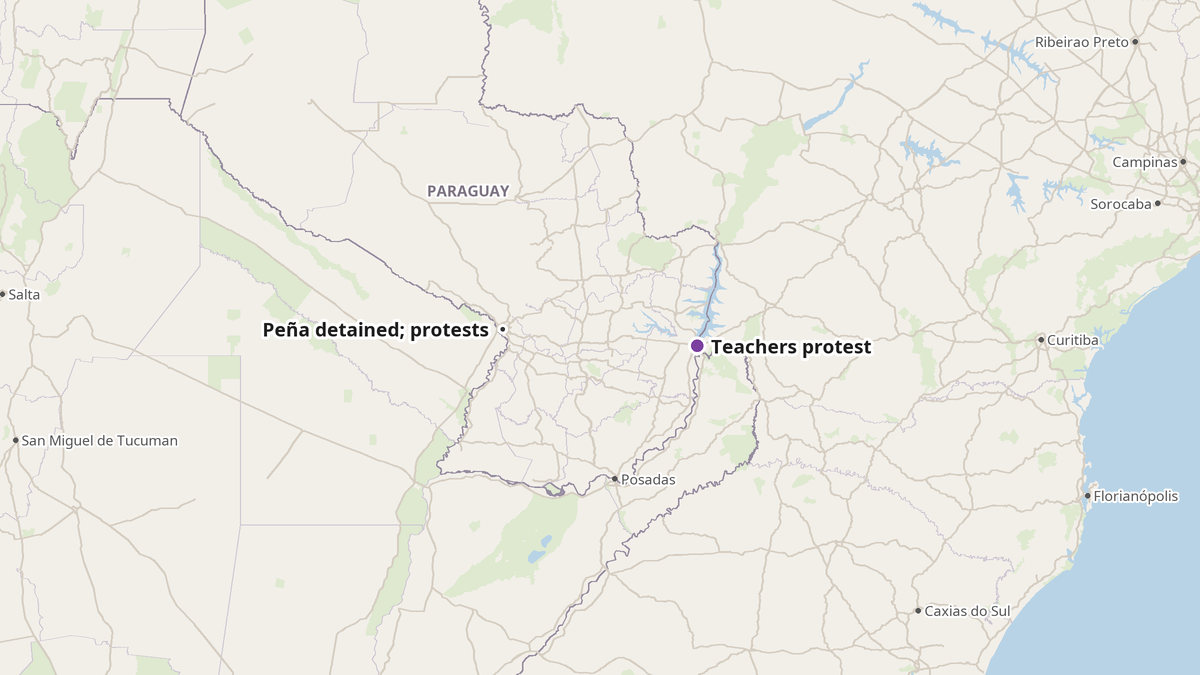
Public schoolteachers went on strike Monday and took to the streets of several cities. Silvio Piris, president of the Federation of Paraguayan Educators, said teachers are worried about around 60 million dollars in pension funds deposited in Ueno. "We want the return of that money to be a priority," he told Paraguay's Channel 9.
The Central Bank last week began returning deposits and said that by Saturday it had partially or fully refunded more than 1.2 million Ueno customers. Alliana said Sunday about 158 million dollars had been paid out, with more reimbursements expected this week. Deposits in Paraguay are insured up to around 37,000 dollars. Still, the crisis has sparked protests from account holders, some clashing with police, and the guaraní has lost about 8 percent of its value against the U.S. dollar since Ueno was intervened.
Cinthia Vargas, an account holder quoted by Democracy Now, put the human cost plainly: "I had my entire life savings in Ueno Bank. I'd been saving there for five years, and overnight I lost everything."
Opposition Senator Rafael Filizzola called it "the biggest corruption scandal in our democratic history." Andrew Nickson, a Paraguay expert at the University of Birmingham, was more skeptical about the outcome, telling Al Jazeera that "only scapegoats are likely to suffer long-term sentences." He noted that two previous attempts since the 1990s to prosecute former Paraguayan presidents ended with charges dropped on appeal.
Why This Matters:
The facts here point to a failure of oversight, not just of one bank. Hundreds of millions in public and pension money sat in a single private institution, reportedly beyond legal limits, while regulators looked past insider lending. That's the kind of concentration risk that sound supervision exists to prevent. Deposit insurance capped at around 37,000 dollars leaves larger savers and public funds exposed, and an 8 percent slide in the guaraní shows how quickly confidence erodes. The case will also test whether Paraguay's institutions can deliver accountability under the rule of law. Peña is presumed innocent, and his lawyer warns that ousting a president without evidence damages trust too. How prosecutors and courts handle the evidence, including whatever sits behind that vault door, will shape whether investors and ordinary savers believe the system can protect them.
- santiago peña
- ueno bank
- paraguay
- central bank
- money laundering
- san bernardino
- presidential mansion
- corruption