
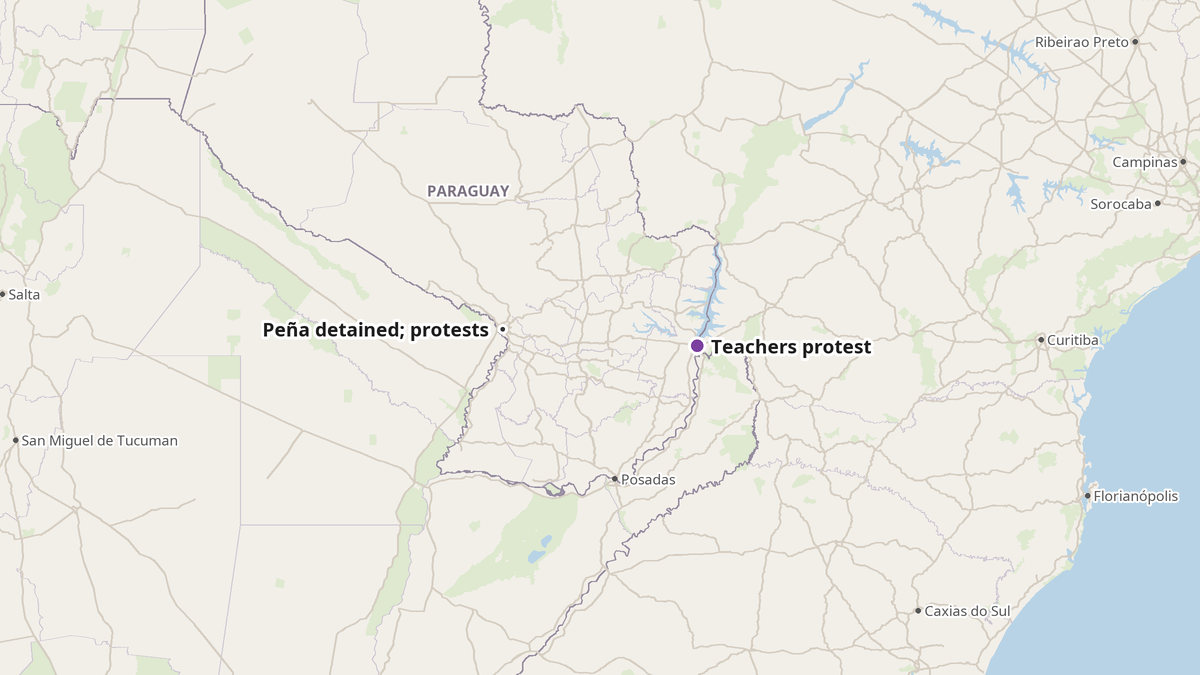
Paraguayan prosecutors raided the summer mansion of ousted President Santiago Peña on Sunday and found an armored vault hidden behind a false wall that they couldn't open. Across the country on Monday, public schoolteachers walked off the job over a different question: where their retirement money went.
Silvio Piris, president of the Federation of Paraguayan Educators, said teachers are worried about the fate of around 60 million dollars in pension funds deposited in Ueno Bank. "We want the return of that money to be a priority," Piris told Paraguay's Channel 9. The strike pulled teachers into the streets of several cities.
Who Pays
Ueno Bank, a private digital bank, was intervened by the Central Bank on November 3, six days ago. About three million clients lost access to their accounts. Al Jazeera describes that as close to half the country's population. Pension funds from the Instituto de Previsión Social, which manages retirement for private-sector workers, had deposited about 355 million dollars there. Al Jazeera, citing the indictment and reports, says Ueno held approximately 850 million dollars in public funds by June.
Cinthia Vargas, an account holder quoted by Democracy Now, put the cost in personal terms: "I had my entire life savings in Ueno Bank. I'd been saving there for five years, and overnight I lost everything."
The guaraní has lost about 8 percent of its value against the U.S. dollar since the intervention. The Central Bank says it has partially or fully refunded more than 1.2 million Ueno customers, and Vice President Pedro Alliana said about 158 million dollars had been paid out as of Sunday. Deposits in Paraguay are insured up to around 37,000 dollars. Account holders have protested, and some have clashed with police.
Who Profited
The charging document traces how the house at the center of the case was financed. On May 13, 2024, while he was president, Peña received two simultaneous loans from Ueno totaling 3,548 million guaraníes, about 567,254 dollars, to build the mansion. Monthly installments of 239 million guaraníes, about 38,250 dollars, equaled six times his presidential salary. Construction cost about 7,700 million guaraníes. A journalistic investigation put the property's value at about 2 million dollars. The lot covers 5,012 square meters, with 1,015 built.
Legislators accuse Peña of using his political influence to steer hundreds of millions of dollars in public funds into Ueno while regulators overlooked risky insider lending. The impeachment charges allege he held a stake in Ueno's holding company, divesting under pressure; Al Jazeera says he held shares in the parent company until March 2025. He is also accused of appointing a former Ueno executive to run the central bank that regulated it, and of letting the state pension fund deposit 355 million dollars beyond legal limits.
Al Jazeera reports the Central Bank intervened after finding Ueno had breached minimum solvency requirements. The bank had made 146 million dollars in questionable loans to companies linked to its owner, and its corrected accounts showed capital below half the legal minimum.
The State's Role
The Senate removed Peña on Friday, November 6, three days ago, rejecting his attempt to resign a day earlier. Al Jazeera reports the vote was unanimous; Clarín reports 44 of 45. Alliana was sworn in and is expected to serve until August 2028. On Saturday, Judge Humberto Otazú ordered Peña held in preventive detention at the Presidential Escort Regiment base in Asunción. Prosecutors charged him with breach of trust and administration for personal gain, and calculate damage of about 809 million dollars, the sum of state deposits in the bank, not a proven loss. Peña denies the charges.
The probe also reaches the central bank. Al Jazeera identifies Carlos Carvallo, who previously headed Ueno, as charged with breach of trust, producing false public documents and administration for personal gain, and ordered into pretrial detention.
Andrew Nickson, a Paraguay expert at the University of Birmingham, told Al Jazeera: "The judicial system is so corrupt and politicised in favour of the [ruling] Colorado Party that only scapegoats are likely to suffer long-term sentences." He said two earlier attempts since the 1990s to prosecute former presidents ended with charges dropped on appeal.
Peña's lawyer, Ricardo Preda, said Peña would plead not guilty. "What sets a serious country apart is not that its banks don't fail, but how it responds," Preda said Friday.
Opposition Senator Rafael Filizzola called it "the biggest corruption scandal in our democratic history." Meanwhile prosecutors are weighing a controlled detonation to open the vault, or bringing in Peña's wife, Leticia Ocampos, to test whether her iris is authorized in the recognition system. What's inside remains unknown.
- santiago peña
- ueno bank
- paraguay
- central bank
- money laundering
- san bernardino
- presidential mansion
- corruption