
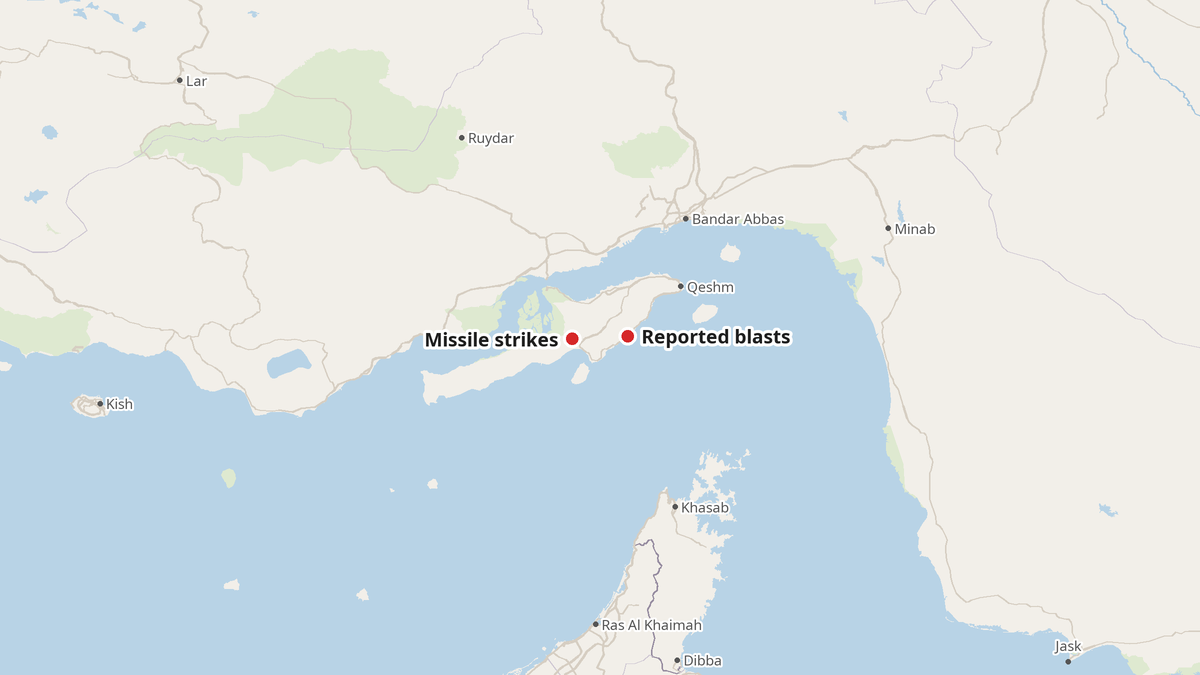
Iranian media reported two missiles striking Qeshm Island near the Strait of Hormuz, as the Islamic Revolutionary Guards Corps said it was building underground complexes for weapons production and storage. The reported damage on Qeshm was unclear. U.S. President Donald Trump said the U.S. military had carried out “minor strikes” there, knocking out Iranian air-defense systems; Iran’s army said its air defenses had downed a U.S. drone over the island.
Strikes and the Strait of Hormuz
Iranian state media said two blasts were heard in the island’s Suza area. Trump told reporters that Iranian air defenses were disabled “in about 15 minutes, maybe five.” U.S. Central Command described the situation as “relatively calm.” The accounts did not establish the extent of damage or independently resolve the conflicting claims about air defenses and the drone.
The strikes came during the U.S.-Israeli war on Iran, launched on February 28. Tehran closed the Strait of Hormuz after the war began, triggering a global energy crisis. Gulf News reported that the United States had launched “defensive strikes” on Qeshm and that Qatar’s mediation between Washington and Tehran remained active.
Qatar rejected reports that negotiations had stalled. “Promoting such false claims serves only those seeking to prolong the war and destabilise the region,” Majad al-Ansari, spokesperson for the Qatari Ministry of Foreign Affairs, said in a post on X. Trump said talks were continuing: “We're dealing with them now. They want to make a deal,” he said, adding, “We've made a lot of progress with Iran.” Gulf News reported that mediators were pursuing a possible agreement linking maritime access, sanctions relief and nuclear inspections.
Iran's Underground Weapons Program
IRGC spokesperson Hossein Mohebbi said Saturday that the force had moved missile and drone production lines from surface facilities to underground sites. Iranian media reported that he made the announcement about military capabilities at a news conference in Tehran. The semi-official Tasnim news agency said an “underground missile city” was among the achievements set to be unveiled.
Mohebbi said underground production allowed manufacturing to continue while adversaries assumed Iran’s stockpiles were dwindling. He also said improvements in stealth technology had enabled Iranian missiles and drones to penetrate air defenses and accurately strike targets in previous rounds of fighting with the United States and Israel. “Today, every weapon used by the IRGC Aerospace Force is manufactured using homegrown knowledge and expertise,” IRNA quoted him as saying. He added that the products were not derived from reverse-engineering captured enemy weapons.
Mohebbi warned that restrictions on the range of Iranian missiles had been lifted. The statement followed Supreme Leader Mojtaba Khamenei’s warning that there would be “no geographical limits” to Iran’s response if the United States and Israel attacked again.
Nuclear and Maritime Security
On Friday, U.S. Central Command announced a reward of up to $20 million, and possible relocation, for information about Iran’s nuclear program. The request covered facilities, equipment, associated personnel, including members of the scientific community, and the movement of those people or items. The reward was offered through the State Department’s Rewards for Justice program, according to Gulf News.
The United States has imposed additional sanctions on Iran and a naval blockade intended to prevent Iranian oil exports. On Saturday, U.S. Central Command announced a task force to support efforts to stop Iran using land routes to transport advanced weapons and other materials. A separate Reuters report found that Iran had targeted Gulf infrastructure at least 135 times during previous rounds of fighting, causing billions of dollars in damage and lost revenues.
Gulf News also reported that Yemen’s Iran-backed Houthis were effectively policing Red Sea maritime transit through a system in which vessels could request safe passage by email. The Houthis, who control swaths of Yemen, declared a maritime blockade of Saudi Arabia earlier in 2026. The Journal report cited by Gulf News said some ships contacted the Houthis before transiting, and replies typically arrived within 24 hours. Tehran has repeatedly warned it would target Gulf energy infrastructure if fighting resumed.
- qeshm island
- iran
- united states
- strait of hormuz
- airstrikes
- iran-us conflict
- qatar mediation
- iran nuclear program