
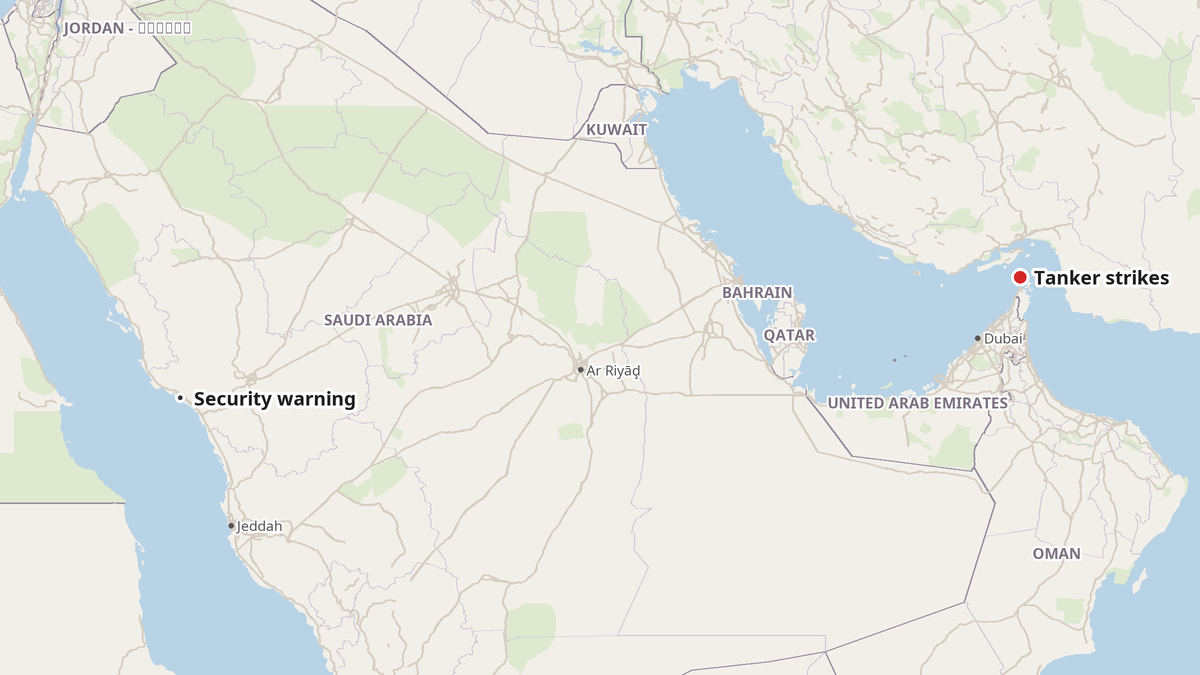
Iranian forces said at least five tankers were damaged in the Strait of Hormuz, while the British military separately reported that a tanker was hit by two projectiles off Qatar's coast. The incidents come as Iran restricts traffic through a waterway that normally carries about one-fifth of global oil consumption, and as US forces prepare for possible renewed combat operations.
The accounts of tanker damage attributed to mines have not been independently confirmed. The United Kingdom Maritime Trade Operations (UKMTO) said the tanker off Qatar was struck at 23:20 GMT on Wednesday, about 50 nautical miles north of Madinat ash-Shamal. It didn't identify the ship or its flag, and no one had immediately claimed responsibility.
Attacks and restricted shipping
The Islamic Revolutionary Guard Corps (IRGC) told the Fars news agency that a large oil tanker trying to pass through what it called an “illegal passageway” south of the strait caught fire after striking a mine the previous night. The IRGC said the tanker was brought to a halt. It also said another supertanker caught fire while leaving the eastern Strait of Hormuz, and that a tugboat approaching to put out the fire caught fire as well.
Iran's army later said three more tankers struck naval mines and caught fire. In statements carried by the official IRNA news agency, it said one tanker caught fire early Thursday in an unsafe area east of the strait, while two others struck mines and caught fire around noon. Gulf News separately reported that the IRGC described two oil tankers and a tugboat catching fire in separate incidents while attempting to use an unauthorized route.
The IRGC blamed the United States for encouraging vessels to use the route, saying the incidents would raise insurance costs for US taxpayers and regional allies. That accusation came from the IRGC; the reported incidents and their causes have not been independently confirmed. UKMTO advised vessels to exercise caution and report suspicious activity. In a report last month, it said it was “struggling to accurately report” the true number of attacks because most ships now refuse to report them.
Last week, the Qatari liquefied natural gas carrier Al Mayeda was struck by “unidentified objects” while sailing in the Gulf, Qatar Gas Transport Company (Nakilat) said. Nakilat reported no injuries among the crew and no environmental impact, and said the vessel remained safe and operational while the impact was assessed.
Nuclear talks and military preparations
Qatar is mediating efforts to resume talks on ending the war. Qatar's Ministry of Foreign Affairs spokesperson said both sides were reviewing mediator proposals and talks were continuing. Mediators were seeking support for a draft proposal with confidence-building measures; direct talks could follow if Washington and Tehran agreed on a framework. No date had been set for new direct negotiations, and neither side had publicly accepted a final settlement.
Iran wants the US naval blockade lifted, sanctions eased and frozen Iranian funds released. Tehran has also tied reopening the Strait of Hormuz to its demands. The New York Times, citing five officials briefed on talks in Doha, reported that Iran was reviewing “concrete proposals” on the future of its nuclear program. The officials, including one American and two Iranians, spoke anonymously and didn't provide details. The Iranian Foreign Ministry hadn't responded to the Times' request for comment.
The Jerusalem Post reported that the Times said a growing number of Iranian clerics and officials were pressing their leaders to reverse their pledge not to pursue nuclear weapons. Former Iranian supreme leader Ayatollah Ali Khamenei issued a fatwa forbidding the development and use of nuclear weapons, while US and Israeli intelligence agencies have reported signs Iran is enriching uranium beyond peaceful levels.
Unnamed Pentagon officials and military commanders told The New York Times that thousands of US air and naval forces, aboard more than a dozen ships and at bases in the Middle East and the United States, were poised to resume major combat operations against Iran on President Donald Trump's orders. Preparations didn't mean Trump had ordered new attacks. He said publicly he was in no rush to decide, with renewed strikes, negotiations, or continued naval blockade and economic sanctions among the options reported by Gulf News.
Regional escalation risks
The Daily Sabah reported that US-Israeli strikes began the war on Feb. 28, and that the conflict was in its ninth month. Tehran fired missiles and drones at Gulf targets and shipping in Hormuz, disrupting global energy supplies, the report said. The campaign badly damaged Iran's military capabilities but didn't produce a decisive outcome, leaving its nuclear program unresolved.
The Saudi-led coalition said its air defences intercepted and destroyed a ballistic missile launched by Yemen's Houthis toward the Medina region on Thursday. The Houthis denied targeting Medina and said their operations were directed at oil facilities and military bases. It wasn't immediately clear whether the missile incident was connected to a warning from Saudi Arabia's civil defence agency about potential danger near the Red Sea port of Yanbu.
Ebtesam al-Ketbi, president of the Emirates Policy Center in Abu Dhabi, said Gulf states wanted the US election to open a path to ending the war, but not at any cost. She said a settlement that disregarded freedom of navigation through Hormuz, allowed Iran to impose tolls or political conditions on shipping, or left Gulf states exposed to military threats would be temporary and lay groundwork for another crisis. Mediation continues. Shipping incidents and military preparations remain unresolved.
- strait of hormuz
- iran
- tanker attacks
- qatar
- nuclear talks
- united states
- maritime security
- iran nuclear program