
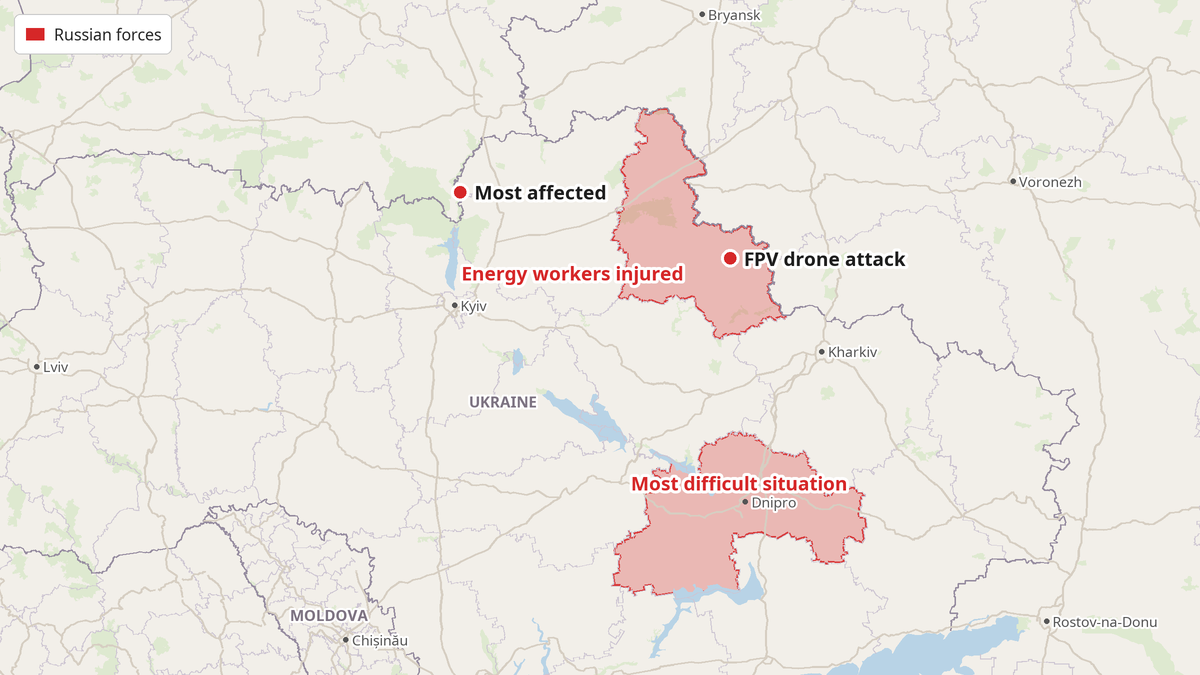
Three Ukrainian energy workers were wounded on Monday when a Russian FPV drone hit their vehicle in Sumy Oblast. One is in critical condition. They were on their way to repair the very grid that Russia has spent the past week trying to destroy.
State-owned operator Ukrenergo said Russian forces deliberately targeted the crew, who maintain and repair damaged energy infrastructure. All three were taken to hospital. "Today's attack is yet another testament to the price paid for this work," the company said.
A Week of Systematic Attacks
Russia deliberately attacked Ukraine's energy and oil and gas sectors 128 times between 2 and 8 November, according to Artem Nekrasov, First Deputy Minister of Energy, speaking at a briefing on the operational situation in the power grid. The ministry recorded 219 incidents that damaged or destroyed energy and oil and gas infrastructure facilities.
The heaviest blow came on 3 November, six days ago. A Russian mass strike that day was the largest attack on Ukraine's energy facilities this year. It caused widespread outages and disrupted water supplies across Kyiv for more than 24 hours. The following day, 4 November, Ukrainian nuclear power plants were forced to reduce their generation capacity because of what Nekrasov called large-scale and systematic Russian attacks.
The overnight strikes didn't let up. According to Oleh Syniehubov, power lines were hit in the village of Zolochiv, Kharkiv Oblast, and in the city of Kharkiv. In Odesa Oblast, local authorities reported massive attacks on the power grid, and in Rivne Oblast an energy infrastructure facility was hit.
Life Without Power
As of Monday morning, consumers in 12 oblasts had no electricity: Vinnytsia, Dnipropetrovsk, Donetsk, Zhytomyr, Zaporizhzhia, Kyiv, Odesa, Poltava, Rivne, Kharkiv, Khmelnytskyi and Chernihiv. The situation remained most difficult in Dnipropetrovsk and Kyiv oblasts.
For households, the arithmetic is brutal. Power cuts of 1.5 to 4 queues will apply in most oblasts throughout 9 November, which means there may be no electricity for up to 16 hours a day. Ukrenergo defines a "queue" as a group of consumers and businesses using a specific amount of megawatts, and the Dispatch Centre decides how many queues are needed to cover energy deficits. Supply can change several times an hour, so the Ministry of Energy urges people to follow announcements from their regional power distribution companies, the oblenergos.
Emergency cuts hit Sumy, Poltava and Kharkiv oblasts in the morning, and Ukrenergo suspended previously announced outage schedules there. Critical infrastructure and eligible industrial companies that import at least 60% of their energy cannot be disconnected, under a Ukrainian Cabinet resolution.
The People Keeping the Lights On
Russia has increasingly targeted power lines as temperatures drop. Repeated strikes have forced authorities to introduce rolling blackouts and emergency power cuts. "Power engineers are working flat out to restore stable power supply to consumers as quickly as possible," Nekrasov said. He added that repair work is underway in all affected regions where the security situation allows.
That caveat matters. Ukrenergo said emergency repairs continue wherever security conditions permit, and it described the situation as particularly critical in Kyiv and Dnipropetrovsk oblasts. The Sumy drone strike shows what that qualifier means in practice: the repair crews themselves are now in the line of fire.
Why This Matters:
The numbers in this story are statistics, but the consequences are human. Up to 16 hours a day without electricity means no heating as temperatures fall, interrupted water supplies, and daily life organised around outage schedules that can change several times an hour. Kyiv's water disruption lasting more than 24 hours shows how quickly a grid attack becomes a public health problem. Support for Ukraine is strategic, but it is also a moral obligation to civilians living through this. The wounding of repair workers underlines the stakes for European partners weighing what air defence, grid equipment and energy assistance they can deliver before the coldest months arrive.
- russia
- ukraine
- power outages
- energy infrastructure
- ukrenergo
- kyiv
- military attacks
- rolling blackouts