
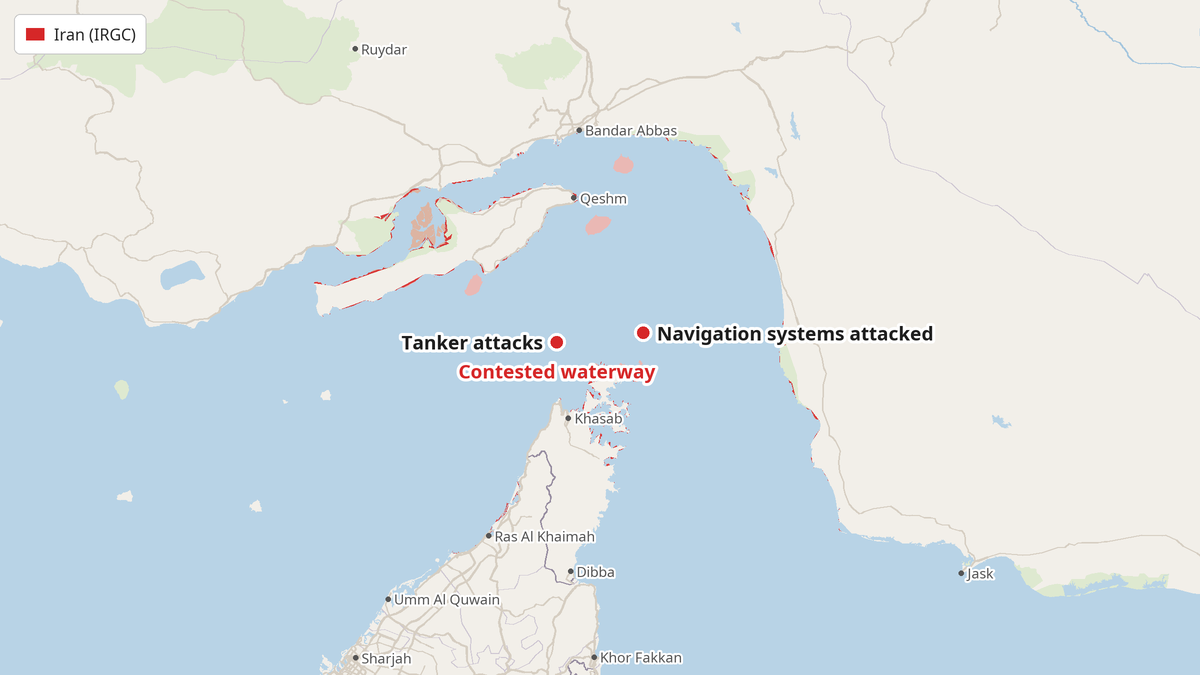
Gulf countries face more than $200bn in damage and economic losses from the war on Iran, and that number could quadruple by 2030, the insurer Allianz Trade said Wednesday. Most of the physical damage, the company said, is concentrated in "Hormuz-locked economies, especially in energy infrastructure." Behind the figure sit shuttered ports, stalled cargoes and a waterway that remains contested months after the guns were supposed to go quiet.
That contest sharpened the same day. Mohammad Bagher Ghalibaf, Iran's parliament speaker and top negotiator, told Al Jazeera in an exclusive interview that the Strait of Hormuz will "never return" to its status before the US-Israel war on Iran. He said Iran and Oman have reached an understanding to oversee the waterway as part of Tehran's seven-point proposal to end the conflict, now in its ninth month. "There are no 'free waters' [international waters] there, and the 1982 [UN Convention on the Law of the Sea] does not apply to the strait," Ghalibaf said. Regulations there, he argued, are governed by the laws of the two littoral states.
Ships Still Under Fire
The claim isn't only rhetorical. Middle East Eye reported that while direct attacks on Gulf states have stopped, Iran is still striking vessels in the strait as it competes with the US for control of the waterway. Al Jazeera reported that Iran continues to target ships it says are violating its conditions for transit. Washington, for its part, is ramping up sanctions, maintaining its blockade of Iranian ports and planning to block Iran's land-based supply routes too.
The people caught between those two strategies aren't generals or ministers. They're the crews on the targeted vessels and the populations of economies that depend on the strait staying open, which is exactly what the Allianz Trade assessment captures.
Seven Conditions, One Standoff
Ghalibaf said Tehran sent the US a clear response through a Qatari mediator, including its seven conditions for peace talks, and is waiting for an official reply. "The ball is now in the American court," he said. The conditions include lifting the US naval blockade and sanctions, releasing Iranian frozen funds, ending fighting on all fronts and an explicit announcement that the war is over. He said these demands were part of the Islamabad memorandum of understanding signed in June, about five months ago, and that implementing them is necessary before negotiations with the US can begin.
He was candid about the obstacle. "What stands in the way of an agreement is our lack of trust in the United States," he said, adding that an agreement is possible if America sticks to what's been agreed "without making excessive demands or engaging in behaviour that breeds distrust." He also said US officials asked Russian President Vladimir Putin to mediate direct negotiations with Tehran during a visit to Moscow.
Ghalibaf warned against new US attacks, saying President Donald Trump would face another defeat and political pressure from the new Congress that takes office in January. Iran, he said, wants to move beyond a state of "no war and no peace," and urged a sustainable deterrent capability, including military capabilities.
Diplomatic Options on the Table
There are openings, at least on paper. In September, about two months ago, Iran proposed a seven-day plan to reopen the strait and restart talks. Tehran has since said that timeline could be cut to two days. US Secretary of State Marco Rubio, meanwhile, pushed G7 allies to help "protect shipping" around the strait, where he said US forces would stay.
On Yemen, where Saudi-backed government forces are fighting the Houthis, Ghalibaf said "no one should interfere." He added that if both the Yemeni government and Saudi Arabia asked for help, Iran "would certainly offer our assistance." Iran offered in October to facilitate talks between Saudi Arabia and the Houthis after a series of deadly attacks on the kingdom.
Why This Matters: Two sides are each insisting the other move first, and the waterway between them carries the cost. Iran says the strait's old legal status is gone; the US says its forces are staying. Neither position leaves much room for the shipping that Gulf economies need to recover, and the $200bn estimate suggests the bill is already enormous. The proposals on the table, including a reopening plan Tehran says could take just two days, show a diplomatic path exists. But with ships still being hit, a blockade tightening and trust described by Iran's own negotiator as the central barrier, the risk is that a standoff meant to pressure governments keeps falling hardest on the civilians and economies in between.
- strait of hormuz
- mohammad bagher ghalibaf
- iran
- united states
- naval blockade
- sanctions
- iran-us negotiations
- shipping attacks