
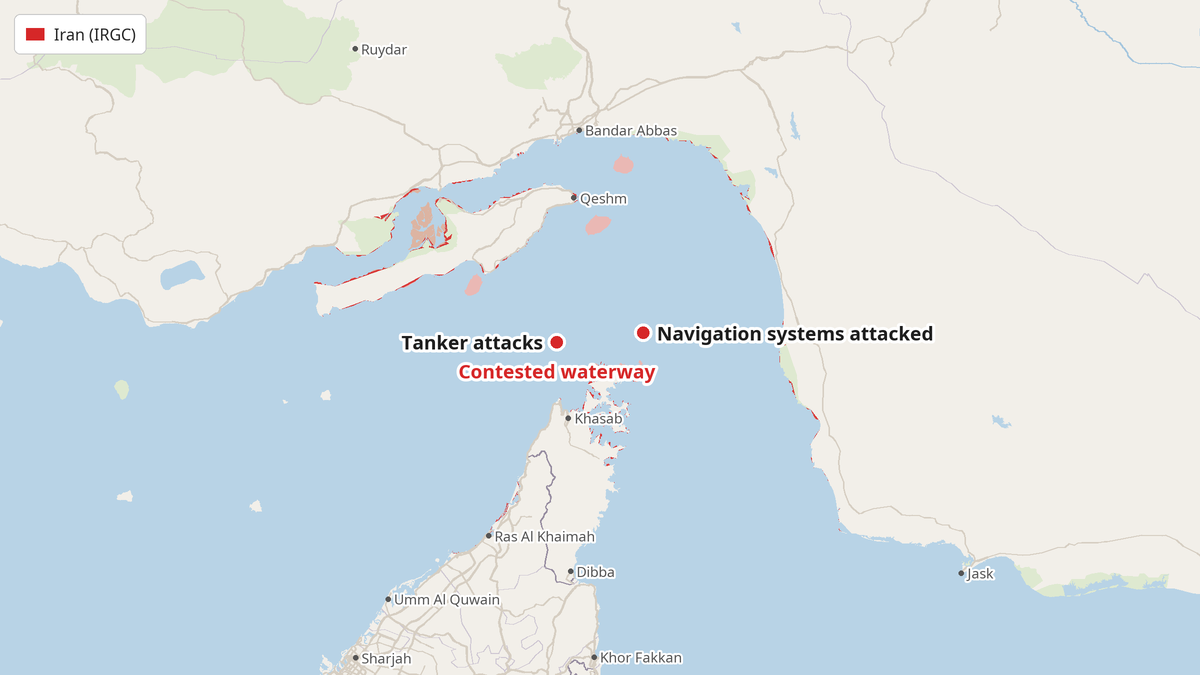
Iran is still striking commercial vessels in the Strait of Hormuz. That's the finding of Middle East Eye, which reported that while direct attacks on Gulf states have stopped, Tehran continues to hit ships as it looks to compete with the US for control of the waterway. Al Jazeera, in its own reporting, said Iran continues to target vessels it claims are violating its conditions for transit through the Strait.
The man announcing those terms is Mohammad Bagher Ghalibaf, Iran's parliament speaker and top negotiator. In an interview published Wednesday, he told Al Jazeera that the Strait of Hormuz will "never return" to its status prior to the US-Israel war on Iran. His reasoning: "There are no 'free waters' [international waters] there, and the 1982 [UN Convention on the Law of the Sea] does not apply to the strait ... The regulations within the Strait of Hormuz are governed by the laws of the two littoral states that border it." He said Iran and Oman reached an understanding to oversee the waterway.
The Terror Threat to Shipping
The claim amounts to a demand for sovereign control over one of the world's most important energy chokepoints, backed by attacks on ships that don't meet Tehran's conditions. Al Jazeera reported that the US is responding by ramping up sanctions, continuing to blockade Iranian ports, and planning to block Iran's land-based supply routes as well.
Ghalibaf was blunt about Iran's long-term posture. He said Tehran is determined to move beyond a state of "no war and no peace," and urged a sustainable deterrent capability, including military capabilities. He also warned against new US attacks on Iran, saying US President Donald Trump will face another defeat and political pressure from the new Congress that takes office in January.
Iran's Conditions and the Yemen Front
Ghalibaf said Tehran gave the US a response through a Qatari mediator that included seven conditions for peace talks. By his account they include lifting the US-imposed naval blockade and sanctions, the release of Iranian frozen funds, ending fighting on all fronts, and an explicit announcement of an end to the war. He said these demands were part of the Islamabad memorandum of understanding signed in June, and that their implementation was necessary before entering negotiations with the US. "The ball is now in the American court," he said.
He placed the burden on Washington. "What stands in the way of an agreement is our lack of trust in the United States," he said. He added that US officials asked Russian President Vladimir Putin to mediate direct negotiations with Tehran during a visit to Moscow.
On Yemen, where Saudi-backed internationally recognised government forces are fighting the Houthis, Ghalibaf said "no one should interfere." Yet he added that if both the Yemeni government and Saudi Arabia asked for Iran's help, "we would certainly offer our assistance." Iran offered in October to facilitate talks between Saudi Arabia and the Houthis following a series of deadly attacks on the kingdom. Tehran is positioning itself as broker in a war involving a militia it is aligned with, after attacks that killed people in the kingdom.
Economic Damage and the Western Response
The cost is already large. The Allianz Trade insurer said Wednesday that Gulf countries face more than $200bn in damage and economic losses from the war, and that the number could quadruple by 2030. "Physical damage across the region is assessed [at] just above $200bn, mostly concentrated in Hormuz-locked economies, especially in energy infrastructure," the insurer said.
In September, Iran proposed a seven-day plan to reopen the Strait of Hormuz and restart talks. Tehran has since said that timeline could be brought down to two days. The offer comes from the party that, according to Middle East Eye, is still hitting vessels in the waterway it now offers to reopen.
US Secretary of State Marco Rubio pushed G7 allies to help "protect shipping" around the Strait of Hormuz, where he said US forces would stay. The request puts the question to America's partners: whether they will help secure a shipping lane that Iran says is governed only by Iran and Oman. The conflict is in its ninth month, and Tehran is still dictating terms for the passage of the world's ships.
- strait of hormuz
- mohammad bagher ghalibaf
- iran
- united states
- naval blockade
- sanctions
- iran-us negotiations
- shipping attacks