
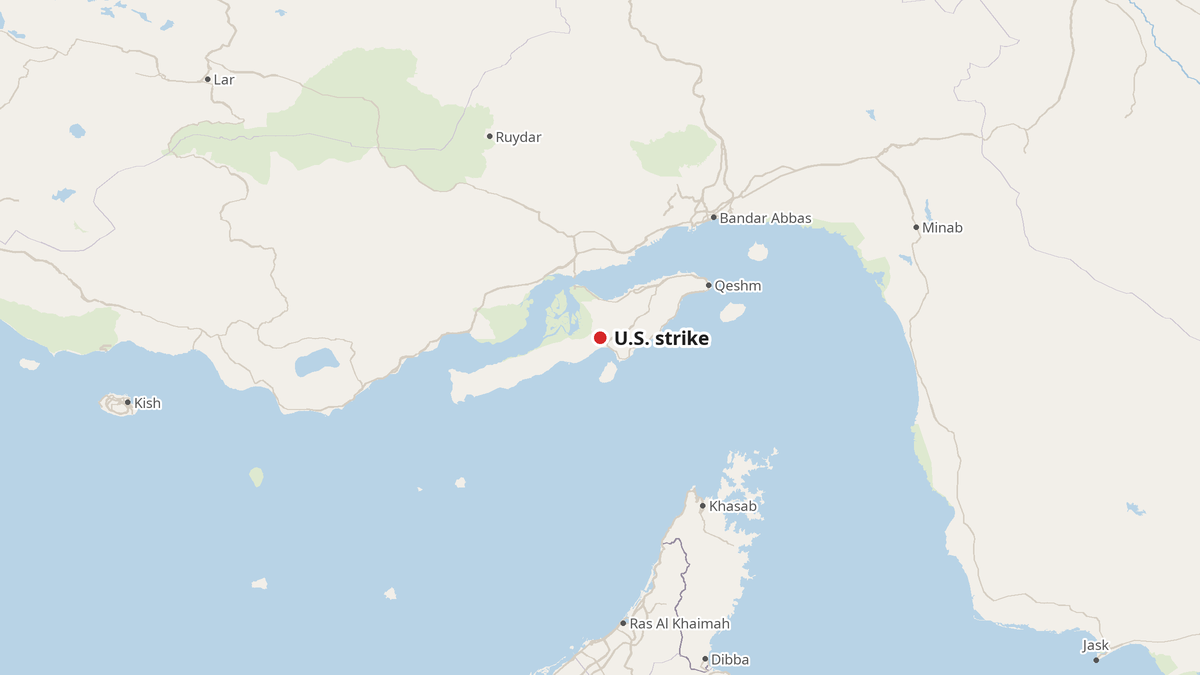
President Trump confirmed Tuesday that the U.S. military struck an Iranian anti-aircraft facility on Qeshm Island, a strike he described as “minor” and “not war.” The attack took place Monday, a day before the U.S. midterm elections, as Washington and Tehran pursued indirect talks through Qatari mediators.
The Strike and Its Targets
Trump told Fox News by phone that the United States had watched Iran build the facility for roughly two months and attacked after construction finished. “We watched it get built, as soon as it was completed, we hit it last night very nicely,” he said. The facility reportedly included radar detectors and missile launchers.
The U.S. military said Monday’s strikes on Qeshm Island and Hengam Island, both in the Strait of Hormuz, were defensive. Trump said Iran had no working airplanes or air defenses left after previous U.S. strikes. “They have no airplanes. They have no anti-aircraft. We took some out last night,” he said. “It’s just a minor attack. It wasn’t war.”
Qeshm is the biggest island in the Persian Gulf and lies in the Strait of Hormuz. The U.S. military has previously targeted the island, which is home to a naval base and an underground missile site. The latest strike therefore took place at a location where military facilities and control of the strait intersect.
Talks, Conditions and Control of the Strait
The strikes came as the United States and Iran pursued indirect talks through Qatari mediators. Iran’s chief negotiator, Mohammad Bagher Qalibaf, said it was up to the United States to prevent a return to all-out war. Tehran had given Washington what he called a “firm and rational response” to U.S. demands concerning nuclear weapons and reopening the Strait of Hormuz. He didn’t specify which response he meant.
Vice President Vance reportedly reached out in recent days to Iran’s security chief, Mohsen Rezaei, as part of efforts to restart talks. Trump has issued mixed messages, threatening for weeks to authorize major combat operations against Tehran after the midterms while also pushing for a peace deal. Vance said Monday that he and Trump “both feel pretty good about the prospects for potentially coming to a negotiated settlement.”
Iran has made concessions on reopening the strait or its nuclear program conditional on the United States lifting its naval blockade on Iranian ports, waiving sanctions on Iranian oil sales, and demanding a ceasefire between Israel and Hezbollah in Lebanon, among other stipulations. Rezaei wrote on social media Tuesday: “America’s response to Iran’s rights and demands was not convincing, and they must fully and explicitly address Iran’s seven conditions and act upon them.” He added: “Only in this case will the Strait of Hormuz be reopened.”
The Cost of the Conflict
The U.S.-Israeli war against Iran began on Feb. 28 and led Tehran to close the Strait of Hormuz. The conflict has driven fuel costs higher around the globe, an issue that has crippled the Republican Party ahead of the elections. The standoff now links military action, negotiations over Iran’s nuclear program, the naval blockade, sanctions on Iranian oil sales and the reopening of a major waterway. The stated conditions remain at odds, while U.S. officials have described both military action and the prospect of a negotiated settlement.
- donald trump
- qeshm island
- iran
- us military strike
- strait of hormuz
- iran nuclear talks
- mohsen rezaei
- middle east conflict