
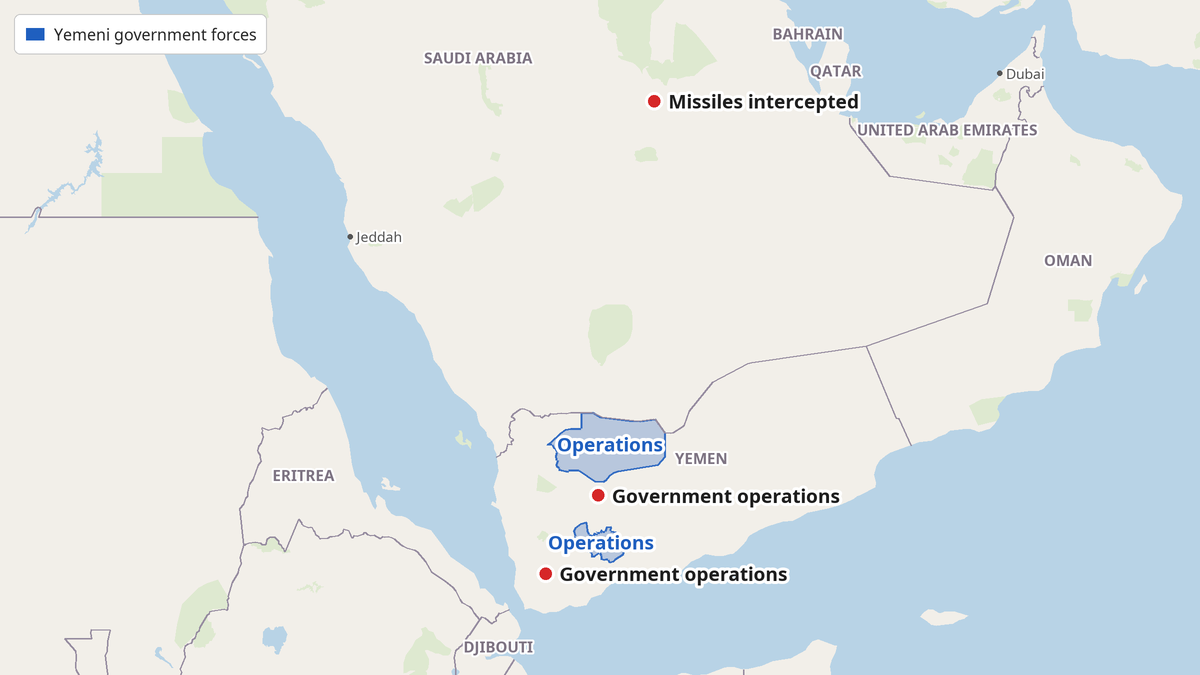
Yemeni government forces said Wednesday they carried out 773 field artillery bombings, 44 drone strikes, 37 rocket attacks and 23 air strikes against Houthi positions in a single reported stretch of fighting. That's more than 870 separate attacks, announced in one post. The base account offers no word on what the barrage meant for the civilians living near those front lines.
Majed Abdullah al-Nuzaili, a spokesperson for Yemen's government forces, wrote on X that the strikes killed and wounded 138 Houthi fighters and damaged 86 heavy weapons and military vehicles. He said operations against the Houthis in al-Jawf, Marib, al-Bayda, Taiz and the southern sectors are continuing. The figures are the government's own, issued by a party to the war, and the available reporting doesn't include independent verification.
A Widening Front
The fighting isn't confined to Yemeni soil. Middle East Eye reported separately that the Houthis, who are aligned with Iran, are bombing Saudi Arabia as they look to extend their territory in Yemen. The Saudi-backed, internationally recognised government is fighting to push back on one front while the kingdom itself absorbs attacks on another.
The list of provinces named by Nuzaili is itself telling. Al-Jawf, Marib, al-Bayda, Taiz and the south span a wide arc of the country. Operations stretching across that many sectors suggest a conflict with no single, contained battlefield. Details on casualties among civilians, displacement, or damage to infrastructure in those areas weren't available in the reporting.
Iran Offers to Mediate
Iran's role is where diplomacy enters the picture, however tentatively. Mohammad Bagher Ghalibaf, Iran's parliament speaker and top negotiator, told Al Jazeera that on the fighting between the Saudi-backed government forces and the Houthis, also known as Ansar Allah (Arabic for "Supporters of God"), "no one should interfere." He then added a conditional offer: "If both the government in Yemen and Saudi Arabia were to ask for our help, we would certainly offer our assistance to help resolve their conflict."
The offer isn't new. Iran previously offered to facilitate talks between Saudi Arabia and the Houthis in October, about one month ago, following a series of deadly attacks on the kingdom. No talks are reported to have followed. The tension in Ghalibaf's remarks is hard to miss: a state described as aligned with one of the combatants says outsiders shouldn't interfere, while volunteering itself as a broker if both sides ask.
The Humanitarian Gap
What's missing from this account matters. Reporting on the Yemeni minister's remarks on foreign commanders, on airport damage, and on conditions in Sanaa could not be retrieved, so those details aren't reported here. The people who bear the cost of artillery, drone and rocket fire across five-plus provinces, and of missile attacks on Saudi territory, remain largely unnamed in the available record.
Why This Matters:
When hundreds of strikes can be tallied in a day and an offer of mediation still produces no negotiating table, the gap between military activity and diplomatic effort is the story. Iran says it will help only if invited, Saudi Arabia is absorbing attacks, and Yemeni forces report operations continuing in at least five areas. The civilians in those areas have no seat in any of these conversations. From a humanitarian standpoint, a war that widens across provinces and borders while talks stay hypothetical tends to deepen the toll on people who didn't choose it. The October offer of facilitation, unanswered by any reported progress, is a reminder that the opening for diplomacy exists on paper long before it exists in practice.
- houthis
- yemen
- saudi arabia
- yemeni government forces
- iran
- mohammad bagher ghalibaf
- majed abdullah al-nuzaili
- military strikes