
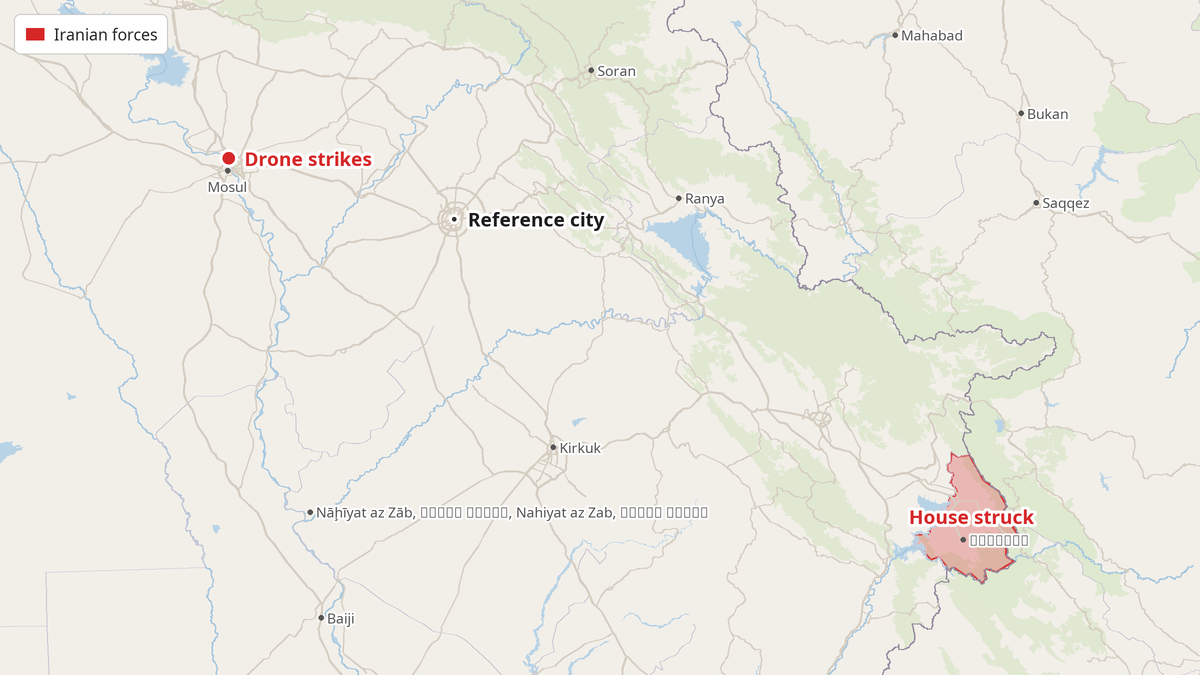
A drone strike early Tuesday blew out the windows, doors and glass at Alwan Abdullah's house in Tawella, in Halabja province. Nobody was hurt. "We don't know what happened," he told Rudaw. "We haven't seen any debris. Our house sustained heavy damage; our glass, doors, and windows are all broken." A security source confirmed the property suffered extensive damage. It was one small piece of a regional war that Iran's leaders, the day after America's midterm elections, were busy turning into a political victory lap.
Strikes on Iraqi Kurdistan
At around 8:45 a.m. Wednesday, two explosive drones hit a Komala group base in the Alana valley of Balisan, about 90 km northeast of Erbil, Rudaw reported. Komala said in a statement: "Despite material damage, this attack resulted in no casualties." Its forces at the site escaped harm.
Ali Ranjbari of Komala called it an "Islamic Republic's drone attack on Komala Peshmerga" and blamed Iran's Islamic Revolutionary Guard Corps. He said the strike formed part of a wider Iranian campaign to spread the conflict to Iraq and pre-empt a Kurdish uprising. Komala is one of five Kurdish groups in a coalition opposing the Iranian regime. The groups have maintained bases in northern Iraq for decades, while many Kurds have fled Iran.
The count is stark: more than 1,000 Iranian drone and missile attacks have targeted the Kurdistan Region of northern Iraq. The strikes intensified after the United States and Israel attacked Iran on February 28, although attacks had happened earlier. The Kurdistan Regional Government is caught in the middle; its autonomous region shares a long border with Iran. Its leadership in Erbil has criticized the Iranian Kurdish groups and openly worried that they could drag the region into conflict. Last month, Iran's ambassador to Iraq, Mohammed Kazem Al-e Sadegh, said Baghdad had agreed to expel the organizations or hand their members to Tehran. An Iraqi official who attended the security meeting disputed that, Rudaw reported.
Tehran Reads the Election
Democrats captured majorities in both the Senate and House on Tuesday, amid frustration over the economy and a war that has driven up fuel prices. Iranian officials celebrated the result. Parliament Speaker Mohammad Baqer Qalibaf, whom Reuters described as Iran's chief negotiator, wrote on X: "Conscience or the cost of living, Americans said NO TO WAR, and we endorse this message." He warned that if Washington ignored the vote, "it will learn our NO comes with a Nightmare."
Two senior Iranian sources said Tehran welcomed the result but feared Trump might try to make up for it with a military strike. Supreme Leader Mojtaba Khamenei said U.S. hostility would continue whichever party held power, and warned that Iran's response to renewed aggression would come "on a much greater scale." Mohsen Rezaei, Supreme National Security Council Secretary, said Washington must answer Iran's seven conditions fully and explicitly before "the Strait of Hormuz be opened."
The threats grew wider. At a rally in Bandar Abbas, Hamidreza Moghadamfar, an adviser to the Revolutionary Guard Corps commander-in-chief, said Iran would extend its response beyond U.S. bases if Gulf states let Washington launch attacks from their territory. He said the UAE and Bahrain would face a wider response.
The Political Fallout in Washington
On Tuesday, Trump refused to rule out resuming combat operations. He told Fox News the war was "a part of" his party's losses. Vice President JD Vance put it more plainly: "The reason we lost is the war. The president himself said so last night." Vance said many 2024 Trump voters switched to Democrats in 2026, citing the Iran war and the economy. Senate Democrat Chuck Schumer said: "This war must end. It must end," and pointed to the "power of the purse" as a way to check a president "who does war without the consent of the American people." Trump threatened to use his veto.
Mediators, including Qatar, Russia and China, have stepped up efforts to end the war, fearing it could reignite. Fighting has reached southern Iran, the Strait of Hormuz, Lebanon and Yemen, where Houthis struck energy facilities, airports and other targets in Saudi Arabia. Tehran's closure of the Strait of Hormuz has disrupted shipping and pushed global oil and gas prices higher. The U.S. naval blockade has damaged Iran's economy.
In Tehran, thousands marched on the 47th anniversary of the U.S. Embassy seizure, burning American and Israeli flags and chanting "Death to America." Zahra Nadiminejad said that whichever party wins, "our hostility toward America will never come to an end."
Why This Matters: The war now runs on two tracks that rarely meet: a theatrical political contest in Washington and Tehran, and the daily reality of drone strikes on border villages like Tawella. Residents of Iraqi Kurdistan didn't choose this fight, yet they absorb its blows. Iranian threats to widen the response to Gulf states, and Trump's refusal to rule out renewed combat, show how little the election has settled. Diplomacy is the only exit anyone has named, and mediators are straining to reach it. If it fails, civilians across a half-dozen countries pay first, in damaged homes, higher prices and closed shipping lanes.
- iran
- united states
- drone strikes
- midterm elections
- strait of hormuz
- komala
- iraq
- military deterrence