
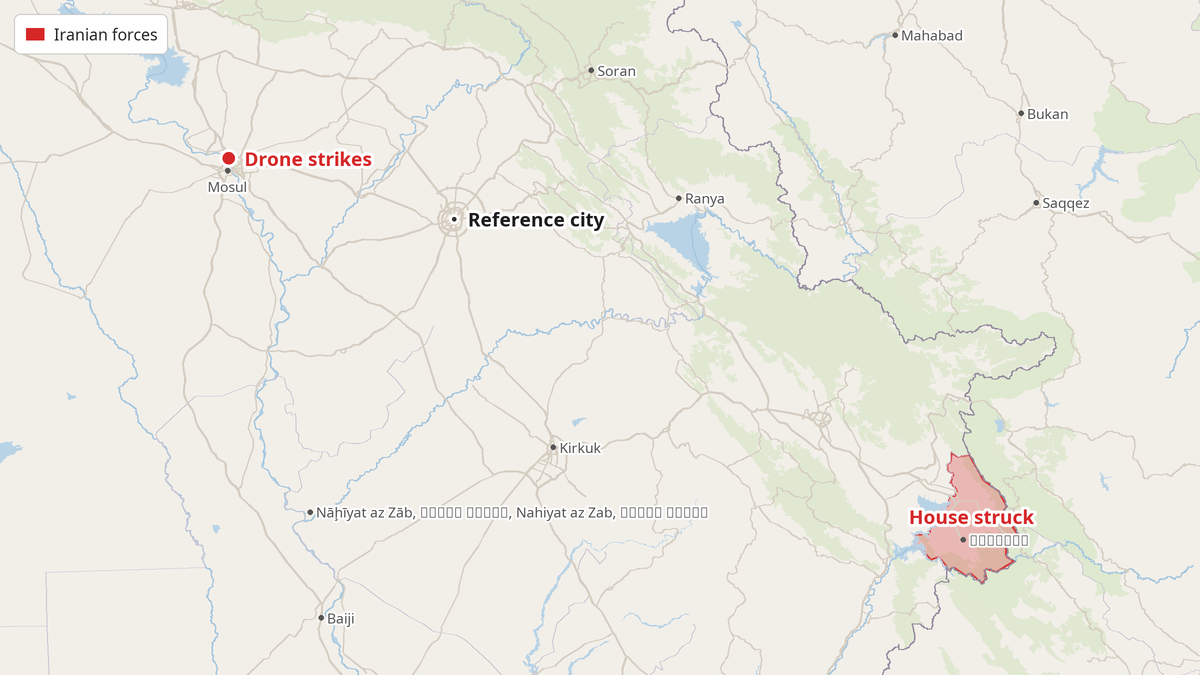
Two explosive drones struck a base belonging to the Kurdish opposition group Komala in northern Iraq on Wednesday morning, while Iran's leaders celebrated the Democrats' midterm victories. Tehran was celebrating at home and applying military pressure abroad. The timing says plenty about how the country conducts its politics.
Rudaw reported that the drones hit the Komala base in the Alana valley of Balisan, about 90 km northeast of Erbil, at around 8:45 a.m. Komala said the attack caused material damage but no casualties. A separate strike damaged a house in Tawella, in Halabja province, early Tuesday. Homeowner Alwan Abdullah told Rudaw: "We don't know what happened. We haven't seen any debris. Our house sustained heavy damage; our glass, doors, and windows are all broken." No one was hurt.
The Strike Campaign Against Iranian Dissidents
Komala's Ali Ranjbari called the attack an "Islamic Republic's drone attack on Komala Peshmerga" and blamed Iran's Islamic Revolutionary Guard Corps. He described it as part of a wider Iranian campaign to spread the conflict to Iraq and pre-empt a Kurdish uprising. Komala belongs to a five-group Kurdish coalition opposing the Iranian regime, alongside PJAK, PAK, the PDKI and other Komala branches. Those groups have kept bases in northern Iraq for decades, and many Kurds have fled Iran.
Iran has carried out more than 1,000 attacks on the Kurdistan Region using drones and missiles. Tehran wants Baghdad to expel the groups. Last month, Iranian Ambassador to Iraq Mohammed Kazem Al-e Sadegh said Baghdad had agreed to expel them or hand their members over to Tehran. An Iraqi official who attended the security meeting disputed that account, Rudaw reported. The Kurdistan Regional Government shares a long border with Iran and close ties with Western countries, leaving it caught in the middle. Its leadership in Erbil has criticized the Iranian Kurdish groups and voiced concern they could draw the region into conflict.
Tehran's Threats Widen
Iranian officials made clear the Democratic wave hasn't softened their posture. Hamidreza Moghadamfar, an adviser to the Revolutionary Guard Corps commander-in-chief, told a rally in Bandar Abbas that Iran would broaden its response beyond U.S. military bases if Gulf states allowed Washington to launch attacks from their territory. He promised a "new doctrine and new technology" and named the UAE and Bahrain as countries that would face a wider response.
Parliament Speaker Mohammad Baqer Qalibaf, whom Reuters described as Iran's chief negotiator, posted on X: "Conscience or the cost of living, Americans said NO TO WAR, and we endorse this message." He added that if Washington ignored the vote, "it will learn our NO comes with a Nightmare."
Supreme Leader Mojtaba Khamenei offered no opening. U.S. hostility would persist regardless of which party held power, he said, and he warned against "even the slightest inclination towards submission." The path to "absolute deterrence," he said, lay in an "even more powerful Iran." He cited Iran's destruction of U.S. bases in the region and its management of the Strait of Hormuz as part of a campaign against U.S. hegemony.
Supreme National Security Council Secretary Mohsen Rezaei, who recently received a letter from U.S. Vice President JD Vance, wrote that Washington's response to Iran's demands "was not convincing." He said the United States must answer Iran's seven conditions fully and explicitly before "the Strait of Hormuz be opened." Iran is holding a global shipping lane hostage to a list of demands.
A Regional War Still Unresolved
The United States and Israel began the war with attacks on Iran on February 28. Iran responded with strikes on Israel and Gulf states hosting U.S. bases. Fighting erupted in Lebanon between Iran-backed Hezbollah and Israel, then spread to Yemen, where Iran-aligned Houthis struck energy facilities, airports and other targets in Saudi Arabia. Tehran declared the Strait of Hormuz closed, disrupting shipping and driving up global oil and gas prices. The United States imposed a naval blockade on Iran.
Ceasefire agreements and diplomacy haven't ended the fighting. Military confrontations continue in southern Iran and around the Strait of Hormuz. Qatar, Russia and China are among the mediators trying to avert a U.S. strike, and they've intensified their efforts over fears the war could reignite after the election. Trump declined Tuesday to rule out resuming combat operations.
Two senior Iranian sources said Tehran welcomed the Democratic result but worried Trump could try to compensate with a military strike.
Celebration in Tehran, Division in Washington
At a government-organized rally marking the anniversary of the 1979 seizure of the U.S. Embassy, thousands marched in Tehran. Demonstrators burned American and Israeli flags, chanted "Death to America" and "Death to Israel," and displayed effigies of Trump and Israeli Prime Minister Benjamin Netanyahu. The 1979 takeover held 52 Americans hostage for 444 days; this year marked its 47th anniversary. One demonstrator, Zahra Nadiminejad, said: "whether the Democrats win or the Republicans win, our hostility toward America will never come to an end."
Tehran Mayor Alireza Zakani claimed a "decisive defeat of the United States and the Zionist regime in recent developments and elections," including the previous week's Israeli elections.
In Washington, the blame is landing on the war. Trump told Fox News: "I think a part of it was Iran, but at the same time people understood the importance of what I've done with Iran." Vance was blunter, writing on X: "The reason we lost is the war. The president himself said so last night." He said a pollster he respected pointed to the Iran war and the economy as key reasons voters abandoned Republicans, along with a desire to "change our relationship to Israel." Senate Democratic leader Chuck Schumer said: "This war must end," and floated the "power of the purse" as a lever. Trump ruled out firing Defense Secretary Pete Hegseth and threatened to use his veto.
Why This Matters: Iran's leaders are reading the American vote as proof that pressure works, and they're saying so openly. Khamenei's insistence that hostility will outlast any change in Washington, and Qalibaf's talk of a "Nightmare," suggest Tehran sees domestic U.S. war fatigue as leverage rather than a reason for restraint. Meanwhile, the Strait of Hormuz stays closed, Iranian drones keep hitting dissident bases on Iraqi soil, and Gulf states hosting U.S. forces face explicit threats of wider retaliation. From a security standpoint, a withdrawal of American resolve before Iran's seven conditions are tested against any verifiable guarantees would leave Israel and the Gulf exposed to a regime that has just promised to escalate on its own terms.
- iran
- united states
- drone strikes
- midterm elections
- strait of hormuz
- komala
- iraq
- military deterrence