
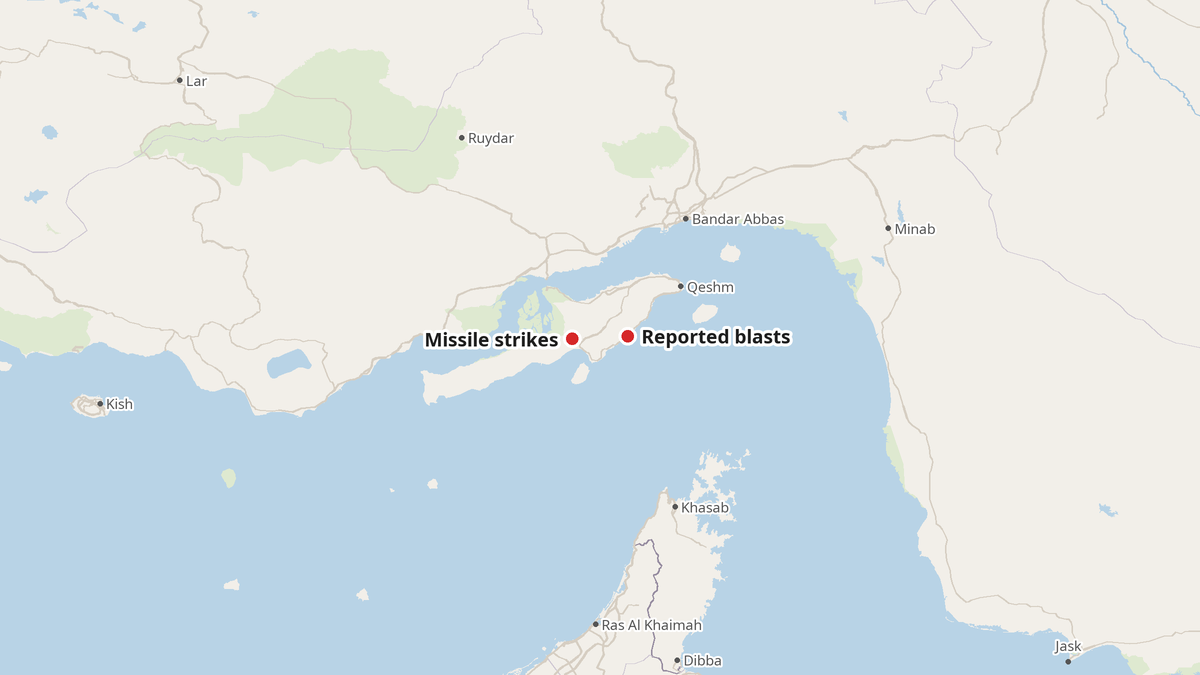
Two missiles struck Qeshm Island near the Strait of Hormuz, Iranian news agencies reported, and state media said two blasts echoed through the island's Suza area. The damage was unclear. For the people who live on Qeshm, that uncertainty is its own kind of weight.
U.S. President Donald Trump said on Friday that the American military had carried out a new round of "minor strikes" on the island, which he said knocked out Iranian air-defense systems. They were disabled "in about 15 minutes, maybe five," he told reporters. Iran's army offered a different account. Speaking through state broadcaster IRIB, it said its air defenses had downed a U.S. drone over the island. U.S. Central Command described the situation as "relatively calm."
The base reporting contains no casualty figures and no word on whether civilians were hurt or displaced. That silence matters. The strikes landed in a war launched by the United States and Israel on February 28, and Tehran closed the Strait of Hormuz after the fighting began, triggering a global energy crisis whose costs reach well beyond the battlefield.
Diplomacy Under Strain
Even as missiles flew, talks were said to be alive. Gulf News reported that Qatar's mediation between Washington and Tehran remained active, and Qatar pushed back hard on reports that negotiations had stalled. "Promoting such false claims serves only those seeking to prolong the war and destabilise the region," Majad al-Ansari, spokesperson for the Qatari Ministry of Foreign Affairs, said in a post on X.
Trump struck a similar note. "We're dealing with them now. They want to make a deal," he said, adding, "We've made a lot of progress with Iran." Gulf News said mediators were pursuing a possible agreement linking maritime access, sanctions relief and nuclear inspections.
But the messaging has pulled in opposite directions. Middle East Eye reported that these were the first strikes since Trump's Republican Party suffered a crushing defeat in the U.S. midterm elections, a loss it said was fueled in part by the war and rising energy prices. Trump's rhetoric, it said, has swung between threats to "destroy" Iran and claims the war is nearing an end. Gulf News noted that Washington is offering a reward of up to $20 million for information about Iran's nuclear program, even as Trump has repeatedly claimed that program was obliterated.
Pressure on Iran, and Iran's Answer
Washington has added sanctions and imposed a naval blockade meant to stop Iran from exporting oil. That has strained Iran's economy and forced the country onto new trade routes. On Saturday, U.S. Central Command announced a task force to keep Iran from moving advanced weapons and other materials over land.
Tehran is signaling it won't blink. At a news conference in Tehran on Saturday, IRGC spokesperson Hossein Mohebbi said the force had rapidly moved missile and drone production lines from the surface to underground facilities, so output could continue while adversaries assumed Iran's stockpiles were dwindling. Tasnim reported that an "underground missile city" was among the achievements set to be unveiled. Mohebbi also warned that restrictions on the range of Iranian missiles had been lifted, following Supreme Leader Mojtaba Khamenei's warning that there would be "no geographical limits" to Iran's response if it were attacked again.
The Regional Bill
The damage already done is substantial. Al Jazeera, citing The Wall Street Journal, reported that Iran caused billions of dollars in damage to U.S. bases across the Middle East in earlier rounds of fighting. A separate Reuters report found Iran had hit Gulf infrastructure at least 135 times, causing billions of dollars in damage and lost revenues. Tehran has repeatedly threatened Gulf energy infrastructure if fighting resumes, a prospect the report said would likely push energy prices higher.
The pressure is spreading to the Red Sea. Gulf News, citing The Wall Street Journal, reported that Yemen's Iran-backed Houthis are effectively policing maritime transit there, with vessels requesting safe passage by email and replies typically arriving within 24 hours. The Houthis declared a maritime blockade of Saudi Arabia earlier in 2026.
Why This Matters: Every stalled round of mediation leaves ordinary people carrying the cost. Fuel prices climb, shipping lanes are policed by armed groups, and communities like those on Qeshm wait to learn what each blast has damaged. The reporting here shows both sides promising a deal while preparing for escalation, with Iran digging deeper underground and Washington tightening sanctions and blockades. Strikes that are called minor from a distance can mean something very different on the ground, and the absence of casualty figures shouldn't be mistaken for the absence of harm. Qatar's insistence that talks continue is the one thread pointing away from wider war. If mediators can't turn it into an agreement on maritime access, sanctions and inspections, the danger is a conflict with, in Iran's words, no geographical limits.
- qeshm island
- iran
- united states
- strait of hormuz
- airstrikes
- iran-us conflict
- qatar mediation
- iran nuclear program