
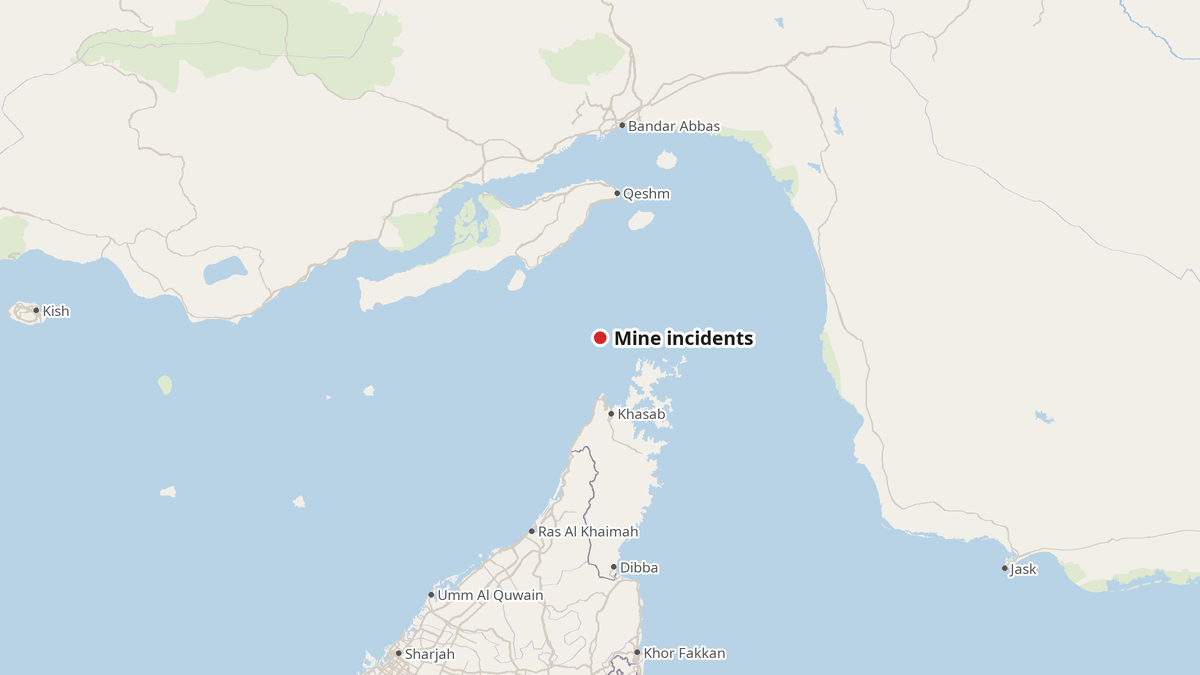
Three tankers burned after striking mines in the Strait of Hormuz, Iran’s Islamic Revolutionary Guard Corps navy said Friday. A fourth vessel hit naval mines farther east in the waterway. No one knows yet whether anyone was hurt or who laid the mines.
The IRGC said the three tankers struck mines while attempting to cross an unauthorized route south of the strait during the previous 24 hours. It said the ships had switched off radar and navigation systems, ignored warnings from its naval forces and were abandoned on the strait’s southern shores. Separately, the United Kingdom Maritime Trade Operations reported a vessel on fire about 25 nautical miles northeast of Khasab, Oman, travelling outbound. The cause, the crew’s condition, the extent of the damage and any environmental impact remain unknown. UKMTO urged ships to transit cautiously and report anything suspicious.
Military Options on the Table
The fires came as Washington weighed military force. The Wall Street Journal reported that the top US commander overseeing the Middle East met President Donald Trump at the White House on Thursday and presented options. Defense Secretary Pete Hegseth and Joint Chiefs Chairman Dan Caine attended; US Central Command chief Adm. Brad Cooper made the presentation. Reuters said it couldn’t independently verify the account.
The meeting followed reports the previous week that Washington and Jerusalem were considering a “short but intensive operation” of renewed strikes on Iran after the November 3 midterm elections, four days away. Drills had ramped up, with Iranian energy sites, nuclear facilities and arsenals of missiles and drones among the targets. The report said Trump could still decide against military action.
The buildup is visible. Analysts tracking open-source flight data counted more than 10 US military transport aircraft landing at Israeli airbases in southern Israel over the past week. Most flew from Biggs Army Airfield in El Paso, Texas, to Nevatim and Ovda. Other cargo flights went to American bases in Jordan, Saudi Arabia, Qatar and Kuwait. The cargo remains unknown, though it’s thought to be tied to bolstering regional air defences. On Wednesday, The Wall Street Journal reported that a Patriot battery was heading from Texas to the region.
The Civilian Dimension
Iran’s UN ambassador, Amir-Saeid Iravani, told the Security Council that Washington and its supporters were responsible for insecurity in Hormuz and disrupted shipping, state broadcaster IRIB reported. He said the US naval blockade of Iran violated the UN Charter and threatened civilians’ access to food, medicine, fuel and other essentials. He called it “collective punishment” against the Iranian people. The United States said its blockade was effective and that no Iranian ship had crossed the strait.
The UN account of the human toll points in more than one direction. UN Special Rapporteur Mai Sato told the General Assembly that US and Israeli military actions had compounded Iranians’ suffering, while authorities in Tehran had used the regional conflict to intensify a crackdown on dissent through arrests and executions. Foreign Ministry spokesman Esmaeil Baghaei accused the UN’s human rights mechanism of trying to “whitewash aggression, atrocities, and unilateral coercive measures,” and called Sato’s mandate “politically motivated.”
A Narrow Diplomatic Opening
A channel remains open amid the threats. Iran confirmed Thursday that it had received a letter from US Vice President JD Vance but hadn’t responded, Tasnim reported. The Wall Street Journal had said Vance wrote to Iranian security chief Mohsen Rezaei to revive negotiations. Tasnim said Tehran still insists on seven conditions it set for the United States, adding that “any position that contradicts this framework is unacceptable.” It didn’t detail the conditions.
Trump described the outreach in narrow terms. “What that is is they need help with medical supplies and various things,” he said Wednesday, adding that it was “getting supplies in to help people that are not well.” Asked whether he’d directed Vance to restart talks, he said, “No.”
The Washington Post, as cited by the Times of Israel, reported that US intelligence sees Rezaei as Washington’s best option to head off renewed fighting. An official said Vance’s letter urged Iran to send negotiators “empowered” to resolve the nuclear issue. Rezaei hasn’t responded, and his longstanding hardline stance toward the United States casts doubt on whether he’ll pursue a deal. A Kremlin spokesman told Al Jazeera that Russia is ready to mediate if asked. Qatari mediators returned to Tehran Friday for talks coordinated with the United States, an official told Reuters.
The G20 in Atlanta
The war loomed over the G20 foreign ministers’ meeting in Atlanta, which US Secretary of State Marco Rubio hosted beginning Friday. A State Department official said ministers would discuss energy and supply-chain issues. Turkey was expected to urge dialogue and warn that continued hostilities were worsening regional vulnerabilities. France planned to press for maritime-security cooperation in Hormuz and Bab Al Mandeb. French diplomatic sources said no joint declaration was expected.
Why This Matters: Mines in one of the world’s busiest shipping lanes, a military buildup and strike options timed around an election all point toward renewed fighting. Iranian civilians would bear much of the cost. Iran’s envoy says the blockade is already squeezing access to food and medicine, a claim the US doesn’t address directly. The UN rapporteur’s findings suggest civilians are caught between foreign strikes and their own government’s crackdown. Yet Vance’s letter, Qatari shuttle diplomacy and a Russian offer to mediate show a diplomatic route remains open. Whether the sides take it before the next round of strikes is the question.
- strait of hormuz
- iran
- united states
- islamic revolutionary guard corps
- maritime mines
- military tensions
- peace negotiations
- mohsen rezaei