
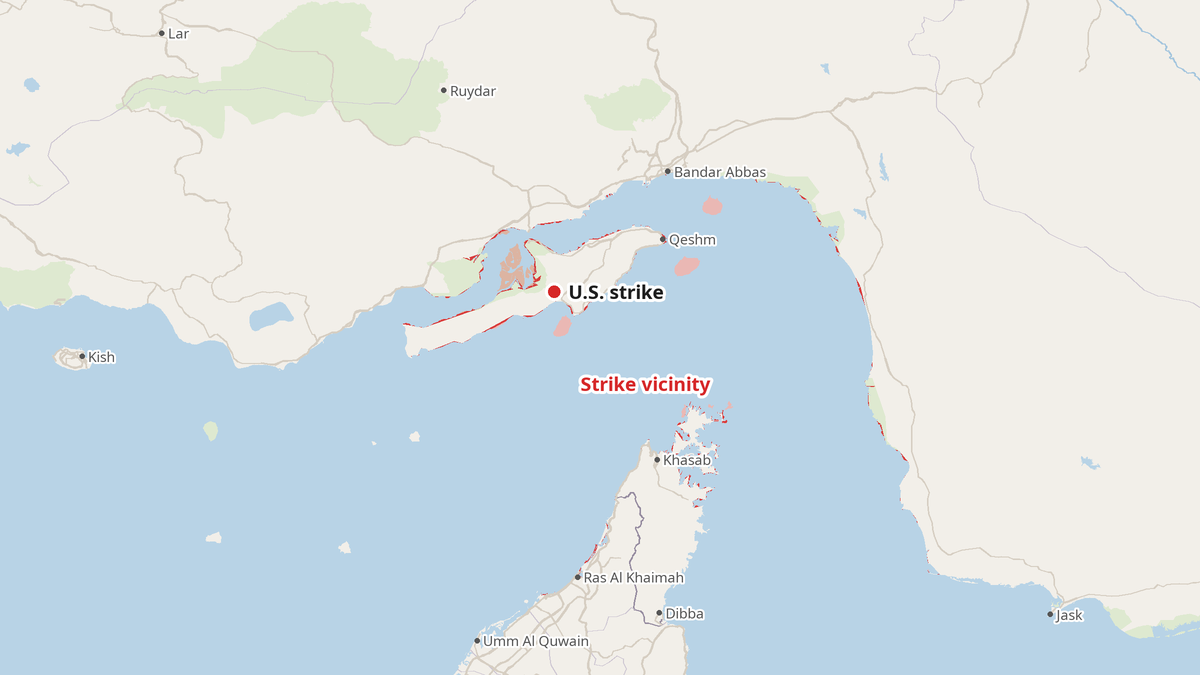
The United States struck Iranian targets near the Strait of Hormuz on Monday night, hours before Americans headed to the polls for the midterm elections. A U.S. official described the operation as limited and defensive, aimed at "Iranians using surface-to-air missiles against US assets." Iranian state media reported explosions on Qeshm and Hengam islands and near Bandar Abbas.
The timing is hard to miss. Trump had previously said the United States would not strike Iran before the election, and he'd repeatedly suggested major military operations could resume afterward. Now, with fuel prices elevated and a war that was first described as a matter of weeks stretched into months, the strikes landed on the last night of the campaign.
What Happened on Qeshm
Iran's state-owned Islamic Republic News Agency reported several explosions in rapid succession on Qeshm late Monday, and said witnesses saw two aircraft over the island off Iran's southern coast. Fox News reported that residents heard five explosions. The Revolutionary Guard said it destroyed a U.S. MQ-9 drone east of the Strait of Hormuz and shot down two more U.S. military drones south of Qeshm, according to Tasnim, an Iranian news agency close to the IRGC.
Qeshm isn't a minor outpost. It's home to an underground missile site, a naval base and a major desalination plant, and analysts describe it as the primary platform for Iran's "asymmetric" naval power. A U.S. official told Fox News the strike responded to Iran firing at a U.S. aircraft and was "defensive," not the start of renewed escalation. The Wall Street Journal, citing an unnamed official, reported the strikes did not resume a major operation. The Pentagon referred questions to U.S. Central Command, which didn't immediately respond to USA TODAY.
The United States hadn't publicly disclosed strikes on Iranian military targets since Sept. 1, according to USA TODAY. Meanwhile, thousands of U.S. troops remain in waters off Iran enforcing a naval blockade meant to keep Iranian oil tankers from the global market. Another aircraft carrier and thousands more troops are on their way to the Middle East.
"Not a War," Says the President
Trump downplayed the fighting. At the Lincoln Memorial Reflecting Pool on Nov. 2, he said the conflict was "not a war." He added, "I don't know if you even call it a war because we haven't been doing any fighting for months." On Fox News' "Hannity," he called it a "soft war." On Tuesday, he described the Qeshm strikes this way: "We took some out last night. It's just a minor attack. It wasn't war."
The record says otherwise. The wider war began on Feb. 28, when the United States and Israel launched strikes across Iran. The Strait of Hormuz closed, oil and gas prices surged, and military, civilian and energy facilities around the Gulf took extensive damage. Fortune reported that recent estimates put the war's cost at $47 billion, against U.S. national debt of $40 trillion. Iran's deputy foreign minister, Kazem Gharibabadi, put it plainly: "We are still in a state of war."
Public support is thin. A Pew Research study last month found 14% of voters strongly approved of Trump's handling of the conflict, and a further 20% somewhat approved. UBS's Paul Donovan suggested Trump might become more aggressive in the Gulf "once freed from the pursuit of popularity." Trump himself said he might strike Pickaxe Mountain, a suspected underground facility tied to Iran's nuclear program. "I'm not looking to, you know, kill lots of people, but if we have to, we'll have to," he told "Fox & Friends."
Diplomacy Under Strain
Qatar-led mediation is trying to keep the region from sliding back into all-out war. Qatari mediators traveled to Tehran on Monday night to discuss a draft U.S.-Iran agreement with Foreign Minister Abbas Araghchi. The proposal had been under negotiation for eight days, an official told Reuters. Qatar's foreign ministry spokesperson Majed al-Ansari said, "If there were no glimmer of hope, there would be no negotiations... and as a mediator, we cannot lose hope."
A senior Iranian official told Reuters the two sides remain far from a deal, though mediators are working to narrow the gaps. Iranian President Masoud Pezeshkian said Supreme Leader Ayatollah Mojtaba Khamenei had given the government "certain authorities" over negotiations, a shift from the breakdown of a June memorandum of understanding that had allowed a brief ceasefire. Vice President JD Vance said he and Trump "both feel pretty good about the prospects for potentially coming to a negotiated settlement." He added that the administration hadn't set deadlines but wants "a firm commitment and a verifiable commitment" that Iran won't rebuild its nuclear program.
Tehran's demands are extensive. Security chief Mohsen Rezaei said Washington must address Iran's seven conditions before the Strait reopens, including unfreezing assets and lifting the blockade of Iranian ports. Armed forces chief of staff Maj. Gen. Ali Abdollahi listed principles for lasting peace that include an end to war on all fronts, especially Gaza and Lebanon, removal of sanctions, and war reparations. Parliament speaker Mohammad Bagher Qalibaf warned that if Washington makes "another strategic miscalculation," it "will face a new battlefield."
Preparations on Both Sides
Iran isn't waiting. It opened its third military training center in Tehran on Monday and announced plans to train 1 million paramilitary volunteers nationwide. Ali Kowsari, the Basij's deputy head for training, said 1,500 training bases would start working across the country this week. Foreign Policy reported that Iran named Mehrdad Akhlaghi, a ballistic missile specialist, as defense minister, tasked with rebuilding capabilities degraded by U.S. and Israeli attacks. He recently said that if Trump "drops a single bomb, his forces are going to leave the region horizontally (i.e., in body bags)."
The fighting has already reached civilians at sea. The United Kingdom Maritime Trade Operations Centre said an Indian-crewed dhow was attacked Monday while traveling outbound through the Strait of Hormuz. The Omani Royal Navy rescued the surviving crew.
Why This Matters: A war launched on Feb. 28 and sold as a short campaign now carries a $47 billion price tag, a closed shipping lane, higher fuel costs and a continuing risk to civilians, from Iranian islanders hearing explosions to the crew of an Indian dhow. Strikes on the eve of an election, after a pledge not to strike before it, raise a basic democratic question: who authorized what, and who's being told what? Congress's incoming members won't take office until January, leaving a two-month window for the White House to act. Meanwhile federal funding expires Dec. 11, and the costs of the war compete with domestic priorities. The most durable way out runs through the diplomacy Qatar and others are trying to protect. Every strike makes that harder, and the people who pay for failure are rarely the ones making the decisions.
- iran strikes
- qeshm island
- strait of hormuz
- united states
- iran
- u.s. midterm elections
- islamic revolutionary guard corps
- military operation