
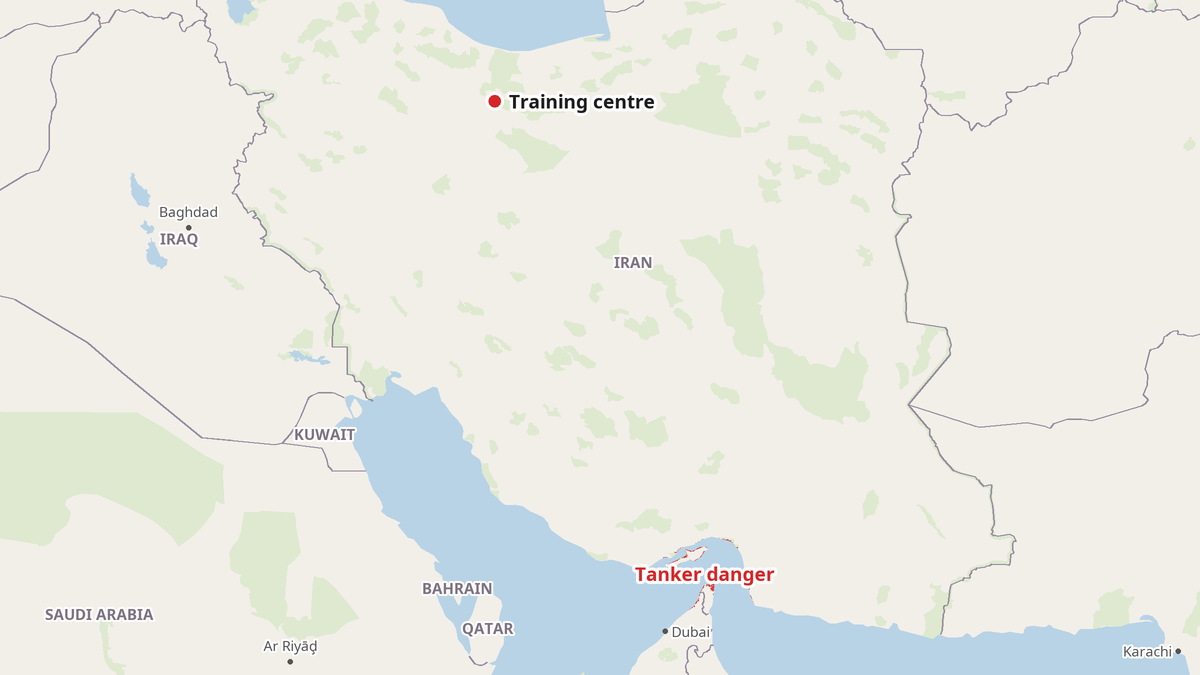
Iran opened a third military training centre in Tehran and announced plans to train one million paramilitary volunteers nationwide, the semi-official ISNA news agency reported. Members of the Basij, a paramilitary force affiliated with the Islamic Revolutionary Guard Corps, attended the opening. Two other centres opened in Tehran in August and September. The mobilization comes amid fears of renewed conflict with the United States and Israel.
It didn't arrive quietly. The announcement coincided with a sharp escalation around the Strait of Hormuz, where Tehran is using control of a vital waterway as leverage.
The Strait as a Bargaining Chip
Iran's proposal would reopen the strait over two days, but only if the United States met seven demands, including lifting sanctions and ending the US naval blockade. Mohsen Rezaei, secretary of Iran's Supreme National Security Council, wrote on X that America's response was "not convincing" and that Washington "must fully and explicitly address Iran's seven conditions and act upon them." He added: "Only in this case will the Strait of Hormuz be reopened."
The terms are plain. Reopening an international shipping lane is being treated as a concession to be purchased rather than a standing obligation.
On the water, the danger is real. The IRGC said four oil tankers were destroyed after striking naval mines while trying to pass through a prohibited lane south of the strait; the tankers remained ablaze, and two other vessels were detained. The United Kingdom Maritime Trade Operations separately reported that two unidentified projectiles struck a tanker's engine room about 14 nautical miles (26km) northeast of Oman's coastal village of Limah. No casualties were reported, and it could not be independently verified whether the incidents were linked. The IRGC's claims about the tankers were not independently verified. The IRGC also claimed its air-defense forces shot down a US-made MQ-9 drone over the strait, calling it the 56th such aircraft it had downed.
Washington Weighs Its Options
President Donald Trump confirmed US strikes on an Iranian anti-aircraft facility on Qeshm Island, calling it a "minor attack" that "wasn't war." He said: "They built an anti-aircraft facility. It took them about two months. We watched it get built. As soon as it was completed, we hit it last night." US officials described the strikes as "defensive" and said they followed Iranian fire at an American aircraft. Trump said, "I'm not looking to ... kill lots of people," adding, "If we have to, we'll have to."
He also warned that something bigger could follow. Speaking to Fox News, he said, "We have to do something large," and, "They will never have a nuclear weapon." The Wall Street Journal reported Trump had "leaned toward" a large attack after the Nov. 3 midterms but had not decided.
Preparations are visible, though not confirmed. Washington was reportedly "rapidly replenishing" THAAD and Patriot anti-missile batteries in southern Israel ahead of a possible Iranian ballistic-missile response. One report said at least 10 US military cargo planes landed at Ovda and Nevatim air bases, most departing from Fort Bliss in Texas. The same airlift pattern had been observed before the previous strike on Iran. There was no US confirmation of an attack plan, and Gulf News noted that the "imminent" framing came from open-source accounts. Israeli outlet Walla reported "no unusual rise" in US aircraft arrivals over the past week.
Tehran's Mixed Signals
Iran's supreme leader, Mojtaba Khamenei, ordered the military at the weekend to respond immediately to any threat without geographical limits and update its list of targets. Iranian officials suggested that European countries and undersea cables in the Gulf could be targeted. Chief negotiator Mohammad Bagher Ghalibaf said the Islamic republic was "ready for battle with its finger on the trigger."
Yet the diplomatic channel hasn't closed. President Masoud Pezeshkian said the government was still seeking to resolve the crisis "through dialogue" and that "no one will benefit from this war" if it reignited. He said the supreme leader had recently granted the government new powers to negotiate previously "off-limits" issues. Qatar's foreign ministry spokesperson Majed al-Ansari said both sides "remain committed to the negotiation process," with Qatar facilitating the "real-time exchange of proposals." Reports cited by Gulf News nonetheless described the talks as "stalled."
Proxies Widen the Front
The pressure extends beyond the Gulf. A Saudi-led coalition said it intercepted three drones targeting Saudi territory, including one over the western Mecca region. Yemen's Houthi group said it launched drone and ballistic-missile attacks on an airport and an airbase in southwestern Saudi Arabia. Coalition spokesman Turki Al Maliki said on X that a drone over the Mecca region had been intercepted and destroyed.
The US Embassy in Yemen accused the Houthis of killing Mohammed Al Shami, a UN Human Rights Office staff member and father of three, while he was detained. It said he had been denied contact with his family and prevented from visiting his dying father or attending the funeral, and that the Houthis concealed his body for months in a morgue in Sana'a while claiming he was alive. The embassy called for the immediate and unconditional release of all detained UN, diplomatic and humanitarian staff.
Doubts in Washington
Not everyone believes more force will work. John Mearsheimer, a US political scientist, questioned whether another short bombing campaign could achieve Washington's aims, warning that Iranian retaliation could draw the United States into a longer confrontation. "If the 40-day bombing campaign didn't work, how is the three-day bombing campaign going to work?" he asked.
Domestic politics hover over the debate. Trump acknowledged that higher petrol prices hurt Republicans in the midterm elections. Ghalibaf said Americans voted "NO TO WAR" after Democrats' midterm gains. Trump, for his part, said the Iran war played a role in the Republican defeat but that people "understood the importance of what I've done with Iran."
Why This Matters: Iran is building a mass paramilitary base at home while holding a global shipping lane hostage to a list of sanctions-relief demands, and its Houthi partners are striking Saudi territory at the same time. From a security standpoint, that's a coordinated pressure campaign, and it runs through the same proxy and paramilitary networks that threaten Israel and Gulf states. Washington is repositioning missile defenses in southern Israel, a sign of how directly Israeli security is tied to this standoff. The central question is whether Tehran is negotiating in earnest or buying time to arm. Pezeshkian's talk of dialogue sits beside Khamenei's order to strike without geographical limits.
- iran
- strait of hormuz
- united states
- islamic revolutionary guard corps
- military escalation
- qeshm island
- donald trump
- military training