
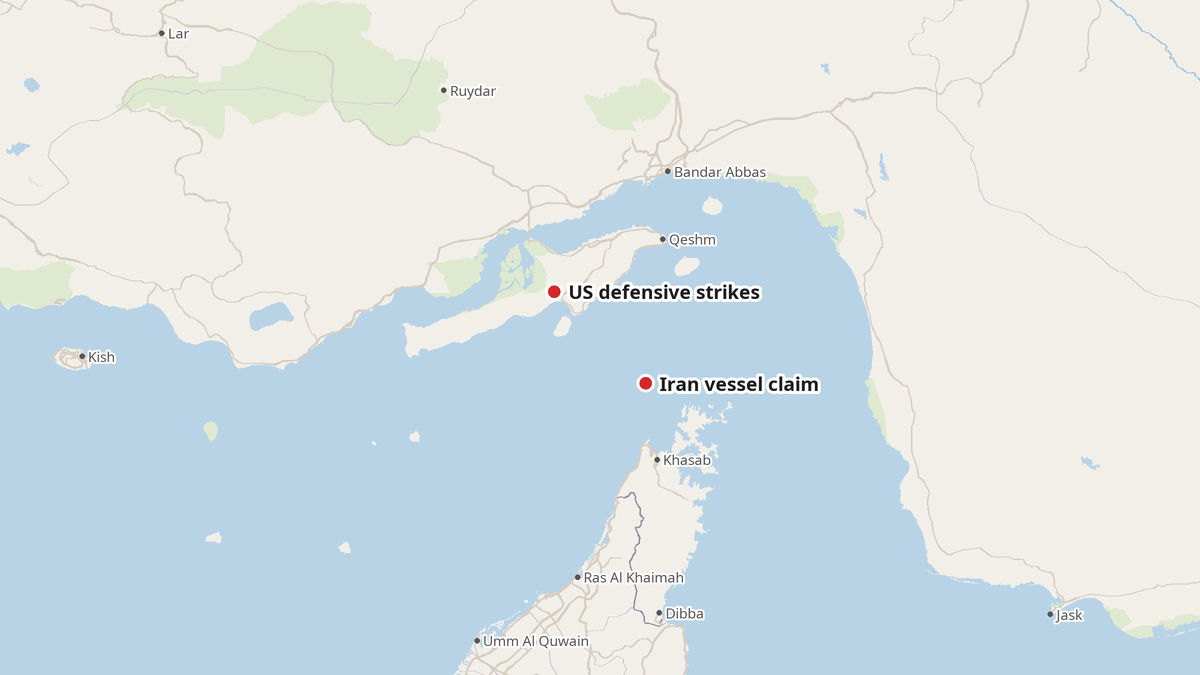
Revolutionary Guard personnel on Iran's Qeshm Island fired a missile at an American aircraft over the Strait of Hormuz, and the United States answered with strikes on the island on November 2, US officials said. "IRGC (Islamic Revolutionary Guard Corps) personnel launched a missile from Qeshm Island toward an American aircraft over the Strait of Hormuz, and in response, the Americans launched a surface-to-air missile in self-defense," a US official told The Jerusalem Post. Another US official told Reuters the strikes were defensive measures against Iranians using surface-to-air missiles against US assets.
Washington described the operation as limited, not a return to major combat. It came hours before the November 3 US midterm elections.
The Security Picture
Qeshm isn't an arbitrary target. It's Iran's largest island in the Strait of Hormuz, sitting at the mouth of a major route for energy shipments. RFE/RL, citing the Wall Street Journal, reported that the island hosts a large underground missile facility, a naval base and a major desalination plant. It has been targeted by US forces in earlier rounds of fighting, and US officials have discussed the possibility of seizing it.
The Journal described Qeshm as the latest in a series of limited US strikes carried out quietly in recent weeks. RFE/RL said earlier actions included strikes on missile-launch sites, an attack on a dhow several days before, and a strike on a commercial vessel that tried to break the US blockade of Iranian trade several weeks earlier. The campaign was kept quiet to avoid signaling an intention to resume major combat operations.
Jason Brodsky, policy director at United Against Nuclear Iran, put the logic plainly. "The US is aiming to degrade Iranian capabilities to threaten the Strait of Hormuz," he told RFE/RL. "This is not meant to change Iranian decision-making calculations necessarily, but it does blind and deprive the Iranian regime from harassing commercial ships. And that's fundamentally in US national security interests."
The harassment is documented. In October, the strait saw its most attacks on commercial ships since March, as Iran sought to pressure Washington into lifting its blockade. The UK Maritime Trade Operations center reported that a vessel off the coast of Lima, Oman, was struck by an "unknown projectile" on Sunday, leaving a hole in its starboard side. The crew was safe. The IRGC Navy, for its part, said three oil tankers using unauthorized lanes struck mines and caught fire; the US military denied the mine claims, saying internationally recognized routes had been cleared by US forces.
Iran's Revolutionary Guards also claimed they downed and captured US drones near Qeshm and destroyed an MQ-9. Those claims couldn't be independently verified. US Central Command said all American unmanned surface vessels in the region were accounted for, and US officials rejected the other drone claims. The Pentagon didn't confirm them.
Diplomatic Dead End, Or Not Quite
The strikes landed alongside intensive diplomacy. President Donald Trump said Monday that "Iran wants a settlement, as soon as possible," and added that "there is a very good chance we make a deal." He also kept the pressure on. Of Pickaxe Mountain, a site linked to Iran's nuclear program that Tehran denies is a nuclear facility, he said: "We might have to go after Pickaxe. We can do that in one hour, as soon as we want, at any time we want."
Vice President JD Vance said the two sides had held "a number of good conversations" and that "we've certainly made some progress." Qatari mediators traveled to Tehran Monday night to discuss a draft deal that had been under negotiation for eight days.
Tehran's public posture is less conciliatory. Iran's parliament speaker, Mohammad Bagher Ghalibaf, identified as Iran's chief negotiator, said Iran stands ready for battle "with its finger on the trigger" while insisting the "ball is now in America's court to prevent war." A senior Iranian official told Reuters that nuclear talks could begin only after Tehran's conditions were met and the strait reopened, and that the sides remained far from a deal. Foreign Minister Abbas Araghchi said Washington must accept a new transit route agreed by Iran and Oman, lift recent sanctions and reduce US troop numbers in the region.
The new Supreme Leader, Ayatollah Mojtaba Khamenei, told military chiefs the response to "any kind and level of threat" should be immediate and without "geographic limits." Iran's demands, in other words, amount to a reopening of a waterway it has been disrupting, in exchange for the lifting of pressure its own conduct helped provoke.
The Regional Threat
The Gulf is bracing. Saudi Arabia has faced intensified fighting with Yemen's Iran-aligned Houthis, who attacked Saudi oil facilities and airports, including Riyadh's international airport, and advanced toward the Bab el-Mandeb Strait. Anwar Gargash, a UAE presidential adviser, said at the Manama Dialogue that "if these positions are not bridged, then we have to worry about the worst." Egypt's Foreign Minister Badr Abdelatty warned the next escalation "will be more dangerous, more destructive, and it will lead to nowhere."
Prime Minister Benjamin Netanyahu was pushing for another wave of strikes after the election, according to two regional officials and another person familiar with the matter. He pressed Trump during a weekend call, but Trump wouldn't commit to military action. The Israeli military told Agence France-Presse it had no involvement in the Qeshm strikes.
The cost is rising on all sides. The war has cost US taxpayers at least $47 billion, according to an Associated Press report, and Brent crude, despite a drop of more than 8% on Monday, still traded around $104 a barrel.
Why This Matters: The Qeshm episode shows what a contested chokepoint looks like in practice: an IRGC missile fired at a US aircraft, a limited American response, and an Iranian leadership that absorbs the blow while publicly threatening limitless retaliation. Analysts quoted here note that Iran has shown restraint, which suggests both sides see risk in escalation. But the strait carries a major share of global energy shipments, Iran-aligned Houthis are pressing Saudi Arabia from the south, and Gulf states are spending billions on defense. From a security perspective, any deal that leaves Iran's capacity to threaten shipping intact would leave the underlying danger in place.
- iran
- qeshm island
- united states
- strait of hormuz
- us airstrikes
- islamic revolutionary guard corps
- donald trump
- us-iran tensions