
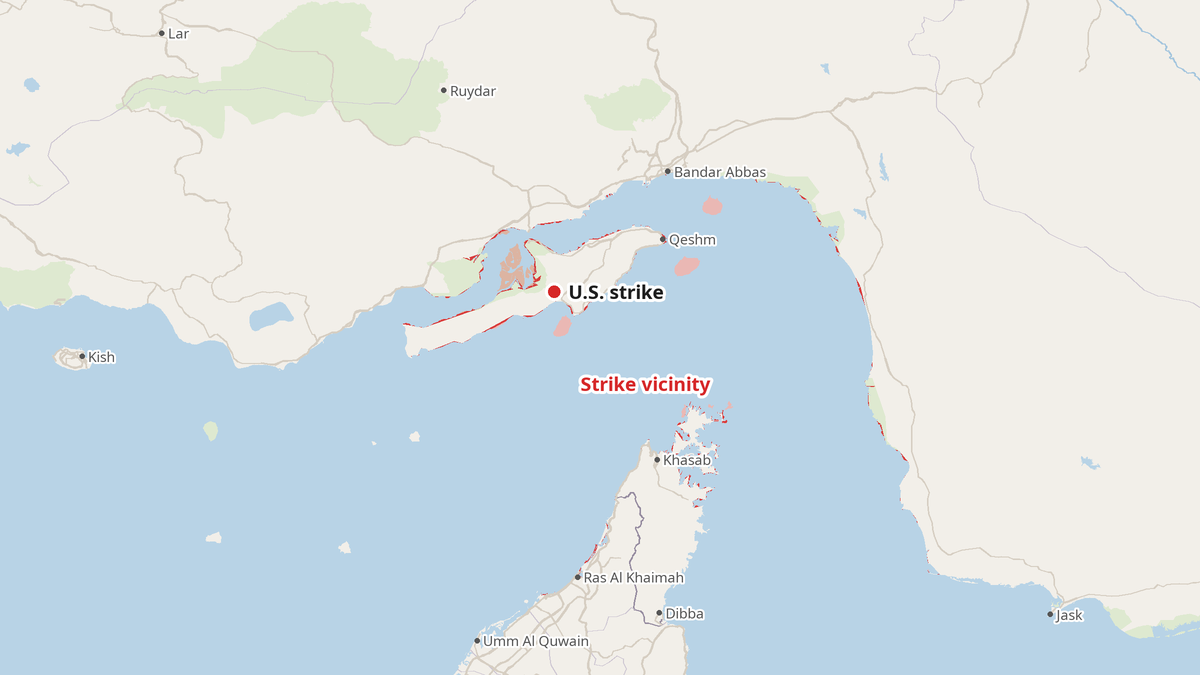
The United States struck Iranian targets near the Strait of Hormuz on Monday, Nov. 2, hitting missile positions that had been used against American forces just one day before voters head to the polls. A U.S. official told the Associated Press the targets were "Iranians using surface-to-air missiles against US assets." Another official told Fox News the strike on Qeshm Island was a response to Iran firing at a U.S. aircraft. Defensive, the official said. Not the start of a wider campaign.
Iran's state-owned Islamic Republic News Agency reported several explosions in rapid succession on Qeshm late Monday and said witnesses saw two aircraft over the island. Iranian state media also reported blasts on Hengam island and near Bandar Abbas. The Revolutionary Guard said it had destroyed a U.S. MQ-9 drone east of the Strait of Hormuz, and Tasnim, an agency close to the Guard, said two more U.S. military drones were shot down south of Qeshm.
The Strikes
Qeshm isn't a minor target. The island holds an underground missile site, a naval base and a major desalination plant, and analysts describe it as the primary platform for Iran's "asymmetric" naval power. That's the capability that can choke a waterway the global economy depends on.
The Wall Street Journal, which first reported the strikes, cited an unnamed official saying the operation appeared limited and didn't resume a major campaign. The Pentagon referred questions to U.S. Central Command, which didn't immediately respond to USA TODAY. The United States hadn't publicly disclosed strikes on Iranian military targets since Sept. 1, about two months earlier.
Thousands of U.S. troops remain in waters off Iran to enforce a naval blockade meant to keep Iranian oil tankers from reaching global markets. Another aircraft carrier and thousands of additional troops are on their way to the Middle East.
The Costs of a Long War
The wider conflict began on Feb. 28, when the United States and Israel launched strikes across Iran. The Strait of Hormuz closed, oil and gas prices surged, and military, civilian and energy facilities around the Gulf took heavy damage. A conflict first described as a matter of weeks has stretched into months and rattled the global economy.
The bill is climbing too. Fortune reported that recent estimates put the cost of the war at $47 billion, set against U.S. national debt of $40 trillion and calls from budget hawks to cut the deficit from 6% of gross domestic product to 3%. Deutsche Bank said Republicans might pursue a party-line reconciliation bill to raise defense spending and address the debt limit. Federal funding expires Dec. 11, so a continuing resolution will need bipartisan support to avoid a shutdown.
Goldman Sachs economists Alec Phillips and Abhay Duggirala expect tariff increases after the election that could lift the effective U.S. tariff rate by a little under 2 percentage points. ING's James Smith said fiscal gridlock could return attention to trade policy and import revenue. UBS's Paul Donovan warned that Trump might become more aggressive in the Gulf "once freed from the pursuit of popularity," and said markets would watch whether he escalated with "wider economic consequences at home and abroad."
Trump's Message
Trump played down the fighting. "I don't know if you even call it a war because we haven't been doing any fighting for months," he said at the Lincoln Memorial Reflecting Pool. On Fox News' "Hannity," he called it a "soft war." Told by "Fox & Friends" on Tuesday about the latest strike, he said, "We took some out last night. It's just a minor attack. It wasn't war."
He also claimed the U.S. military has "total control" of the Strait of Hormuz, noting that Iran fired 111 missiles at a U.S. aircraft carrier "six months ago, at almost the same time" and that each was intercepted. On pressure, he said, "We crippled them financially. They have no money, no gasoline, and their people are getting very tired of it." He added that he's "in no rush" to decide on resuming strikes and said he might hit Pickaxe Mountain, a suspected underground facility tied to Iran's nuclear program: "We can do it in literally one hour."
Diplomacy and Defiance
Qatar-led mediators traveled to Tehran on Monday night to discuss a draft agreement with Foreign Minister Abbas Araghchi. The proposal had been under negotiation for eight days, an official told Reuters. Vice President JD Vance said he and Trump "both feel pretty good about the prospects for potentially coming to a negotiated settlement," but stressed the need for "a firm commitment and a verifiable commitment" that Iran won't rebuild its nuclear program. He said no deadline had been set.
Tehran's tone was harder. Deputy Foreign Minister Kazem Gharibabadi said, "We are still in a state of war." Parliament speaker Mohammad Bagher Qalibaf warned that if Washington makes "another strategic miscalculation," it "will face a new battlefield." Security chief Mohsen Rezaei said Washington must meet Iran's seven conditions, including unfreezing assets and lifting the blockade, before the strait could reopen. A senior Iranian official told Reuters the two sides remain far from a deal.
Iran is also building up. It opened its third military training center in Tehran on Monday and announced plans to train 1 million paramilitary volunteers across the country. Ali Kowsari, the Basij's deputy head for training, said 1,500 training bases would start working this week. Defense Minister Mehrdad Akhlaghi, a ballistic missile specialist tasked with rebuilding capabilities degraded by U.S. and Israeli attacks, said that if Trump "drops a single bomb, his forces are going to leave the region horizontally."
Why This Matters:
The strike was small. The stakes around it aren't. Iran retains a coastline full of missile and drone assets next to the world's most important oil chokepoint, and it's training a million paramilitary volunteers while talks drag on. Washington has now carried out a limited defensive action while keeping a blockade, a carrier build-up and a diplomatic channel open at once. That's a lot to sustain, and the fiscal math is real: a $47 billion war cost, a Dec. 11 funding cliff and talk of higher tariffs mean the economic consequences land at home, not just in the Gulf. From a center-right view, the test is whether any deal delivers the verifiable limits on Iran's nuclear program that Vance described, and whether American deterrence stays credible without an open-ended spending commitment. The post-election weeks, before new members of Congress take their seats in January, will show which way this goes.
- iran strikes
- qeshm island
- strait of hormuz
- united states
- iran
- u.s. midterm elections
- islamic revolutionary guard corps
- military operation