
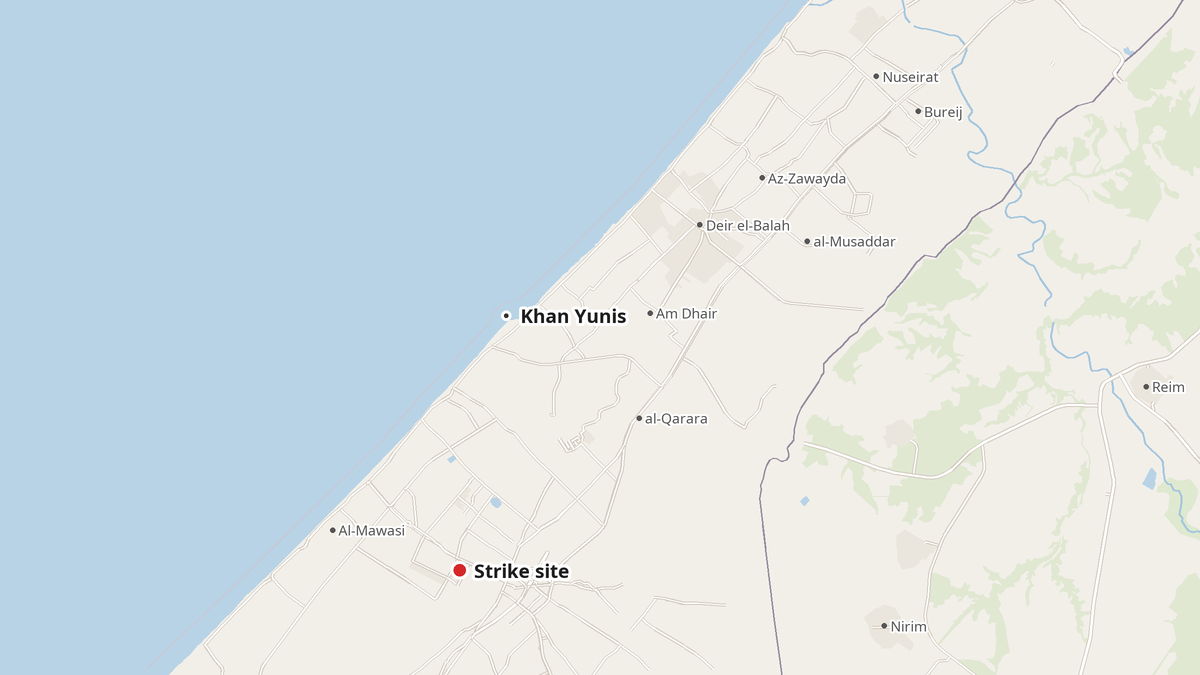
The Israel Defense Forces say the second floor of the Al-Yasin building at Nasser Hospital in Khan Younis was a Hamas military headquarters, a room where civilians were barred and security was tightly controlled. Overnight Thursday into Friday, Israel struck it. At least six people died, including a surgeon and a 13-year-old boy, according to Gaza authorities.
The IDF and the Israel Security Agency, known as Shin Bet, said the target was Muhammad Abu Ismail, whom they identified as a senior commander of Hamas's Khan Younis Brigade. Two other men were targeted with him: Muared Tawfiq Mahmoud Abu Zarifa, a team leader in the brigade's engineering department, and Khaled Osama Abu Anza, head of the communications section of the Operations Department in Hamas's intelligence headquarters. The military said all three were operating from a room inside the compound. It did not immediately confirm whether they were killed.
The Security Picture
The IDF's account goes beyond a single strike. The military said Abu Ismail became a central figure in managing the Khan Younis Brigade after the targeted killing of its commander, Muhammad Yazouri, on Sept. 10. From the hospital compound, the IDF said, commanders directed operations against Israeli forces, advanced dozens of attack plans against soldiers, and coordinated efforts to rebuild the group's military capabilities. It said Hamas also used the complex to store weapons, interrogate and torture Gazans, and coordinate attacks.
On Friday, the IDF added a harder charge. Hamas held dozens of hostages at Nasser Hospital during the war, it said, including women, children, elderly people and foreign nationals, and ran the site as a heavily guarded headquarters. Many of those hostages were abducted from Kibbutz Nahal Oz on Oct. 7, 2023. The IDF named Abu Ismail as responsible for holding numerous captives, among them Edan Alexander, Nimrod Cohen, Staff Sgt. Oz Daniel, Col. Asaf Hamami, Avera Mengistu, Capt. Omer Neutra and Matan Zangauker.
The military said it warned Hamas repeatedly to halt military activity at the hospital, including immediately before the strike. It said the strike was aimed at the specific room, that it used precision munitions and aerial surveillance, and that precautions were taken to minimize harm to civilians and damage to the building. It released graphics illustrating the alleged headquarters. Hamas rejected the claim that it used the hospital as a military base. Daily Sabah reported the military did not provide publicly available evidence, and the Times of Israel reported the IDF took seven hours to comment as world media covered the strike.
The Human Toll
The casualty picture is real and it's grim. Gaza's Civil Defense said the strike hit the second floor of the Al-Yasin building, killing six and injuring at least 30. The Gaza Health Ministry said the dead included medical personnel, patients and their companions. The United Nations reported six killed and 27 injured. Médecins Sans Frontières said 52 people were wounded. The strike severely damaged the surgical and intensive care departments.
Among the dead was Rezik Abushira, a surgeon featured in the 2026 documentary "American Doctor." Gaza's Education Ministry said a 13-year-old boy was also killed. The IDF had not confirmed the Palestinian reports of six dead.
Condemnation and a Different Reading
Türkiye's Foreign Ministry called the strike a serious breach of international humanitarian law. "Israel, which has martyred more than 1,600 Palestinians despite the ceasefire in Gaza and rejected all international efforts aimed at implementing the Gaza Peace Plan, has once again demonstrated that it does not seek peace," the ministry said. Spain also condemned the bombing in the strongest terms. UNRWA chief Philippe Lazzarini asked on X: "How can this still be called a cease-fire?" MSF said it was "utterly appalled and outraged."
The US-led Board of Peace took a notably different line. It said it "deplores the death of any civilians and strongly condemns Hamas's continued exploitation of hospitals and other critical civilian infrastructure for military purposes." Without progress, it warned, there will be more tragedies in which "Hamas alleges deliberate Israeli attacks on hospitals, Israel maintains that Hamas exploits these facilities for its operations, and innocent Gazans ultimately pay the price." It said both sides must honor their commitments, including maintaining the ceasefire and advancing Gaza's demilitarization, and that it had developed a framework for medical care in secure, demilitarized facilities. Daily Sabah noted the board did not directly condemn Israel's strike or provide evidence of military use of the hospital.
Under international humanitarian law, hospitals are specially protected and can lose that protection only if used for military purposes under strict legal conditions. That legal threshold, and whether it was met here, is what the dispute turns on.
The Stalled Ceasefire
The strike lands in the second year of a cease-fire that took effect Oct. 10, 2025. Gaza authorities say Israeli violations since then have killed at least 1,622 Palestinians. The Israeli Prime Minister's Office reiterated Tuesday that Hamas had yet to surrender a single weapon. Other deadly incidents followed Thursday, including an airstrike on a vehicle in Gaza City that the IDF said targeted a Hamas member.
Why This Matters: The Nasser Hospital strike shows the core problem the cease-fire hasn't solved. Hamas hasn't disarmed, and the IDF says it's rebuilding its command structure inside civilian facilities. Israel faces a choice between tolerating that buildup and striking where civilians are present. Gaza's civilians absorb the cost either way. The Board of Peace's call for demilitarized medical facilities points to a way out, but it depends on Hamas surrendering weapons it hasn't given up. Until it does, every disputed strike will erode the truce further and feed the international pressure that bears most heavily on Israel.
- nasser hospital
- gaza
- khan younis
- israeli airstrike
- hamas
- israel defense forces
- international humanitarian law
- cease-fire